


 癌症的基本特征包括细胞增殖、血管生成、迁移、凋亡逃避机制和细胞永生等。找到癌症发生过程中这些通路的关键标记物和对应的抗体用于检测至关重要。
 为您推荐一个泛素化位点预测神器——泛素化分析工具,可以为您的蛋白的泛素化位点作出预测和评分。
 细胞自噬受体图形绘图工具为你的蛋白的细胞受体结合位点作出预测和评分,识别结合到自噬通路中的蛋白是非常重要的,便于让我们理解自噬在正常生理、病理过程中的作用,如发育、细胞分化、神经退化性疾病、压力条件下、感染和癌症。
S100A9 Rabbit mAb
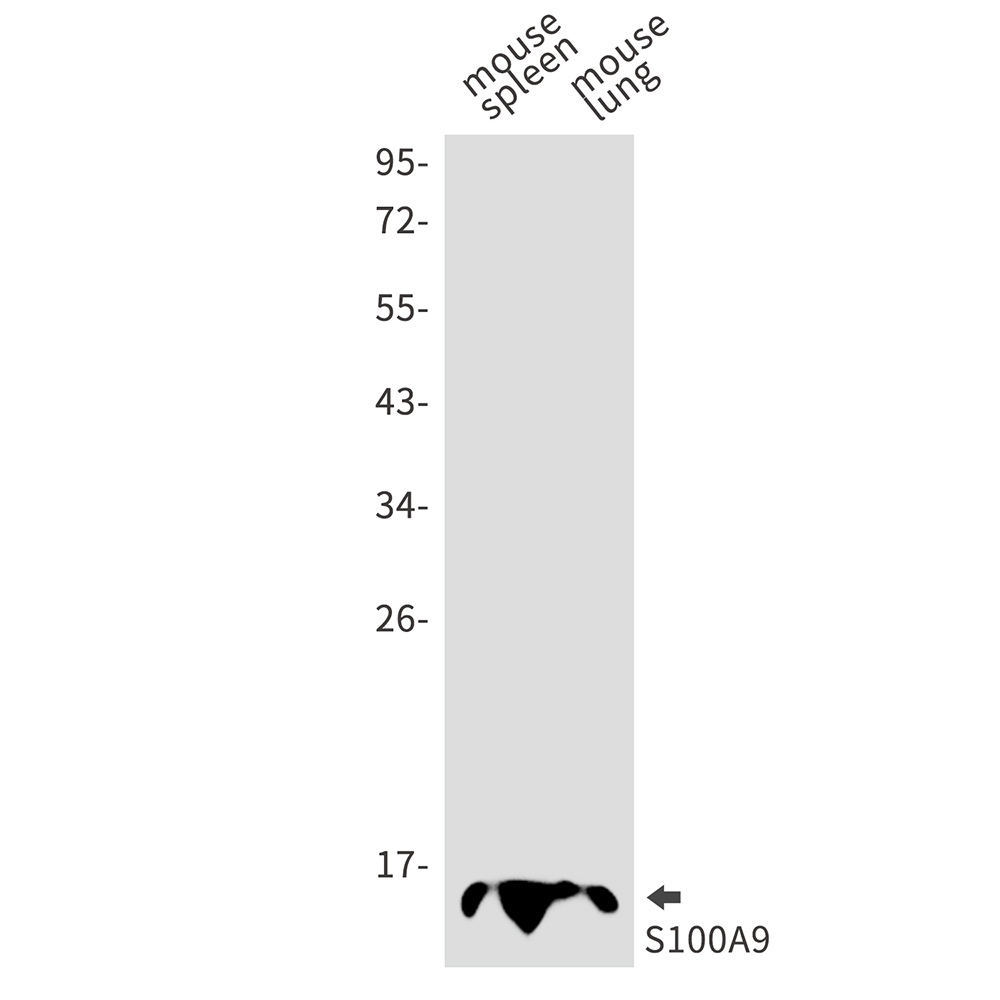
- 产品详情
- 实验流程
- 背景知识
Application 
| WB, IHC-P, FC |
|---|---|
| Primary Accession | P31725 |
| Reactivity | Rat, Mouse |
| Host | Rabbit |
| Clonality | Monoclonal Antibody |
| Isotype | IgG |
| Conjugate | Unconjugated |
| Purification | Affinity Purified |
| Calculated MW | 13049 Da |
| Gene ID | 20202 |
|---|---|
| Other Names | S100A9 |
| Dilution | WB~~1:500-1:1000 IHC-P~~1:50~200 FC~~1:10~50 |
| Format | Liquid in 50mM Tris-Glycine(pH 7.4), 0.15M NaCl, 40%Glycerol, 0.01% sodium azide and 0.05% BSA. |
| Storage | Store at 4°C short term. Aliquot and store at -20°C long term. Avoid freeze/thaw cycles. |
For Research Use Only. Not For Use In Diagnostic Procedures.
| Name | S100a9 |
|---|---|
| Synonyms | Cagb, Mrp14 |
| Function | S100A9 is a calcium- and zinc-binding protein which plays a prominent role in the regulation of inflammatory processes and immune response (PubMed:15331440, PubMed:17767165, PubMed:18403730, PubMed:19402754, PubMed:22804476, PubMed:34562450). It can induce neutrophil chemotaxis, adhesion, can increase the bactericidal activity of neutrophils by promoting phagocytosis via activation of SYK, PI3K/AKT, and ERK1/2 and can induce degranulation of neutrophils by a MAPK-dependent mechanism (By similarity). Predominantly found as calprotectin (S100A8/A9) which has a wide plethora of intra- and extracellular functions (By similarity). The intracellular functions include: facilitating leukocyte arachidonic acid trafficking and metabolism, modulation of the tubulin-dependent cytoskeleton during migration of phagocytes and activation of the neutrophilic NADPH- oxidase (PubMed:15331440). Also participates in regulatory T-cell differentiation together with CD69 (By similarity). Activates NADPH- oxidase by facilitating the enzyme complex assembly at the cell membrane, transferring arachidonic acid, an essential cofactor, to the enzyme complex and S100A8 contributes to the enzyme assembly by directly binding to NCF2/P67PHOX (By similarity). The extracellular functions involve pro-inflammatory, antimicrobial, oxidant-scavenging and apoptosis-inducing activities (PubMed:21382888). Its pro- inflammatory activity includes recruitment of leukocytes, promotion of cytokine and chemokine production, and regulation of leukocyte adhesion and migration (By similarity). Acts as an alarmin or a danger associated molecular pattern (DAMP) molecule and stimulates innate immune cells via binding to pattern recognition receptors such as Toll- like receptor 4 (TLR4) and receptor for advanced glycation endproducts (AGER) (PubMed:17767165, PubMed:18403730, PubMed:19402754). Binding to TLR4 and AGER activates the MAP-kinase and NF-kappa-B signaling pathways resulting in the amplification of the pro-inflammatory cascade (PubMed:17767165, PubMed:18403730, PubMed:19402754, PubMed:22804476). Has antimicrobial activity towards bacteria and fungi and exerts its antimicrobial activity probably via chelation of Zn(2+) which is essential for microbial growth (By similarity). Can induce cell death via autophagy and apoptosis and this occurs through the cross-talk of mitochondria and lysosomes via reactive oxygen species (ROS) and the process involves BNIP3 (By similarity). Can regulate neutrophil number and apoptosis by an anti-apoptotic effect; regulates cell survival via ITGAM/ITGB and TLR4 and a signaling mechanism involving MEK-ERK (By similarity). Its role as an oxidant scavenger has a protective role in preventing exaggerated tissue damage by scavenging oxidants (By similarity). The iNOS-S100A8/A9 transnitrosylase complex is proposed to direct selective inflammatory stimulus-dependent S-nitrosylation of multiple targets such as GAPDH, NXA5, EZR, MSN and VIM by recognizing a [IL]-x-C-x-x-[DE] motif (By similarity). |
| Cellular Location | Secreted {ECO:0000250|UniProtKB:P06702}. Cytoplasm {ECO:0000250|UniProtKB:P06702}. Cytoplasm, cytoskeleton {ECO:0000250|UniProtKB:P06702}. Cell membrane {ECO:0000250|UniProtKB:P06702}; Peripheral membrane protein {ECO:0000250|UniProtKB:P06702}. Note=Predominantly localized in the cytoplasm. Upon elevation of the intracellular calcium level, translocated from the cytoplasm to the cytoskeleton and the cell membrane. Upon neutrophil activation or endothelial adhesion of monocytes, is secreted via a microtubule-mediated, alternative pathway {ECO:0000250|UniProtKB:P06702} |
Provided below are standard protocols that you may find useful for product applications.
BACKGROUND
Predicted to enable calcium ion binding activity and calcium-dependent protein binding activity. Involved in peptidyl-cysteine S-nitrosylation; positive regulation of blood coagulation; and regulation of translation. Acts upstream of or within several processes, including astrocyte development; leukocyte chemotaxis; and regulation of integrin biosynthetic process. Part of S100A9 complex. Is active in cornified envelope. Is expressed in several structures, including jaw; liver; otic capsule; skeleton; and spleen red pulp. Human ortholog(s) of this gene implicated in myocarditis. Orthologous to human S100A9 (S100 calcium binding protein A9).

终于等到您。ABCEPTA(百远生物)抗体产品。
点击下方“我要评价 ”按钮提交您的反馈信息,您的反馈和评价是我们最宝贵的财富之一,
我们将在1-3个工作日内处理您的反馈信息。
如有疑问,联系:0512-88856768 tech-china@abcepta.com.


