


 癌症的基本特征包括细胞增殖、血管生成、迁移、凋亡逃避机制和细胞永生等。找到癌症发生过程中这些通路的关键标记物和对应的抗体用于检测至关重要。
 为您推荐一个泛素化位点预测神器——泛素化分析工具,可以为您的蛋白的泛素化位点作出预测和评分。
 细胞自噬受体图形绘图工具为你的蛋白的细胞受体结合位点作出预测和评分,识别结合到自噬通路中的蛋白是非常重要的,便于让我们理解自噬在正常生理、病理过程中的作用,如发育、细胞分化、神经退化性疾病、压力条件下、感染和癌症。
RES Rabbit mAb
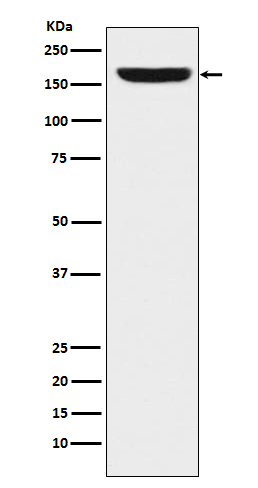
- 产品详情
- 实验流程
Application 
| WB |
|---|---|
| Primary Accession | Q13127 |
| Reactivity | Human |
| Host | Rabbit |
| Clonality | Monoclonal Antibody |
| Isotype | IgG |
| Conjugate | Unconjugated |
| Immunogen | A synthesized peptide derived from human REST / NRSF |
| Purification | Affinity Chromatography |
| Calculated MW | 121872 Da |
| Gene ID | 5978 |
|---|---|
| Other Names | REST |
| Dilution | WB~~1/500-1/1000 |
| Format | Liquid in 10mM PBS, pH 7.4, 150mM sodium chloride, 0.05% BSA, 0.02% sodium azide and 50% glycerol. |
| Storage | Store at 4°C short term. Aliquot and store at -20°C long term. Avoid freeze/thaw cycles. |
For Research Use Only. Not For Use In Diagnostic Procedures.
| Name | REST |
|---|---|
| Synonyms | NRSF, XBR |
| Function | Transcriptional repressor which binds neuron-restrictive silencer element (NRSE) and represses neuronal gene transcription in non-neuronal cells (PubMed:11741002, PubMed:11779185, PubMed:12399542, PubMed:26551668, PubMed:7697725, PubMed:7871435, PubMed:8568247). Restricts the expression of neuronal genes by associating with two distinct corepressors, SIN3A and RCOR1, which in turn recruit histone deacetylase to the promoters of REST-regulated genes (PubMed:10449787, PubMed:10734093). Mediates repression by recruiting the BHC complex at RE1/NRSE sites which acts by deacetylating and demethylating specific sites on histones, thereby acting as a chromatin modifier (By similarity). Transcriptional repression by REST-CDYL via the recruitment of histone methyltransferase EHMT2 may be important in transformation suppression (PubMed:19061646). Represses the expression of SRRM4 in non-neural cells to prevent the activation of neural- specific splicing events and to prevent production of REST isoform 3 (By similarity). Repressor activity may be inhibited by forming heterodimers with isoform 3, thereby preventing binding to NRSE or binding to corepressors and leading to derepression of target genes (PubMed:11779185). Also maintains repression of neuronal genes in neural stem cells, and allows transcription and differentiation into neurons by dissociation from RE1/NRSE sites of target genes (By similarity). Thereby is involved in maintaining the quiescent state of adult neural stem cells and preventing premature differentiation into mature neurons (PubMed:21258371). Plays a role in the developmental switch in synaptic NMDA receptor composition during postnatal development, by repressing GRIN2B expression and thereby altering NMDA receptor properties from containing primarily GRIN2B to primarily GRIN2A subunits (By similarity). Acts as a regulator of osteoblast differentiation (By similarity). Key repressor of gene expression in hypoxia; represses genes in hypoxia by direct binding to an RE1/NRSE site on their promoter regions (PubMed:27531581). May also function in stress resistance in the brain during aging; possibly by regulating expression of genes involved in cell death and in the stress response (PubMed:24670762). Repressor of gene expression in the hippocampus after ischemia by directly binding to RE1/NRSE sites and recruiting SIN3A and RCOR1 to promoters of target genes, thereby promoting changes in chromatin modifications and ischemia-induced cell death (By similarity). After ischemia, might play a role in repression of miR-132 expression in hippocampal neurons, thereby leading to neuronal cell death (By similarity). Negatively regulates the expression of SRRM3 in breast cancer cell lines (PubMed:26053433). |
| Cellular Location | Nucleus. Cytoplasm. Note=Colocalizes with ZFP90 in the nucleus (By similarity). In response to hypoxia, there is a more pronounced increase in levels in the nucleus as compared to the cytoplasm (PubMed:27531581). In aging neurons, increased levels in the nucleus as compared to the cytoplasm (PubMed:24670762, PubMed:30684677). {ECO:0000250|UniProtKB:Q8VIG1, ECO:0000269|PubMed:24670762, ECO:0000269|PubMed:27531581, ECO:0000269|PubMed:30684677} [Isoform 3]: Nucleus |
| Tissue Location | Expressed in neurons of the prefrontal cortex, in hippocampal pyramidal neurons, dentate gyrus granule neurons and cerebellar Purkinje and granule neurons (at protein level) (PubMed:24670762). Expressed in dopaminergic neurons of the substantia nigra (at protein level) (PubMed:30684677). Expressed in neural progenitor cells (at protein level) (PubMed:21258371). In patients suffering from Alzheimer disease, frontotemporal dementia or dementia with Lewy bodies, decreased nuclear levels have been observed in neurons of the prefrontal cortex and the hippocampus, but not in neurons of the dentate gyrus and cerebellum (at protein level) (PubMed:24670762). In patients with Parkinson disease or dementia with Lewy bodies, decreased nuclear levels have been observed in dopaminergic neurons and in cortical neurons and localization to Lewy bodies and pale bodies was detected (at protein level) (PubMed:30684677). Expressed at higher levels in weakly invasive breast cancer cell lines and at lower levels in highly invasive breast cancer lines (at protein level) (PubMed:26053433). Ubiquitous (PubMed:8568247). Expressed at higher levels in the tissues of the lymphocytic compartment, including spleen, thymus, peripheral blood lymphocytes and ovary (PubMed:8568247). |
Research Areas
Application Protocols
Provided below are standard protocols that you may find useful for product applications.

终于等到您。ABCEPTA(百远生物)抗体产品。
点击下方“我要评价 ”按钮提交您的反馈信息,您的反馈和评价是我们最宝贵的财富之一,
我们将在1-3个工作日内处理您的反馈信息。
如有疑问,联系:0512-88856768 tech-china@abcepta.com.
¥ 1,250.00
Cat# AP77773


