


 癌症的基本特征包括细胞增殖、血管生成、迁移、凋亡逃避机制和细胞永生等。找到癌症发生过程中这些通路的关键标记物和对应的抗体用于检测至关重要。
 为您推荐一个泛素化位点预测神器——泛素化分析工具,可以为您的蛋白的泛素化位点作出预测和评分。
 细胞自噬受体图形绘图工具为你的蛋白的细胞受体结合位点作出预测和评分,识别结合到自噬通路中的蛋白是非常重要的,便于让我们理解自噬在正常生理、病理过程中的作用,如发育、细胞分化、神经退化性疾病、压力条件下、感染和癌症。
Nuclear Mitotic Apparatus Protein 1 Rabbit mAb
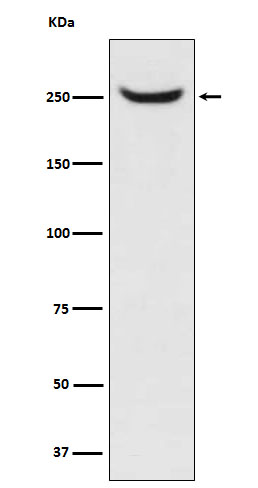
- 产品详情
- 实验流程
Application 
| WB, IHC-P, IF, ICC |
|---|---|
| Primary Accession | Q14980 |
| Reactivity | Rat, Human, Mouse |
| Host | Rabbit |
| Clonality | Monoclonal Antibody |
| Isotype | IgG |
| Conjugate | Unconjugated |
| Immunogen | A synthesized peptide derived from human NuMA |
| Purification | Affinity Chromatography |
| Calculated MW | 238260 Da |
| Gene ID | 4926 |
|---|---|
| Other Names | NUMA1 |
| Dilution | WB~~1/500-1/1000 IHC-P~~1:50~200 IF~~1:50~200 ICC~~N/A |
| Format | Liquid in 10mM PBS, pH 7.4, 150mM sodium chloride, 0.05% BSA, 0.02% sodium azide and 50% glycerol. |
| Storage | Store at 4°C short term. Aliquot and store at -20°C long term. Avoid freeze/thaw cycles. |
For Research Use Only. Not For Use In Diagnostic Procedures.
| Name | NUMA1 (HGNC:8059) |
|---|---|
| Function | Microtubule (MT)-binding protein that plays a role in the formation and maintenance of the spindle poles and the alignement and the segregation of chromosomes during mitotic cell division (PubMed:17172455, PubMed:19255246, PubMed:24996901, PubMed:26195665, PubMed:27462074, PubMed:7769006). Functions to tether the minus ends of MTs at the spindle poles, which is critical for the establishment and maintenance of the spindle poles (PubMed:11956313, PubMed:12445386). Plays a role in the establishment of the mitotic spindle orientation during metaphase and elongation during anaphase in a dynein-dynactin- dependent manner (PubMed:23870127, PubMed:24109598, PubMed:24996901, PubMed:26765568). In metaphase, part of a ternary complex composed of GPSM2 and G(i) alpha proteins, that regulates the recruitment and anchorage of the dynein-dynactin complex in the mitotic cell cortex regions situated above the two spindle poles, and hence regulates the correct oritentation of the mitotic spindle (PubMed:22327364, PubMed:23027904, PubMed:23921553). During anaphase, mediates the recruitment and accumulation of the dynein-dynactin complex at the cell membrane of the polar cortical region through direct association with phosphatidylinositol 4,5-bisphosphate (PI(4,5)P2), and hence participates in the regulation of the spindle elongation and chromosome segregation (PubMed:22327364, PubMed:23921553, PubMed:24371089, PubMed:24996901). Also binds to other polyanionic phosphoinositides, such as phosphatidylinositol 3-phosphate (PIP), lysophosphatidic acid (LPA) and phosphatidylinositol triphosphate (PIP3), in vitro (PubMed:24371089, PubMed:24996901). Also required for proper orientation of the mitotic spindle during asymmetric cell divisions (PubMed:21816348). Plays a role in mitotic MT aster assembly (PubMed:11163243, PubMed:11229403, PubMed:12445386). Involved in anastral spindle assembly (PubMed:25657325). Positively regulates TNKS protein localization to spindle poles in mitosis (PubMed:16076287). Highly abundant component of the nuclear matrix where it may serve a non-mitotic structural role, occupies the majority of the nuclear volume (PubMed:10075938). Required for epidermal differentiation and hair follicle morphogenesis (By similarity). |
| Cellular Location | Nucleus. Nucleus, nucleoplasm. Nucleus matrix. Chromosome. Cytoplasm, cytoskeleton. Cytoplasm, cytoskeleton, microtubule organizing center, centrosome. Cytoplasm, cytoskeleton, spindle pole. Cytoplasm, cell cortex. Cell membrane; Lipid-anchor; Cytoplasmic side. Lateral cell membrane {ECO:0000250|UniProtKB:E9Q7G0}. Note=Mitotic cell cycle- dependent shuttling protein that relocalizes from the interphase nucleus to the spindle poles and cell cortex (PubMed:10811826, PubMed:1541636). The localization to the spindle poles is regulated by AAAS (PubMed:26246606). In interphase, resides in the nuclear matrix (PubMed:1541630, PubMed:1541636, PubMed:23921553). In prophase, restricted to the interchromatin or condensed chromosome space (PubMed:10811826). In prometaphase, after nuclear envelope disassembly, forms aggregates both in the spindle midzone and at duplicated centrosomes and astral microtubules (MTs) of the bipolar spindle apparatus (PubMed:10811826). Translocates from the spindle midzone towards the spindle poles along spindle fibers in a MT- and dynein- dynactin-dependent manner until the anaphase onset (PubMed:10811826, PubMed:1541636). In metaphase, recruited to the polar cortical region in a GPSM2- and GNAI1-dependent manner (PubMed:23870127, PubMed:24109598, PubMed:24996901). Excluded from the metaphase equatorial cortical region in a RanGTP-dependent manner (PubMed:22327364, PubMed:23870127). Phosphorylation on Thr-2055 by CDK1 results in its localization at spindle poles in metaphase, but not at the cell cortex (PubMed:23921553). In anaphase, recruited and anchored at the cell membrane of the polar cortical region in a EPB41-, EPB41L2-, phosphatidylinositol-dependent and GPSM2- and G(i) alpha proteins-independent manner (PubMed:23870127, PubMed:24109598, PubMed:24371089, PubMed:24996901). Excluded from the anaphase equatorial region of the cell cortex in a RACGAP1- and KIF23-dependent and RanGTP-independent manner (PubMed:24996901). Associated with astral MTs emanating from the spindle poles during anaphase (PubMed:12445386, PubMed:24996901). Nonphosphorylated Thr-2055 localizes at the cell cortex, weakly during metaphase and more prominently during anaphase in a phosphatase PPP2CA-dependent manner (PubMed:23921553). As mitosis progresses it reassociates with telophase chromosomes very early during nuclear reformation, before substantial accumulation of lamins on chromosomal surfaces is evident (PubMed:1541636). Localizes to the tips of cortical MTs in prometaphase (PubMed:26765568). Localizes along MTs and specifically to both MT plus and minus ends (PubMed:26765568). Also accumulates at MT tips near the cell periphery (PubMed:26765568) Colocalizes with GPSM2 at mitotic spindle poles during mitosis (PubMed:11781568, PubMed:21816348). Colocalizes with SPAG5 at mitotic spindle at prometaphase and at mitotic spindle poles at metaphase and anaphase (PubMed:27462074). Colocalizes with ABRO1 at mitotic spindle poles (PubMed:26195665). Colocalized with TNKS from prophase through to anaphase in mitosis (PubMed:16076287). Colocalizes with tubulin alpha (PubMed:12445386). CCSAP is essential for its centrosomal localization (PubMed:26562023). In horizontally retinal progenitor dividing cells, localized to the lateral cortical region (By similarity) {ECO:0000250|UniProtKB:E9Q7G0, ECO:0000269|PubMed:10811826, ECO:0000269|PubMed:11781568, ECO:0000269|PubMed:12445386, ECO:0000269|PubMed:1541630, ECO:0000269|PubMed:1541636, ECO:0000269|PubMed:16076287, ECO:0000269|PubMed:21816348, ECO:0000269|PubMed:22327364, ECO:0000269|PubMed:23870127, ECO:0000269|PubMed:23921553, ECO:0000269|PubMed:24109598, ECO:0000269|PubMed:24371089, ECO:0000269|PubMed:24996901, ECO:0000269|PubMed:26195665, ECO:0000269|PubMed:26246606, ECO:0000269|PubMed:26562023, ECO:0000269|PubMed:26765568, ECO:0000269|PubMed:27462074} [Isoform 4]: Cytoplasm, cytosol. Cytoplasm, cytoskeleton, microtubule organizing center, centrosome. Cytoplasm, cytoskeleton, spindle pole. Note=During interphase, mainly clustered at the centrosomal region in the cytosol After entry into mitosis, detected at mitotic spindle poles |
Research Areas
Application Protocols
Provided below are standard protocols that you may find useful for product applications.

终于等到您。ABCEPTA(百远生物)抗体产品。
点击下方“我要评价 ”按钮提交您的反馈信息,您的反馈和评价是我们最宝贵的财富之一,
我们将在1-3个工作日内处理您的反馈信息。
如有疑问,联系:0512-88856768 tech-china@abcepta.com.
¥ 1,250.00
Cat# AP77858


