


 癌症的基本特征包括细胞增殖、血管生成、迁移、凋亡逃避机制和细胞永生等。找到癌症发生过程中这些通路的关键标记物和对应的抗体用于检测至关重要。
 为您推荐一个泛素化位点预测神器——泛素化分析工具,可以为您的蛋白的泛素化位点作出预测和评分。
 细胞自噬受体图形绘图工具为你的蛋白的细胞受体结合位点作出预测和评分,识别结合到自噬通路中的蛋白是非常重要的,便于让我们理解自噬在正常生理、病理过程中的作用,如发育、细胞分化、神经退化性疾病、压力条件下、感染和癌症。
RSK2 (RPS6KA3) Antibody (N-term) 精选
Purified Rabbit Polyclonal Antibody (Pab)

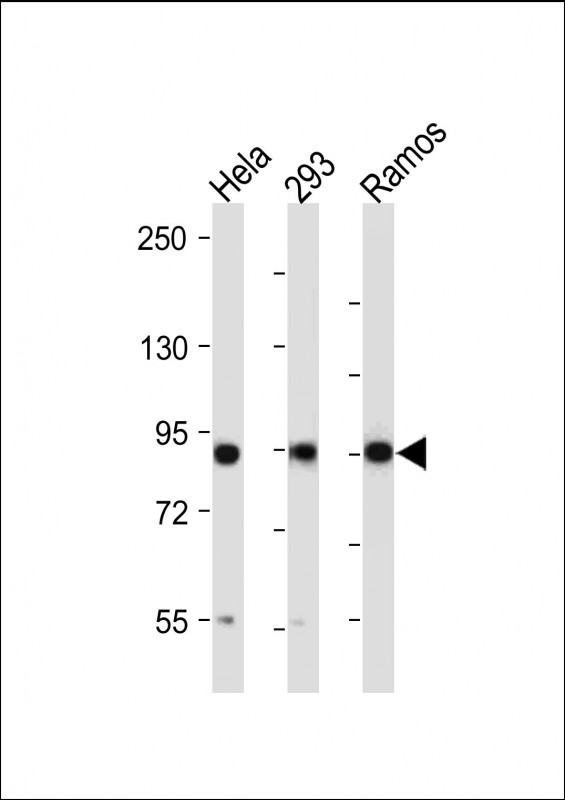
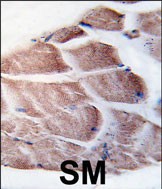
- 产品详情
- 实验流程
- 背景知识
Application 
| IHC-P, WB, E |
|---|---|
| Primary Accession | P51812 |
| Other Accession | P18654 |
| Reactivity | Human, Mouse |
| Predicted | Rat, Bovine, Canine, Rabbit |
| Host | Rabbit |
| Clonality | Polyclonal |
| Isotype | Rabbit IgG |
| Calculated MW | 83736 Da |
| Antigen Region | 13-42 aa |
| Gene ID | 6197 |
|---|---|
| Other Names | Ribosomal protein S6 kinase alpha-3, S6K-alpha-3, 90 kDa ribosomal protein S6 kinase 3, p90-RSK 3, p90RSK3, Insulin-stimulated protein kinase 1, ISPK-1, MAP kinase-activated protein kinase 1b, MAPK-activated protein kinase 1b, MAPKAP kinase 1b, MAPKAPK-1b, Ribosomal S6 kinase 2, RSK-2, pp90RSK2, RPS6KA3, ISPK1, MAPKAPK1B, RSK2 |
| Target/Specificity | This RSK2 (RPS6KA3) antibody is generated from rabbits immunized with a KLH conjugated synthetic peptide between 13-42 amino acids from the N-terminal region of human RSK2 (RPS6KA3). |
| Dilution | IHC-P~~1:100~500 WB~~1:2000 E~~Use at an assay dependent concentration. |
| Format | Purified polyclonal antibody supplied in PBS with 0.09% (W/V) sodium azide. This antibody is prepared by Saturated Ammonium Sulfate (SAS) precipitation followed by dialysis against PBS. |
| Storage | Maintain refrigerated at 2-8°C for up to 2 weeks. For long term storage store at -20°C in small aliquots to prevent freeze-thaw cycles. |
| Precautions | RSK2 (RPS6KA3) Antibody (N-term) is for research use only and not for use in diagnostic or therapeutic procedures. |
For Research Use Only. Not For Use In Diagnostic Procedures.
| Name | RPS6KA3 |
|---|---|
| Synonyms | ISPK1, MAPKAPK1B, RSK2 |
| Function | Serine/threonine-protein kinase that acts downstream of ERK (MAPK1/ERK2 and MAPK3/ERK1) signaling and mediates mitogenic and stress-induced activation of the transcription factors CREB1, ETV1/ER81 and NR4A1/NUR77, regulates translation through RPS6 and EIF4B phosphorylation, and mediates cellular proliferation, survival, and differentiation by modulating mTOR signaling and repressing pro- apoptotic function of BAD and DAPK1 (PubMed:16213824, PubMed:16223362, PubMed:17360704, PubMed:9770464). In fibroblast, is required for EGF- stimulated phosphorylation of CREB1 and histone H3 at 'Ser-10', which results in the subsequent transcriptional activation of several immediate-early genes (PubMed:10436156, PubMed:9770464). In response to mitogenic stimulation (EGF and PMA), phosphorylates and activates NR4A1/NUR77 and ETV1/ER81 transcription factors and the cofactor CREBBP (PubMed:16223362). Upon insulin-derived signal, acts indirectly on the transcription regulation of several genes by phosphorylating GSK3B at 'Ser-9' and inhibiting its activity (PubMed:8250835). Phosphorylates RPS6 in response to serum or EGF via an mTOR-independent mechanism and promotes translation initiation by facilitating assembly of the preinitiation complex (PubMed:17360704). In response to insulin, phosphorylates EIF4B, enhancing EIF4B affinity for the EIF3 complex and stimulating cap-dependent translation (PubMed:18508509, PubMed:18813292). Is involved in the mTOR nutrient-sensing pathway by directly phosphorylating TSC2 at 'Ser-1798', which potently inhibits TSC2 ability to suppress mTOR signaling, and mediates phosphorylation of RPTOR, which regulates mTORC1 activity and may promote rapamycin- sensitive signaling independently of the PI3K/AKT pathway (PubMed:18722121). Mediates cell survival by phosphorylating the pro- apoptotic proteins BAD and DAPK1 and suppressing their pro-apoptotic function (PubMed:16213824). Promotes the survival of hepatic stellate cells by phosphorylating CEBPB in response to the hepatotoxin carbon tetrachloride (CCl4) (PubMed:18508509, PubMed:18813292). Is involved in cell cycle regulation by phosphorylating the CDK inhibitor CDKN1B, which promotes CDKN1B association with 14-3-3 proteins and prevents its translocation to the nucleus and inhibition of G1 progression (By similarity). In LPS-stimulated dendritic cells, is involved in TLR4- induced macropinocytosis, and in myeloma cells, acts as effector of FGFR3-mediated transformation signaling, after direct phosphorylation at Tyr-529 by FGFR3 (By similarity). Negatively regulates EGF-induced MAPK1/3 phosphorylation via phosphorylation of SOS1 (By similarity). Phosphorylates SOS1 at 'Ser-1134' and 'Ser-1161' that create YWHAB and YWHAE binding sites and which contribute to the negative regulation of MAPK1/3 phosphorylation (By similarity). Phosphorylates EPHA2 at 'Ser- 897', the RPS6KA-EPHA2 signaling pathway controls cell migration (PubMed:26158630). Acts as a regulator of osteoblast differentiation by mediating phosphorylation of ATF4, thereby promoting ATF4 transactivation activity (By similarity). |
| Cellular Location | Nucleus. Cytoplasm |
| Tissue Location | Expressed in many tissues, highest levels in skeletal muscle |
Provided below are standard protocols that you may find useful for product applications.
BACKGROUND
RSK3 is a member of the RSK (ribosomal S6 kinase) family of serine/threonine kinases. This kinase contains 2 non-identical kinase catalytic domains and phosphorylates various substrates, including members of the mitogen-activated kinase (MAPK) signalling pathway. The activity of this protein has been implicated in controlling cell growth and differentiation. Mutations in the gene have been associated with Coffin-Lowry syndrome (CLS).
REFERENCES
Yang, X., et al., Cell 117(3):387-398 (2004).
Guimiot, F., et al., Gene Expr. Patterns 4(1):111-114 (2004).
Zeniou, M., et al., (er) Nucleic Acids Res. 32(3):1214-1223 (2004).
Vaidyanathan, H., et al., J. Biol. Chem. 278(34):32367-32372 (2003).
Zhang, Y., et al., J. Biol. Chem. 278(15):12650-12659 (2003).

终于等到您。ABCEPTA(百远生物)抗体产品。
点击下方“我要评价 ”按钮提交您的反馈信息,您的反馈和评价是我们最宝贵的财富之一,
我们将在1-3个工作日内处理您的反馈信息。
如有疑问,联系:0512-88856768 tech-china@abcepta.com.


