


 癌症的基本特征包括细胞增殖、血管生成、迁移、凋亡逃避机制和细胞永生等。找到癌症发生过程中这些通路的关键标记物和对应的抗体用于检测至关重要。
 为您推荐一个泛素化位点预测神器——泛素化分析工具,可以为您的蛋白的泛素化位点作出预测和评分。
 细胞自噬受体图形绘图工具为你的蛋白的细胞受体结合位点作出预测和评分,识别结合到自噬通路中的蛋白是非常重要的,便于让我们理解自噬在正常生理、病理过程中的作用,如发育、细胞分化、神经退化性疾病、压力条件下、感染和癌症。
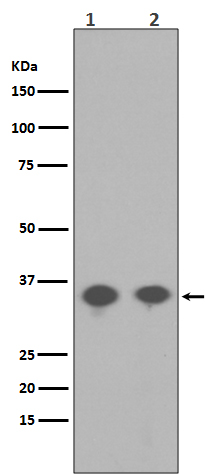
Phospho-PP2A alpha (Y307) Antibody
Rabbit mAb
- 产品详情
- 实验流程
Application 
| WB, IHC, IF, ICC, IP, IHF |
|---|---|
| Primary Accession | P67775 |
| Reactivity | Rat, Human, Mouse |
| Clonality | Monoclonal |
| Other Names | eplication protein C; PP2A-alpha; Replication protein C; RP-C; PPP2CA; MGC786 |
| Isotype | Rabbit IgG |
| Host | Rabbit |
| Calculated MW | 35594 Da |
| Dilution | WB 1:500~1:2000 IHC 1:50~1:200 ICC/IF 1:50~1:200 IP 1:50 |
|---|---|
| Purification | Affinity-chromatography |
| Immunogen | A synthesized peptide derived from human Phospho-PP2A alpha (Y307) |
| Description | PP2A is the major phosphatase for microtubule-associated proteins (MAPs). PP2A can modulate the activity of phosphorylase B kinase casein kinase 2, mitogen-stimulated S6 kinase, and MAP-2 kinase. Cooperates with SGOL2 to protect centromeric cohesin from separase-mediated cleavage in oocytes specifically during meiosis I (By similarity). Can dephosphorylate SV40 large T antigen and p53/TP53. Activates RAF1 by dephosphorylating it at 'Ser-259'. |
| Storage Condition and Buffer | Rabbit IgG in phosphate buffered saline , pH 7.4, 150mM NaCl, 0.02% sodium azide and 50% glycerol. Store at +4°C short term. Store at -20°C long term. Avoid freeze / thaw cycle. |
For Research Use Only. Not For Use In Diagnostic Procedures.
| Name | PPP2CA |
|---|---|
| Function | Catalytic subunit of protein phosphatase 2A (PP2A), a serine/threonine phosphatase involved in the regulation of a wide variety of enzymes, signal transduction pathways, and cellular events (PubMed:10801873, PubMed:12473674, PubMed:17245430, PubMed:22613722, PubMed:33243860, PubMed:34004147, PubMed:9920888, PubMed:41986709). PP2A is the major phosphatase for microtubule-associated proteins (MAPs) (PubMed:22613722). PP2A can modulate the activity of phosphorylase B kinase casein kinase 2, mitogen-stimulated S6 kinase, and MAP-2 kinase (PubMed:22613722). Cooperates with SGO2 to protect centromeric cohesin from separase-mediated cleavage in oocytes specifically during meiosis I (By similarity). Can dephosphorylate various proteins, such as SV40 large T antigen, AXIN1, p53/TP53, PIM3, WEE1 (PubMed:10801873, PubMed:12473674, PubMed:17245430, PubMed:9920888). Activates RAF1 by dephosphorylating it at 'Ser-259' (PubMed:10801873). Mediates dephosphorylation of WEE1, preventing its ubiquitin-mediated proteolysis, increasing WEE1 protein levels, and promoting the G2/M checkpoint (PubMed:33108758). Mediates dephosphorylation of MYC; promoting its ubiquitin-mediated proteolysis: interaction with AMBRA1 enhances interaction between PPP2CA and MYC (PubMed:25438055). Mediates dephosphorylation of FOXO3; promoting its stabilization: interaction with AMBRA1 enhances interaction between PPP2CA and FOXO3 (PubMed:30513302). Catalyzes dephosphorylation of the pyrin domain of NLRP3, promoting assembly of the NLRP3 inflammasome (By similarity). Together with RACK1 adapter, mediates dephosphorylation of AKT1 at 'Ser-473', preventing AKT1 activation and AKT-mTOR signaling pathway (By similarity). Dephosphorylation of AKT1 is essential for regulatory T-cells (Treg) homeostasis and stability (By similarity). Catalyzes dephosphorylation of PIM3, promoting PIM3 ubiquitination and proteasomal degradation (PubMed:12473674). Part of the striatin- interacting phosphatase and kinase (STRIPAK) complexes (PubMed:33633399). STRIPAK complexes have critical roles in protein (de)phosphorylation and are regulators of multiple signaling pathways including Hippo, MAPK, nuclear receptor and cytoskeleton remodeling (PubMed:33633399). Different types of STRIPAK complexes are involved in a variety of biological processes such as cell growth, differentiation, apoptosis, metabolism and immune regulation (PubMed:33633399). Key mediator of a quality checkpoint during transcription elongation as part of the Integrator-PP2A (INTAC) complex (PubMed:33243860, PubMed:34004147, PubMed:37080207). The INTAC complex drives premature transcription termination of transcripts that are unfavorably configured for transcriptional elongation: within the INTAC complex, PPP2CA catalyzes dephosphorylation of the C-terminal domain (CTD) of Pol II subunit POLR2A/RPB1 and SUPT5H/SPT5, thereby preventing transcriptional elongation (PubMed:33243860, PubMed:34004147, PubMed:37080207). |
| Cellular Location | Cytoplasm. Nucleus. Chromosome. Chromosome, centromere. Cytoplasm, cytoskeleton, spindle pole. Note=In prometaphase cells, but not in anaphase cells, localizes at centromeres (PubMed:16541025). During mitosis, also found at spindle poles (PubMed:16541025). Centromeric localization requires the presence of SGO2 (By similarity). Recruited to chromatin and transcription pause-release checkpoint via its association with the Integrator complex (PubMed:33243860, PubMed:34004147). {ECO:0000250|UniProtKB:P63330, ECO:0000269|PubMed:16541025, ECO:0000269|PubMed:33243860, ECO:0000269|PubMed:34004147} |
Research Areas
Application Protocols
Provided below are standard protocols that you may find useful for product applications.

终于等到您。ABCEPTA(百远生物)抗体产品。
点击下方“我要评价 ”按钮提交您的反馈信息,您的反馈和评价是我们最宝贵的财富之一,
我们将在1-3个工作日内处理您的反馈信息。
如有疑问,联系:0512-88856768 tech-china@abcepta.com.
¥ 1,250.00
Cat# AP90124


