


 癌症的基本特征包括细胞增殖、血管生成、迁移、凋亡逃避机制和细胞永生等。找到癌症发生过程中这些通路的关键标记物和对应的抗体用于检测至关重要。
 为您推荐一个泛素化位点预测神器——泛素化分析工具,可以为您的蛋白的泛素化位点作出预测和评分。
 细胞自噬受体图形绘图工具为你的蛋白的细胞受体结合位点作出预测和评分,识别结合到自噬通路中的蛋白是非常重要的,便于让我们理解自噬在正常生理、病理过程中的作用,如发育、细胞分化、神经退化性疾病、压力条件下、感染和癌症。
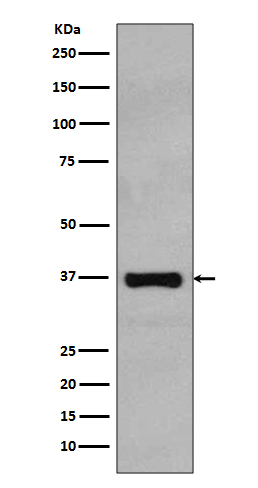
Rad51 Antibody
Rabbit mAb
- 产品详情
- 实验流程
Application 
| WB, FC, IP |
|---|---|
| Primary Accession | Q06609 |
| Reactivity | Rat, Human, Mouse |
| Clonality | Monoclonal |
| Other Names | RAD51; BRCC5; MRMV2; RECA; DNA repair protein rhp51;RAD51; BRCC5; MRMV2; RECA; DNA repair protein rhp51; |
| Isotype | Rabbit IgG |
| Host | Rabbit |
| Calculated MW | 36966 Da |
| Dilution | WB 1:500~1:2000 IP 1:50 FC 1:50 |
|---|---|
| Purification | Affinity-chromatography |
| Immunogen | A synthesized peptide derived from human Rad51 |
| Description | Rad51 is a recombinase that is essential for homologous recombination and double-strand break repair. It binds to single and double-stranded DNA, and has DNA-dependent ATPase activity. Rad51 unwinds duplex DNA and forms helical nucleoprotein filaments in a manner that is controlled through the action of DNA helicases that counteract nucleofilament formation. Rad51 interacts with BRCA1 and BRCA2, and also plays a role in p53-mediated signalling. Interaction of Rad51 with Chk1 kinase may occur in response to Chk1 phosphorylation. |
| Storage Condition and Buffer | Rabbit IgG in phosphate buffered saline , pH 7.4, 150mM NaCl, 0.02% sodium azide and 50% glycerol. Store at +4°C short term. Store at -20°C long term. Avoid freeze / thaw cycle. |
For Research Use Only. Not For Use In Diagnostic Procedures.
| Name | RAD51 {ECO:0000303|PubMed:8358431, ECO:0000312|HGNC:HGNC:9817} |
|---|---|
| Function | Homologous DNA recombinase that catalyzes strand exchange, a key step in DNA repair through homologous recombination (HR) (PubMed:12205100, PubMed:12442171, PubMed:15937124, PubMed:17515904, PubMed:17515903, PubMed:18417535, PubMed:19303847, PubMed:20231364, PubMed:20348101, PubMed:22325354, PubMed:23509288, PubMed:23754376, PubMed:24141787, PubMed:26681308, PubMed:27941124, PubMed:28575658, PubMed:32640219, PubMed:37499663, PubMed:38509361, PubMed:7988572). Binds to single-stranded DNA (ssDNA) in an ATP-dependent manner to form nucleoprotein filaments which are essential for the homology search and strand exchange (PubMed:12205100, PubMed:15937124, PubMed:17515904, PubMed:17515903, PubMed:18417535, PubMed:19303847, PubMed:15226506, PubMed:20231364, PubMed:20348101, PubMed:23509288, PubMed:23754376, PubMed:26681308, PubMed:28575658, PubMed:37499663, PubMed:39636933, PubMed:41166468, PubMed:38509361, PubMed:7988572). Catalyzes the recognition of homology and strand exchange between homologous DNA partners to form a joint molecule between a processed DNA break and the repair template (PubMed:12205100, PubMed:18417535, PubMed:19303847, PubMed:20231364, PubMed:20348101, PubMed:23509288, PubMed:23754376, PubMed:26681308, PubMed:28575658, PubMed:38459011). RAD51 targeting to ssDNA promotes removal of replication protein-A (RPA) from ssDNA and stabilization of RAD51-ssDNA filaments by blocking ATP hydrolysis (PubMed:20729859). Nucleosomal DNA is peeled from the histone surface by the RAD51 filament (PubMed:38509361). Recruited to resolve stalled replication forks during replication stress (PubMed:27797818, PubMed:31844045). Also required for homologous recombination during meiosis by acting as an non-catalytic accessory factor for DMC1 recombinase, enabling proper chromosome pairing and crossing over (By similarity). Plays a role in regulating mitochondrial DNA copy number under conditions of oxidative stress in the presence of RAD51C and XRCC3 (PubMed:20413593). Also involved in interstrand cross-link repair (PubMed:26253028). |
| Cellular Location | Chromosome. Nucleus. Cytoplasm. Cytoplasm, perinuclear region. Mitochondrion matrix. Cytoplasm, cytoskeleton, microtubule organizing center, centrosome Note=Colocalizes with RAD51AP1 and RPA2 to multiple nuclear foci upon induction of DNA damage (PubMed:20154705). DNA damage induces an increase in nuclear levels (PubMed:20154705). Together with FIGNL1, redistributed in discrete nuclear DNA damage-induced foci after ionizing radiation (IR) or camptothecin (CPT) treatment (PubMed:23754376). Accumulated at sites of DNA damage in a SPIDR- dependent manner (PubMed:23509288). Recruited at sites of DNA damage in a MCM9-MCM8-dependent manner (PubMed:23401855). Recruited at sites of DNA damage following interaction with TOPBP1 in S-phase (PubMed:26811421). Colocalizes with ERCC5/XPG to nuclear foci in S phase (PubMed:26833090). Recruited to stalled replication forks during replication stress by the TONSL-MMS22L complex, as well as ATAD5 and WDR48 in an ATR-dependent manner (PubMed:27797818, PubMed:31844045). In germ cells, during meiotic prcess, binds single-stranded DNA (ssDNA) away from the break site (By similarity) {ECO:0000250|UniProtKB:Q08297, ECO:0000269|PubMed:20154705, ECO:0000269|PubMed:23401855, ECO:0000269|PubMed:23509288, ECO:0000269|PubMed:23754376, ECO:0000269|PubMed:26811421, ECO:0000269|PubMed:26833090, ECO:0000269|PubMed:27797818, ECO:0000269|PubMed:31844045} |
| Tissue Location | Highly expressed in testis and thymus, followed by small intestine, placenta, colon, pancreas and ovary (PubMed:18417535) Weakly expressed in breast (PubMed:18417535) |
Research Areas
Application Protocols
Provided below are standard protocols that you may find useful for product applications.

终于等到您。ABCEPTA(百远生物)抗体产品。
点击下方“我要评价 ”按钮提交您的反馈信息,您的反馈和评价是我们最宝贵的财富之一,
我们将在1-3个工作日内处理您的反馈信息。
如有疑问,联系:0512-88856768 tech-china@abcepta.com.


