


 癌症的基本特征包括细胞增殖、血管生成、迁移、凋亡逃避机制和细胞永生等。找到癌症发生过程中这些通路的关键标记物和对应的抗体用于检测至关重要。
 为您推荐一个泛素化位点预测神器——泛素化分析工具,可以为您的蛋白的泛素化位点作出预测和评分。
 细胞自噬受体图形绘图工具为你的蛋白的细胞受体结合位点作出预测和评分,识别结合到自噬通路中的蛋白是非常重要的,便于让我们理解自噬在正常生理、病理过程中的作用,如发育、细胞分化、神经退化性疾病、压力条件下、感染和癌症。
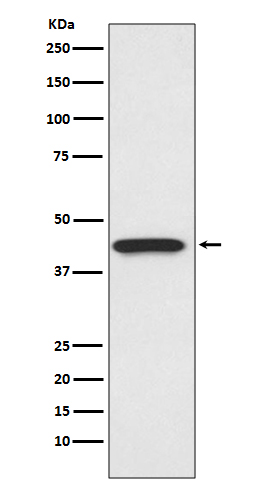
CDK9 Antibody
Rabbit mAb

- 产品详情
- 实验流程
Application 
| WB, IHC, IF, ICC, IP, IHF |
|---|---|
| Primary Accession | P50750 |
| Reactivity | Human |
| Clonality | Monoclonal |
| Other Names | Cyclin-dependent kinase 9; C-2K; Cell division cycle 2-like protein kinase 4; Cell division protein kinase 9; CDC2L4; TAK; |
| Isotype | Rabbit IgG |
| Host | Rabbit |
| Calculated MW | 42778 Da |
| Dilution | WB 1:1000~1:2000 IHC 1:50~1:200 ICC/IF 1:50~1:200 IP 1:40 |
|---|---|
| Purification | Affinity-chromatography |
| Immunogen | A synthesized peptide derived from human CDK9 |
| Description | Cyclin dependent kinases (CDKs) are activated in part by cyclin binding and by phosphorylation of a conserved threonine in the T-loop domain. Member of the cyclin-dependent kinase pair (CDK9/cyclin-T) complex, also called positive transcription elongation factor b (P-TEFb), which facilitates the transition from abortive to production elongation by phosphorylating the CTD (C-terminal domain) of the large subunit of RNA polymerase II (RNAP II), SUPT5H and RDBP. |
| Storage Condition and Buffer | Rabbit IgG in phosphate buffered saline , pH 7.4, 150mM NaCl, 0.02% sodium azide and 50% glycerol. Store at +4°C short term. Store at -20°C long term. Avoid freeze / thaw cycle. |
For Research Use Only. Not For Use In Diagnostic Procedures.
| Name | CDK9 {ECO:0000303|PubMed:10903437, ECO:0000312|HGNC:HGNC:1780} |
|---|---|
| Function | Protein kinase involved in the regulation of transcription (PubMed:10574912, PubMed:10757782, PubMed:11145967, PubMed:11575923, PubMed:11809800, PubMed:11884399, PubMed:14701750, PubMed:16109376, PubMed:16109377, PubMed:20930849, PubMed:28426094, PubMed:29335245). Member of the cyclin-dependent kinase pair (CDK9/cyclin-T) complex, also called positive transcription elongation factor b (P-TEFb), which facilitates the transition from abortive to productive elongation by phosphorylating the CTD (C-terminal domain) of the large subunit of RNA polymerase II (RNAP II) POLR2A, SUPT5H and RDBP (PubMed:10574912, PubMed:10757782, PubMed:11145967, PubMed:11575923, PubMed:11809800, PubMed:11884399, PubMed:14701750, PubMed:16109376, PubMed:16109377, PubMed:16427012, PubMed:20930849, PubMed:28426094, PubMed:30134174). This complex is inactive when in the 7SK snRNP complex form (PubMed:10574912, PubMed:10757782, PubMed:11145967, PubMed:11575923, PubMed:11809800, PubMed:11884399, PubMed:14701750, PubMed:16109376, PubMed:16109377, PubMed:20930849, PubMed:28426094). Phosphorylates EP300, MYOD1, RPB1/POLR2A and AR and the negative elongation factors DSIF and NELFE (PubMed:10912001, PubMed:11112772, PubMed:12037670, PubMed:16427012, PubMed:20081228, PubMed:20980437, PubMed:21127351, PubMed:9857195). Regulates cytokine inducible transcription networks by facilitating promoter recognition of target transcription factors (e.g. TNF-inducible RELA/p65 activation and IL-6-inducible STAT3 signaling) (PubMed:17956865, PubMed:18362169). Promotes RNA synthesis in genetic programs for cell growth, differentiation and viral pathogenesis (PubMed:10393184, PubMed:11112772). P-TEFb is also involved in cotranscriptional histone modification, mRNA processing and mRNA export (PubMed:15564463, PubMed:19575011, PubMed:19844166, PubMed:28539972). Modulates a complex network of chromatin modifications including histone H2B monoubiquitination (H2Bub1), H3 lysine 4 trimethylation (H3K4me3) and H3K36me3; integrates phosphorylation during transcription with chromatin modifications to control co-transcriptional histone mRNA processing (PubMed:15564463, PubMed:19575011, PubMed:19844166). Also catalyzes phosphorylation of histone H1.4 (H1-4) at 'Ser-187' (H1.4S187Ph), a modification associated with transcription activation (PubMed:28539972). The CDK9/cyclin-K complex has also a kinase activity towards CTD of RNAP II and can substitute for CDK9/cyclin-T P-TEFb in vitro (PubMed:21127351). Replication stress response protein; the CDK9/cyclin-K complex is required for genome integrity maintenance, by promoting cell cycle recovery from replication arrest and limiting single-stranded DNA amount in response to replication stress, thus reducing the breakdown of stalled replication forks and avoiding DNA damage (PubMed:20493174). In addition, probable function in DNA repair of isoform 2 via interaction with KU70/XRCC6 (PubMed:20493174). Promotes cardiac myocyte enlargement (PubMed:20081228). RPB1/POLR2A phosphorylation on 'Ser-2' in CTD activates transcription (PubMed:21127351). AR phosphorylation modulates AR transcription factor promoter selectivity and cell growth. DSIF and NELF phosphorylation promotes transcription by inhibiting their negative effect (PubMed:10912001, PubMed:11112772, PubMed:9857195). The phosphorylation of MYOD1 enhances its transcriptional activity and thus promotes muscle differentiation (PubMed:12037670). Catalyzes phosphorylation of KAT5, promoting KAT5 recruitment to chromatin and histone acetyltransferase activity (PubMed:29335245). |
| Cellular Location | Nucleus. Cytoplasm. Nucleus, PML body. Note=Accumulates on chromatin in response to replication stress Complexed with CCNT1 in nuclear speckles, but uncomplexed form in the cytoplasm. The translocation from nucleus to cytoplasm is XPO1/CRM1- dependent. Associates with PML body when acetylated |
| Tissue Location | Ubiquitous. |
Research Areas
Application Protocols
Provided below are standard protocols that you may find useful for product applications.

终于等到您。ABCEPTA(百远生物)抗体产品。
点击下方“我要评价 ”按钮提交您的反馈信息,您的反馈和评价是我们最宝贵的财富之一,
我们将在1-3个工作日内处理您的反馈信息。
如有疑问,联系:0512-88856768 tech-china@abcepta.com.
¥ 1,250.00
Cat# AP90832


