


 癌症的基本特征包括细胞增殖、血管生成、迁移、凋亡逃避机制和细胞永生等。找到癌症发生过程中这些通路的关键标记物和对应的抗体用于检测至关重要。
 为您推荐一个泛素化位点预测神器——泛素化分析工具,可以为您的蛋白的泛素化位点作出预测和评分。
 细胞自噬受体图形绘图工具为你的蛋白的细胞受体结合位点作出预测和评分,识别结合到自噬通路中的蛋白是非常重要的,便于让我们理解自噬在正常生理、病理过程中的作用,如发育、细胞分化、神经退化性疾病、压力条件下、感染和癌症。
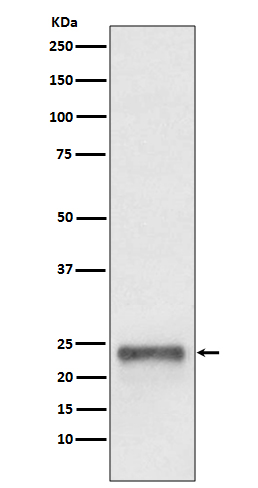
Ubiquitin D Antibody
Rabbit mAb
- 产品详情
- 实验流程
Application 
| WB, IHC, IF, ICC, IHF |
|---|---|
| Primary Accession | O15205 |
| Reactivity | Human, Mouse |
| Clonality | Monoclonal |
| Other Names | FAT10; UBD-3; GABBR1; UBD; Ubiquitin D; |
| Isotype | Rabbit IgG |
| Host | Rabbit |
| Calculated MW | 18473 Da |
| Dilution | WB 1:500~1:1000 IHC 1:50~1:200 ICC/IF 1:50~1:200 |
|---|---|
| Purification | Affinity-chromatography |
| Immunogen | A synthesized peptide derived from human Ubiquitin D |
| Description | UBD (ubiquitin D) is a protein-coding gene. Diseases associated with UBD include nephrosclerosis, and severe acute respiratory syndrome, and among its related super-pathways are NF-KappaB Family Pathway and MIF Regulation of Innate Immune Cells. GO annotations related to this gene include proteasome binding and protein binding. An important paralog of this gene is ISG15. |
| Storage Condition and Buffer | Rabbit IgG in phosphate buffered saline , pH 7.4, 150mM NaCl, 0.02% sodium azide and 50% glycerol. Store at +4°C short term. Store at -20°C long term. Avoid freeze / thaw cycle. |
For Research Use Only. Not For Use In Diagnostic Procedures.
| Name | UBD |
|---|---|
| Synonyms | FAT10 |
| Function | Ubiquitin-like protein modifier which can be covalently attached to target proteins and subsequently leads to their degradation by the 26S proteasome, in a NUB1-dependent manner (PubMed:15831455, PubMed:16707496, PubMed:19166848). Conjugation to the target protein is activated by UBA6 via adenylation of its C-terminal glycine (PubMed:17889673, PubMed:35970836). Promotes the expression of the proteasome subunit beta type-9 (PSMB9/LMP2). Regulates TNF-induced and LPS-mediated activation of the central mediator of innate immunity NF- kappa-B by promoting TNF-mediated proteasomal degradation of ubiquitinated-I-kappa-B-alpha (PubMed:19959714). Required for TNF- induced p65 nuclear translocation in renal tubular epithelial cells (RTECs). May be involved in dendritic cell (DC) maturation, the process by which immature dendritic cells differentiate into fully competent antigen-presenting cells that initiate T-cell responses (PubMed:19028597). Mediates mitotic non-disjunction and chromosome instability, in long-term in vitro culture and cancers, by abbreviating mitotic phase and impairing the kinetochore localization of MAD2L1 during the prometaphase stage of the cell cycle (PubMed:16495226). May be involved in the formation of aggresomes when proteasome is saturated or impaired (PubMed:19033385). Mediates apoptosis in a caspase- dependent manner, especially in renal epithelium and tubular cells during renal diseases such as polycystic kidney disease and Human immunodeficiency virus (HIV)-associated nephropathy (HIVAN) (PubMed:16495380). |
| Cellular Location | Nucleus. Cytoplasm {ECO:0000250|UniProtKB:P63072} Note=Accumulates in aggresomes under proteasome inhibition conditions |
| Tissue Location | Constitutively expressed in mature dendritic cells and B-cells. Mostly expressed in the reticuloendothelial system (e.g thymus, spleen), the gastrointestinal system, kidney, lung and prostate gland. |
Research Areas
Application Protocols
Provided below are standard protocols that you may find useful for product applications.

终于等到您。ABCEPTA(百远生物)抗体产品。
点击下方“我要评价 ”按钮提交您的反馈信息,您的反馈和评价是我们最宝贵的财富之一,
我们将在1-3个工作日内处理您的反馈信息。
如有疑问,联系:0512-88856768 tech-china@abcepta.com.
¥ 1,250.00
Cat# AP90928


