


 癌症的基本特征包括细胞增殖、血管生成、迁移、凋亡逃避机制和细胞永生等。找到癌症发生过程中这些通路的关键标记物和对应的抗体用于检测至关重要。
 为您推荐一个泛素化位点预测神器——泛素化分析工具,可以为您的蛋白的泛素化位点作出预测和评分。
 细胞自噬受体图形绘图工具为你的蛋白的细胞受体结合位点作出预测和评分,识别结合到自噬通路中的蛋白是非常重要的,便于让我们理解自噬在正常生理、病理过程中的作用,如发育、细胞分化、神经退化性疾病、压力条件下、感染和癌症。
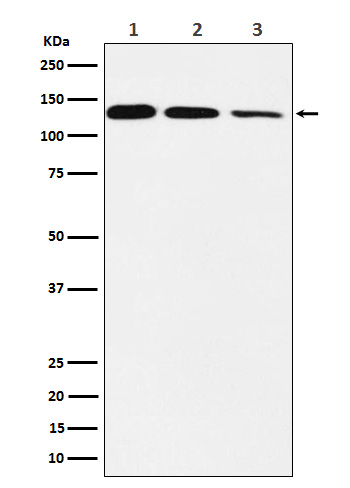
POLD1 Antibody
Rabbit mAb
- 产品详情
- 实验流程
Application 
| WB, IHC, IF, FC, ICC, IHF |
|---|---|
| Primary Accession | P28340 |
| Reactivity | Rat, Human, Mouse |
| Clonality | Monoclonal |
| Other Names | CDC2; CRCS10; MDPL; POLD; POLD1; |
| Isotype | Rabbit IgG |
| Host | Rabbit |
| Calculated MW | 123631 Da |
| Dilution | WB 1:500~1:2000 IHC 1:50~1:200 ICC/IF 1:50~1:200 FC 1:100 |
|---|---|
| Purification | Affinity-chromatography |
| Immunogen | A synthesized peptide derived from human POLD1 |
| Description | Possesses two enzymatic activities: DNA synthesis (polymerase) and an exonucleolytic activity that degrades single stranded DNA in the 3'- to 5'-direction. Required with its accessory proteins (proliferating cell nuclear antigen (PCNA) and replication factor C (RFC) or activator 1) for leading strand synthesis. Also involved in completing Okazaki fragments initiated by the DNA polymerase alpha/primase complex. |
| Storage Condition and Buffer | Rabbit IgG in phosphate buffered saline , pH 7.4, 150mM NaCl, 0.02% sodium azide and 50% glycerol. Store at +4°C short term. Store at -20°C long term. Avoid freeze / thaw cycle. |
For Research Use Only. Not For Use In Diagnostic Procedures.
| Name | POLD1 (HGNC:9175) |
|---|---|
| Synonyms | POLD |
| Function | As the catalytic component of the trimeric (Pol-delta3 complex) and tetrameric DNA polymerase delta complexes (Pol-delta4 complex), plays a crucial role in high fidelity genome replication, including in lagging strand synthesis, and repair (PubMed:16510448, PubMed:19074196, PubMed:20334433, PubMed:24022480, PubMed:24035200, PubMed:31449058). Exhibits both DNA polymerase and 3'- to 5'- exonuclease activities (PubMed:16510448, PubMed:19074196, PubMed:20334433, PubMed:24022480, PubMed:24035200). Requires the presence of accessory proteins POLD2, POLD3 and POLD4 for full activity. Depending upon the absence (Pol-delta3) or the presence of POLD4 (Pol-delta4), displays differences in catalytic activity. Most notably, expresses higher proofreading activity in the context of Pol- delta3 compared with that of Pol-delta4 (PubMed:19074196, PubMed:20334433). Although both Pol-delta3 and Pol-delta4 process Okazaki fragments in vitro, Pol-delta3 may be better suited to fulfill this task, exhibiting near-absence of strand displacement activity compared to Pol-delta4 and stalling on encounter with the 5'-blocking oligonucleotides. Pol-delta3 idling process may avoid the formation of a gap, while maintaining a nick that can be readily ligated (PubMed:24035200). Along with DNA polymerase kappa, DNA polymerase delta carries out approximately half of nucleotide excision repair (NER) synthesis following UV irradiation (PubMed:20227374). Under conditions of DNA replication stress, in the presence of POLD3 and POLD4, may catalyze the repair of broken replication forks through break-induced replication (BIR) (PubMed:24310611). Involved in the translesion synthesis (TLS) of templates carrying O6-methylguanine, 8oxoG or abasic sites (PubMed:19074196, PubMed:24191025). |
| Cellular Location | Nucleus Note=Colocalizes with PCNA and POLD3 at S phase replication sites (PubMed:11595739). After UV irradiation, recruited to DNA damage sites within 2 hours, independently of the cell cycle phase, nor on PCNA ubiquitination. This recruitment requires POLD3, PCNA and RFC1- replication factor C complex (PubMed:20227374, PubMed:22801543) |
| Tissue Location | Widely expressed, with high levels of expression in heart and lung. |
Research Areas
Application Protocols
Provided below are standard protocols that you may find useful for product applications.

终于等到您。ABCEPTA(百远生物)抗体产品。
点击下方“我要评价 ”按钮提交您的反馈信息,您的反馈和评价是我们最宝贵的财富之一,
我们将在1-3个工作日内处理您的反馈信息。
如有疑问,联系:0512-88856768 tech-china@abcepta.com.
¥ 1,250.00
Cat# AP92118


