


 癌症的基本特征包括细胞增殖、血管生成、迁移、凋亡逃避机制和细胞永生等。找到癌症发生过程中这些通路的关键标记物和对应的抗体用于检测至关重要。
 为您推荐一个泛素化位点预测神器——泛素化分析工具,可以为您的蛋白的泛素化位点作出预测和评分。
 细胞自噬受体图形绘图工具为你的蛋白的细胞受体结合位点作出预测和评分,识别结合到自噬通路中的蛋白是非常重要的,便于让我们理解自噬在正常生理、病理过程中的作用,如发育、细胞分化、神经退化性疾病、压力条件下、感染和癌症。
PLSCR3 Antibody
Rabbit mAb
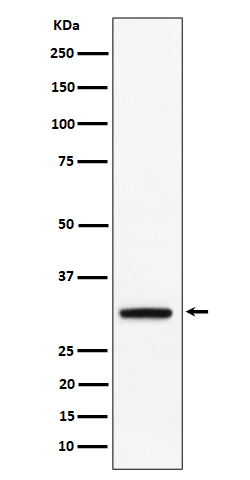
- 产品详情
- 实验流程
Application 
| WB |
|---|---|
| Primary Accession | Q9NRY6 |
| Reactivity | Rat, Human, Mouse |
| Clonality | Monoclonal |
| Other Names | PLS3; Plscr3; |
| Isotype | Rabbit IgG |
| Host | Rabbit |
| Calculated MW | 31648 Da |
| Dilution | WB 1:500~1:2000 |
|---|---|
| Purification | Affinity-chromatography |
| Immunogen | A synthesized peptide derived from human PLSCR3 |
| Description | May mediate accelerated ATP-independent bidirectional transbilayer migration of phospholipids upon binding calcium ions that results in a loss of phospholipid asymmetry in the plasma membrane. May play a central role in the initiation of fibrin clot formation, in the activation of mast cells and in the recognition of apoptotic and injured cells by the reticuloendothelial system. |
| Storage Condition and Buffer | Rabbit IgG in phosphate buffered saline , pH 7.4, 150mM NaCl, 0.02% sodium azide and 50% glycerol. Store at +4°C short term. Store at -20°C long term. Avoid freeze / thaw cycle. |
For Research Use Only. Not For Use In Diagnostic Procedures.
| Name | PLSCR3 |
|---|---|
| Function | Catalyzes calcium-induced ATP-independent rapid bidirectional and non-specific movement of the phospholipids (lipid scrambling or lipid flip-flop) between the inner and outer membrane of the mitochondria (PubMed:14573790, PubMed:17226776, PubMed:18358005, PubMed:29337693, PubMed:31769662). Plays an important role in mitochondrial respiratory function, morphology, and apoptotic response (PubMed:12649167, PubMed:14573790, PubMed:17226776, PubMed:18358005). Mediates the translocation of cardiolipin from the mitochondrial inner membrane to outer membrane enhancing t-Bid induced cytochrome c release and apoptosis (PubMed:14573790, PubMed:17226776, PubMed:18358005). Enhances TNFSF10-induced apoptosis by regulating the distribution of cardiolipin in the mitochondrial membrane resulting in increased release of apoptogenic factors and consequent amplification of the activity of caspases (PubMed:18491232). Regulates cardiolipin de novo biosynthesis and its resynthesis (PubMed:16939411). |
| Cellular Location | Mitochondrion membrane; Single-pass type II membrane protein {ECO:0000250|UniProtKB:Q6QBQ4}. Mitochondrion inner membrane {ECO:0000250|UniProtKB:Q6QBQ4}; Single-pass type II membrane protein {ECO:0000250|UniProtKB:Q6QBQ4}. Nucleus {ECO:0000250|UniProtKB:Q9JIZ9} Note=Palmitoylation regulates its localization to the cell membrane or the nucleus; trafficking to the cell membrane is dependent upon palmitoylation whereas in the absence of palmitoylation, localizes to the nucleus. {ECO:0000250|UniProtKB:Q9JIZ9} |
| Tissue Location | Expressed in heart, placenta, lung, liver, skeletal muscle, kidney, pancreas, spleen, thymus, prostate, uterus, small intestine and peripheral blood lymphocytes. Not detected in testis, brain and liver |
Research Areas
Application Protocols
Provided below are standard protocols that you may find useful for product applications.

终于等到您。ABCEPTA(百远生物)抗体产品。
点击下方“我要评价 ”按钮提交您的反馈信息,您的反馈和评价是我们最宝贵的财富之一,
我们将在1-3个工作日内处理您的反馈信息。
如有疑问,联系:0512-88856768 tech-china@abcepta.com.
¥ 1,250.00
Cat# AP92917


