


 癌症的基本特征包括细胞增殖、血管生成、迁移、凋亡逃避机制和细胞永生等。找到癌症发生过程中这些通路的关键标记物和对应的抗体用于检测至关重要。
 为您推荐一个泛素化位点预测神器——泛素化分析工具,可以为您的蛋白的泛素化位点作出预测和评分。
 细胞自噬受体图形绘图工具为你的蛋白的细胞受体结合位点作出预测和评分,识别结合到自噬通路中的蛋白是非常重要的,便于让我们理解自噬在正常生理、病理过程中的作用,如发育、细胞分化、神经退化性疾病、压力条件下、感染和癌症。
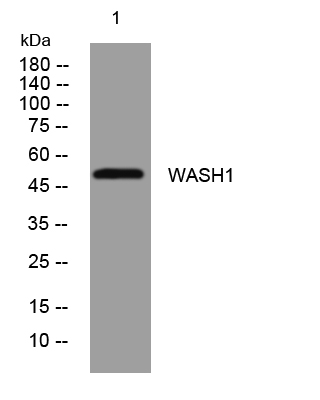
WASH1 Rabbit Polyclonal Antibody
WASH1 Rabbit Polyclonal Antibody
- 产品详情
- 实验流程
Application 
| WB |
|---|---|
| Primary Accession | A8K0Z3 |
| Reactivity | Human, Mouse, Rat |
| Host | Polyclonal, Rabbit,IgG |
| Clonality | Polyclonal |
| Calculated MW | 50328 Da |
| Gene ID | 100287171 |
|---|---|
| Other Names | WASH complex subunit 1 {ECO:0000312|HGNC:HGNC:24361}, CXYorf1-like protein on chromosome 9, Protein FAM39E, WAS protein family homolog 1, WASHC1 (HGNC:24361), FAM39E, WASH1 |
| Dilution | WB~~1:1000 |
| Storage Conditions | -20℃ |
For Research Use Only. Not For Use In Diagnostic Procedures.
| Name | WASHC1 (HGNC:24361) |
|---|---|
| Synonyms | FAM39E, WASH1 |
| Function | Acts as a component of the WASH core complex that functions as a nucleation-promoting factor (NPF) at the surface of endosomes, where it recruits and activates the Arp2/3 complex to induce actin polymerization, playing a key role in the fission of tubules that serve as transport intermediates during endosome sorting (PubMed:19922874, PubMed:19922875, PubMed:20498093, PubMed:23452853). Involved in endocytic trafficking of EGF (By similarity). Involved in transferrin receptor recycling. Regulates the trafficking of endosomal alpha5beta1 integrin to the plasma membrane and involved in invasive cell migration (PubMed:22114305). In T-cells involved in endosome-to-membrane recycling of receptors including T-cell receptor (TCR), CD28 and ITGAL; proposed to be implicated in T cell proliferation and effector function. In dendritic cells involved in endosome-to-membrane recycling of major histocompatibility complex (MHC) class II probably involving retromer and subsequently allowing antigen sampling, loading and presentation during T-cell activation (By similarity). Involved in Arp2/3 complex-dependent actin assembly driving Salmonella typhimurium invasion independent of ruffling. Involved in the exocytosis of MMP14 leading to matrix remodeling during invasive migration and implicating late endosome-to-plasma membrane tubular connections and cooperation with the exocyst complex (PubMed:24344185). Involved in negative regulation of autophagy independently from its role in endosomal sorting by inhibiting BECN1 ubiquitination to inactivate PIK3C3/Vps34 activity (By similarity). |
| Cellular Location | Early endosome membrane. Recycling endosome membrane {ECO:0000250|UniProtKB:Q8VDD8}. Late endosome. Cytoplasmic vesicle, autophagosome {ECO:0000250|UniProtKB:Q8VDD8}. Cytoplasm, cytoskeleton, microtubule organizing center, centrosome, centriole {ECO:0000250|UniProtKB:Q8VDD8}. Note=Localization to the endosome membrane is mediated via its interaction with WASHC2 (PubMed:19922874) Localizes to MMP14-positive late endosomes and transiently to invadipodia (PubMed:24344185). Localized to Salmonella typhimurium entry sites (By similarity). {ECO:0000250|UniProtKB:Q8VDD8, ECO:0000269|PubMed:19922874, ECO:0000269|PubMed:24344185} |
Research Areas
Application Protocols
Provided below are standard protocols that you may find useful for product applications.

终于等到您。ABCEPTA(百远生物)抗体产品。
点击下方“我要评价 ”按钮提交您的反馈信息,您的反馈和评价是我们最宝贵的财富之一,
我们将在1-3个工作日内处理您的反馈信息。
如有疑问,联系:0512-88856768 tech-china@abcepta.com.


