


 癌症的基本特征包括细胞增殖、血管生成、迁移、凋亡逃避机制和细胞永生等。找到癌症发生过程中这些通路的关键标记物和对应的抗体用于检测至关重要。
 为您推荐一个泛素化位点预测神器——泛素化分析工具,可以为您的蛋白的泛素化位点作出预测和评分。
 细胞自噬受体图形绘图工具为你的蛋白的细胞受体结合位点作出预测和评分,识别结合到自噬通路中的蛋白是非常重要的,便于让我们理解自噬在正常生理、病理过程中的作用,如发育、细胞分化、神经退化性疾病、压力条件下、感染和癌症。
ALOX15 (19A1) Rabbit Monoclonal Antibody
ALOX15 (19A1) Rabbit Monoclonal Antibody
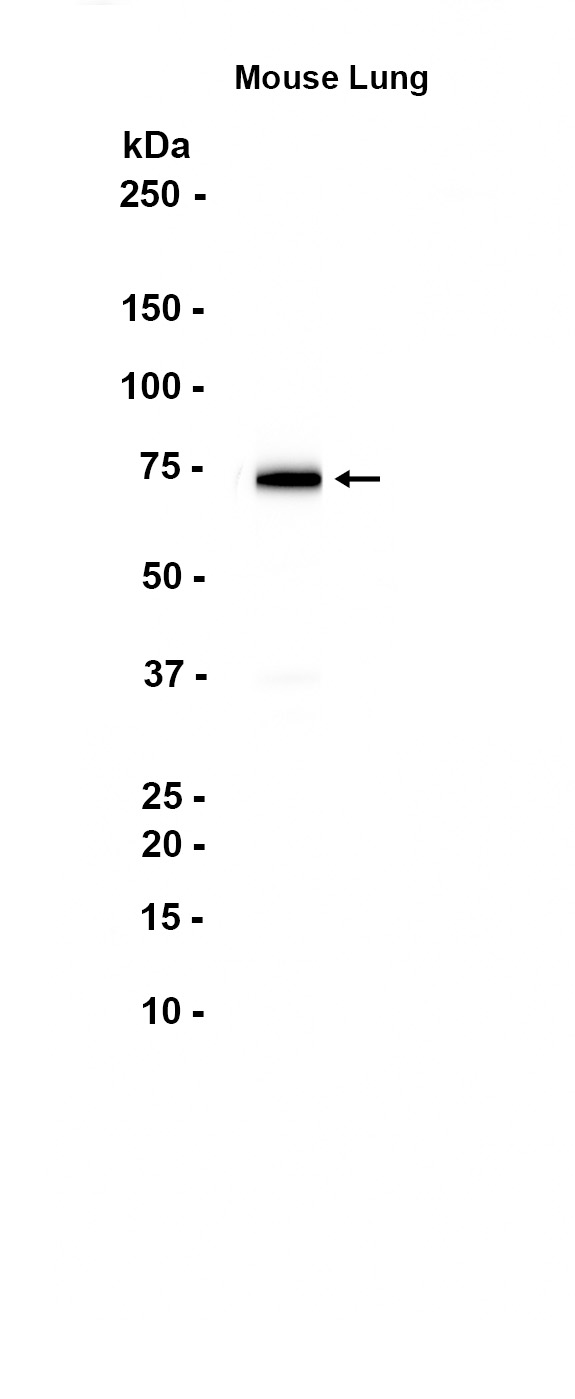
- 产品详情
- 实验流程
- 背景知识
Application 
| WB, IHC-P, ICC, IF |
|---|---|
| Primary Accession | P16050, P39654, Q02759 |
| Reactivity | Human, Mouse, Rat |
| Clonality | Monoclonal |
| Calculated MW | 74804 Da |
| Gene ID | 246 |
|---|---|
| Dilution | WB~~1:1000 IHC-P~~1:50~200 ICC~~N/A IF~~1:50~200 |
| Storage Conditions | -20℃ |
For Research Use Only. Not For Use In Diagnostic Procedures.
| Name | ALOX15 (HGNC:433) |
|---|---|
| Synonyms | LOG15 |
| Function | Non-heme iron-containing dioxygenase that catalyzes the stereo-specific peroxidation of free and esterified polyunsaturated fatty acids generating a spectrum of bioactive lipid mediators (PubMed:17052953, PubMed:1944593, PubMed:24282679, PubMed:25293588, PubMed:32404334, PubMed:8334154). It inserts peroxyl groups at C12 or C15 of arachidonate ((5Z,8Z,11Z,14Z)-eicosatetraenoate) producing both 12-hydroperoxyeicosatetraenoate/12-HPETE and 15- hydroperoxyeicosatetraenoate/15-HPETE (PubMed:17052953, PubMed:1944593, PubMed:24282679, PubMed:8334154). It may then act on 12-HPETE to produce hepoxilins, which may show pro-inflammatory properties (By similarity). Can also peroxidize linoleate ((9Z,12Z)-octadecadienoate) to 13-hydroperoxyoctadecadienoate/13-HPODE (PubMed:8334154). May participate in the sequential oxidations of DHA ((4Z,7Z,10Z,13Z,16Z,19Z)-docosahexaenoate) to generate specialized pro- resolving mediators (SPMs)like resolvin D5 ((7S,17S)-diHPDHA) and (7S,14S)-diHPDHA, that actively down-regulate the immune response and have anti-aggregation properties with platelets (PubMed:32404334). Can convert epoxy fatty acids to hydroperoxy-epoxides derivatives followed by an intramolecular nucleophilic substitution leading to the formation of monocyclic endoperoxides (PubMed:25293588). Plays an important role during the maintenance of self-tolerance by peroxidizing membrane-bound phosphatidylethanolamine which can then signal the sorting process for clearance of apoptotic cells during inflammation and prevent an autoimmune response. In addition to its role in the immune and inflammatory responses, this enzyme may play a role in epithelial wound healing in the cornea through production of lipoxin A4 (LXA(4)) and docosahexaenoic acid-derived neuroprotectin D1 (NPD1; 10R,17S-HDHA), both lipid autacoids exhibit anti-inflammatory and neuroprotective properties. Furthermore, it may regulate actin polymerization which is crucial for several biological processes such as the phagocytosis of apoptotic cells. It is also implicated in the generation of endogenous ligands for peroxisome proliferator activated receptor (PPAR-gamma), hence modulating macrophage development and function. It may also exert a negative effect on skeletal development by regulating bone mass through this pathway. As well as participates in ER stress and downstream inflammation in adipocytes, pancreatic islets, and liver (By similarity). Finally, it is also involved in the cellular response to IL13/interleukin-13 (PubMed:21831839). |
| Cellular Location | Cytoplasm, cytosol. Cell membrane; Peripheral membrane protein. Lipid droplet. Note=Predominantly cytosolic; becomes enriched at membranes upon calcium binding (By similarity) Translocates from the cytosol to the plasma membrane when stimulated by IL13/interleukin-13 and in macrophages binding apoptotic cells (By similarity). {ECO:0000250|UniProtKB:P39654} |
| Tissue Location | Detected in monocytes and eosinophils (at protein level). Expressed in airway epithelial cells |
Provided below are standard protocols that you may find useful for product applications.
BACKGROUND
This gene encodes a member of the lipoxygenase family of proteins. The encoded enzyme acts on various polyunsaturated fatty acid substrates to generate various bioactive lipid mediators such as eicosanoids, hepoxilins, lipoxins, and other molecules. The encoded enzyme and its reaction products have been shown to regulate inflammation and immunity. Multiple pseudogenes of this gene have been identified in the human genome. [provided by RefSeq, Aug 2017]

终于等到您。ABCEPTA(百远生物)抗体产品。
点击下方“我要评价 ”按钮提交您的反馈信息,您的反馈和评价是我们最宝贵的财富之一,
我们将在1-3个工作日内处理您的反馈信息。
如有疑问,联系:0512-88856768 tech-china@abcepta.com.


