


 癌症的基本特征包括细胞增殖、血管生成、迁移、凋亡逃避机制和细胞永生等。找到癌症发生过程中这些通路的关键标记物和对应的抗体用于检测至关重要。
 为您推荐一个泛素化位点预测神器——泛素化分析工具,可以为您的蛋白的泛素化位点作出预测和评分。
 细胞自噬受体图形绘图工具为你的蛋白的细胞受体结合位点作出预测和评分,识别结合到自噬通路中的蛋白是非常重要的,便于让我们理解自噬在正常生理、病理过程中的作用,如发育、细胞分化、神经退化性疾病、压力条件下、感染和癌症。
SHP2 (11I13) Rabbit Monoclonal Antibody
SHP2 (11I13) Rabbit Monoclonal Antibody
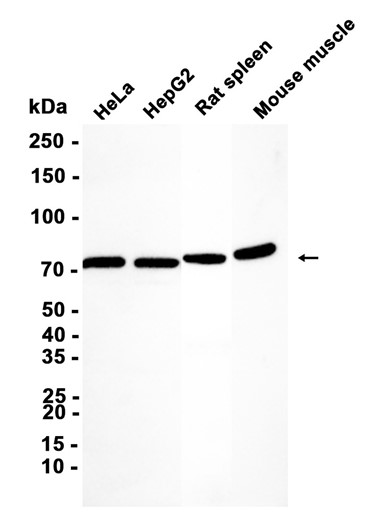
- 产品详情
- 实验流程
- 背景知识
Application 
| WB, IP |
|---|---|
| Primary Accession | P35235 |
| Reactivity | Mouse, Rat |
| Clonality | Monoclonal |
| Calculated MW | 68035 Da |
| Gene ID | 19247 |
|---|---|
| Other Names | Tyrosine-protein phosphatase non-receptor type 11, 3.1.3.48, Protein-tyrosine phosphatase SYP, SH-PTP2, SHP-2, Shp2, Ptpn11 |
| Dilution | WB~~1:1000 IP~~N/A |
| Storage Conditions | -20℃ |
For Research Use Only. Not For Use In Diagnostic Procedures.
| Name | Ptpn11 |
|---|---|
| Function | Acts downstream of various receptor and cytoplasmic protein tyrosine kinases to participate in the signal transduction from the cell surface to the nucleus (PubMed:11698646, PubMed:14967142). Positively regulates MAPK signal transduction pathway (By similarity). Dephosphorylates GAB1, ARHGAP35 and EGFR (By similarity). Dephosphorylates ROCK2 at 'Tyr-722' resulting in stimulation of its RhoA binding activity (By similarity). Dephosphorylates CDC73 (By similarity). Dephosphorylates SOX9 on tyrosine residues, leading to inactivate SOX9 and promote ossification (PubMed:29644115). Dephosphorylates tyrosine-phosphorylated NEDD9/CAS-L (By similarity). Acts as an effector of PDCD1-mediated inhibition of T-cell response: recruited by phosphorylated PDCD1, mediating dephosphorylation of key T-cell receptor (TCR) proximal signaling molecules, leading to TCR signaling inhibition (PubMed:11698646). |
| Cellular Location | Cytoplasm. |
| Tissue Location | Highly expressed in brain, heart and kidney. |
Provided below are standard protocols that you may find useful for product applications.
BACKGROUND
Enables cell adhesion molecule binding activity; protein tyrosine phosphatase activity; and signaling receptor binding activity. Involved in negative regulation of chondrocyte differentiation; positive regulation of cytokine production; and positive regulation of ossification. Acts upstream of or within several processes, including cell surface receptor signaling pathway; myeloid cell differentiation; and regulation of hormone secretion. Predicted to be located in several cellular components, including mitochondrion; plasma membrane raft; and stress fiber. Predicted to be part of protein-containing complex. Is expressed in several structures, including alimentary system; brain; genitourinary system; hemolymphoid system gland; and liver and biliary system. Used to study several diseases, including Noonan syndrome 1; Noonan syndrome with multiple lentigines; hepatocellular adenoma; intrinsic cardiomyopathy (multiple); and juvenile myelomonocytic leukemia. Human ortholog(s) of this gene implicated in several diseases, including Noonan syndrome (multiple); Noonan syndrome with multiple lentigines 1; atrophic gastritis; juvenile myelomonocytic leukemia; and metachondromatosis. Orthologous to human PTPN11 (protein tyrosine phosphatase non-receptor type 11). [provided by Alliance of Genome Resources, Apr 2022]

终于等到您。ABCEPTA(百远生物)抗体产品。
点击下方“我要评价 ”按钮提交您的反馈信息,您的反馈和评价是我们最宝贵的财富之一,
我们将在1-3个工作日内处理您的反馈信息。
如有疑问,联系:0512-88856768 tech-china@abcepta.com.


