


 癌症的基本特征包括细胞增殖、血管生成、迁移、凋亡逃避机制和细胞永生等。找到癌症发生过程中这些通路的关键标记物和对应的抗体用于检测至关重要。
 为您推荐一个泛素化位点预测神器——泛素化分析工具,可以为您的蛋白的泛素化位点作出预测和评分。
 细胞自噬受体图形绘图工具为你的蛋白的细胞受体结合位点作出预测和评分,识别结合到自噬通路中的蛋白是非常重要的,便于让我们理解自噬在正常生理、病理过程中的作用,如发育、细胞分化、神经退化性疾病、压力条件下、感染和癌症。
TIM4 Rabbit pAb
TIM4 Rabbit pAb
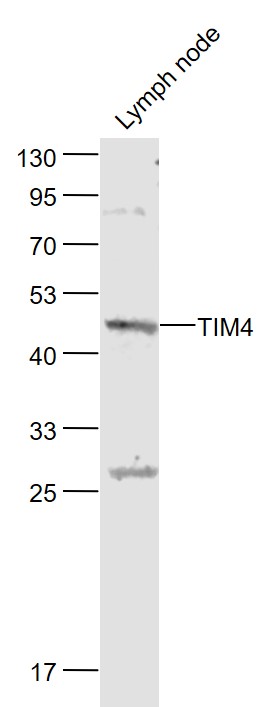
- 产品详情
- 实验流程
- 背景知识
Application 
| WB |
|---|---|
| Primary Accession | Q6U7R4 |
| Reactivity | Mouse |
| Host | Rabbit |
| Clonality | Polyclonal |
| Calculated MW | 37548 Da |
| Physical State | Liquid |
| Immunogen | KLH conjugated synthetic peptide derived from mouse TIM4 |
| Epitope Specificity | 221-320/374 |
| Isotype | IgG |
| Purity | affinity purified by Protein A |
| Buffer | 0.01M TBS (pH7.4) with 1% BSA, 0.02% Proclin300 and 50% Glycerol. |
| SUBCELLULAR LOCATION | Membrane; Single-pass type I membrane protein (Potential). |
| Important Note | This product as supplied is intended for research use only, not for use in human, therapeutic or diagnostic applications. |
| Background Descriptions | The T cell immunoglobulin and mucin domain containing protein (TIM) family encodes cell surface receptors that are involved in the regulation of T helper (Th) -1 and -2 cell-mediated immunity. Studies have shown that TIM 4, which is preferentially expressed on macrophages and dendritic cells, is the natural ligand of TIM 1, and that this binding leads to T-cell expansion and cytokine production. Unlike other members of the TIM family, TIM 4 lacks a putative tyrosine phosphorylation signal sequence in its intracellular domain. The TIM 4 gene maps to a locus associated with predisposition to asthma in both mice and humans and with its connection to TIM 1-triggered Th2 responsiveness, may be considered as a candidate disease/predisposition gene for asthma. |
| Gene ID | 276891 |
|---|---|
| Other Names | T-cell immunoglobulin and mucin domain-containing protein 4, TIMD-4, Spleen, mucin-containing, knockout of lymphotoxin protein, SMUCKLER, T-cell immunoglobulin mucin receptor 4, TIM-4, T-cell membrane protein 4, Timd4, Tim4 |
| Dilution | WB=1:500-2000 |
| Storage | Store at -20 °C for one year. Avoid repeated freeze/thaw cycles. When reconstituted in sterile pH 7.4 0.01M PBS or diluent of antibody the antibody is stable for at least two weeks at 2-4 °C. |
For Research Use Only. Not For Use In Diagnostic Procedures.
| Name | Timd4 |
|---|---|
| Synonyms | Tim4 |
| Function | Phosphatidylserine receptor that plays different role in immune response including phagocytosis of apoptotic cells and T-cell regulation (PubMed:17960135, PubMed:18354194, PubMed:18367551, PubMed:20368430). Involved in efferocytosis, the process by which apoptotic cells are removed by phagocytic cells by promoting the engulfment of apoptotic cells or exogenous particles (PubMed:17960135, PubMed:20368430). Mechanistically, acts by securing apoptotic cells to phagocytes through direct binding to phosphatidylserine present on apoptotic cells, while other engulfment receptors such as MERTK efficiently recognize apoptotic cells and mediate their ingestion (PubMed:17960135). Controls T-cell activation in a bimodal fashion, decreasing the activation of naive T-cells by inducing cell cycle arrest, while increasing proliferation of activated T-cells by activating AKT1 and ERK1/2 phosphorylations and subsequent signaling pathways (PubMed:18354194, PubMed:18367551). Also promotes autophagy process by suppressing NLRP3 inflammasome activity via activation of LKB1/PRKAA1 pathway in a phosphatidylserine-dependent mechanism (PubMed:31263038). |
| Cellular Location | Cell membrane {ECO:0000250|UniProtKB:Q96H15}; Single-pass type I membrane protein |
| Tissue Location | Predominantly expressed in lymphoid tissues, such as spleen, lymph nodes, and Peyer patches (PubMed:14768054, PubMed:17960135). Also expressed in fetal liver, salivary gland, and spleen stromal cells, predominantly in the marginal zone and to a lesser extent throughout the white pulp (PubMed:14768054, PubMed:17960135). Not expressed in bone marrow-derived cells (PubMed:14768054, PubMed:17960135). Expressed mainly by antigen presenting cells (APCs) in T- and B-cell areas, but not by T- or B- lymphocytes (PubMed:18354194, PubMed:20368430) |
Research Areas
Application Protocols
Provided below are standard protocols that you may find useful for product applications.
BACKGROUND
This product as supplied is intended for research use only, not for use in human, therapeutic or diagnostic applications.

终于等到您。ABCEPTA(百远生物)抗体产品。
点击下方“我要评价 ”按钮提交您的反馈信息,您的反馈和评价是我们最宝贵的财富之一,
我们将在1-3个工作日内处理您的反馈信息。
如有疑问,联系:0512-88856768 tech-china@abcepta.com.


