


 癌症的基本特征包括细胞增殖、血管生成、迁移、凋亡逃避机制和细胞永生等。找到癌症发生过程中这些通路的关键标记物和对应的抗体用于检测至关重要。
 为您推荐一个泛素化位点预测神器——泛素化分析工具,可以为您的蛋白的泛素化位点作出预测和评分。
 细胞自噬受体图形绘图工具为你的蛋白的细胞受体结合位点作出预测和评分,识别结合到自噬通路中的蛋白是非常重要的,便于让我们理解自噬在正常生理、病理过程中的作用,如发育、细胞分化、神经退化性疾病、压力条件下、感染和癌症。
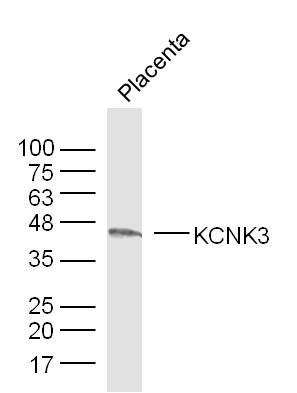
KCNK3 Rabbit pAb
KCNK3 Rabbit pAb
- 产品详情
- 实验流程
- 背景知识
Application 
| WB |
|---|---|
| Primary Accession | O14649 |
| Reactivity | Rat, Mouse |
| Predicted | Dog, Human, Rabbit, Chicken, Sheep |
| Host | Rabbit |
| Clonality | Polyclonal |
| Calculated MW | 43518 Da |
| Physical State | Liquid |
| Immunogen | KLH conjugated synthetic peptide derived from human KCNK3 |
| Epitope Specificity | 51-150/394 |
| Isotype | IgG |
| Purity | affinity purified by Protein A |
| Buffer | 0.01M TBS (pH7.4) with 1% BSA, 0.02% Proclin300 and 50% Glycerol. |
| SUBCELLULAR LOCATION | Membrane; Multi-pass membrane protein (Potential). |
| Important Note | This product as supplied is intended for research use only, not for use in human, therapeutic or diagnostic applications. |
| Background Descriptions | KCNK9 or TASK-3 (TWIK-related Acid sensitive K+ channel) is a member of the potassium channel family of proteins that contain two-pore domain and four transmembrane domains. These channels are characterized as leak K+ channels that are sensitive to changes in the extracellular pH. The physiological functions of TASK channels are largely unknown; it has been proposed that they may be involved in the regulation of breathing, aldosterone secretion and anesthetic-mediated neuronal activity. They were found to act in neurons' membrane potential and in resting K+ currents. KCNK9 gene has been localized to the chromosomal region 8q24. The protein is expressed at high levels mainly in the brain and at low levels in other tissues. In contrast to normal tissues, it was found that KCNK9 is amplified in some human carcinomas such as breast, lung, colon and metastatic prostate. In 10% of breast cancer patients this gene is amplified, and in 44% the protein is over expressed. Monoclonal antibodies to KNCK9 are an important tool for studying the potassium channel family of proteins in different tissues. |
| Gene ID | 3777 |
|---|---|
| Other Names | Potassium channel subfamily K member 3, Acid-sensitive potassium channel protein TASK-1, TWIK-related acid-sensitive K(+) channel 1, Two pore potassium channel KT3.1, Two pore K(+) channel KT3.1, KCNK3 {ECO:0000303|PubMed:10748056, ECO:0000312|HGNC:HGNC:6278} |
| Dilution | WB=1:500-2000 |
| Storage | Store at -20 °C for one year. Avoid repeated freeze/thaw cycles. When reconstituted in sterile pH 7.4 0.01M PBS or diluent of antibody the antibody is stable for at least two weeks at 2-4 °C. |
For Research Use Only. Not For Use In Diagnostic Procedures.
| Name | KCNK3 {ECO:0000303|PubMed:10748056, ECO:0000312|HGNC:HGNC:6278} |
|---|---|
| Function | K(+) channel that conducts voltage-dependent outward rectifying currents upon membrane depolarization. Voltage sensing is coupled to K(+) electrochemical gradient in an 'ion flux gating' mode where outward but not inward ion flow opens the gate (PubMed:23169818, PubMed:26919430, PubMed:32499642, PubMed:36195757, PubMed:9312005). Changes ion selectivity and becomes permeable to Na(+) ions in response to extracellular acidification. Protonation of the pH sensor His-98 stabilizes C-type inactivation conformation likely converting the channel from outward K(+)-conducting, to inward Na(+)-conducting to nonconductive state (PubMed:22948150). Homo- and heterodimerizes to form functional channels with distinct regulatory and gating properties (PubMed:23169818, PubMed:32499642). Allows K(+) currents with fast- gating kinetics important for the repolarization and hyperpolarization phases of action potentials (By similarity). In cerebellar granule cells, heteromeric KCNK3:KCNK9 channel may hyperpolarize the resting membrane potential to limit intrinsic neuronal excitability, but once the action potential threshold is reached, it may support high- frequency action potential firing and increased neuronal excitability (By similarity). Dispensable for central chemosensory respiration i.e. breathing controlled by brainstem CO2/pH, it rather conducts pH- sensitive currents and controls the firing rate of serotonergic raphe neurons involved in potentiation of the respiratory chemoreflex. Additionally, imparts chemosensitivity to type 1 cells in carotid bodies which respond to a decrease in arterial oxygen pressure or an increase in carbon dioxide pressure or pH to initiate adaptive changes in pulmonary ventilation (By similarity). In adrenal gland, contributes to the maintenance of a hyperpolarized resting membrane potential of aldosterone-producing cells at zona glomerulosa and limits aldosterone release as part of a regulatory mechanism that controls arterial blood pressure and electrolyte homeostasis (By similarity). In brown adipocytes, mediates K(+) efflux that counteracts norepinephrine- induced membrane depolarization, limits Ca(2+) efflux and downstream cAMP and PKA signaling, ultimately attenuating lipid oxidation and adaptive thermogenesis (By similarity). |
| Cellular Location | Cell membrane; Multi-pass membrane protein |
| Tissue Location | Widespread expression in adult. Strongest expression in pancreas and placenta. Lower expression in brain, lung, prostate, heart, kidney, uterus, small intestine and colon |
Research Areas
Application Protocols
Provided below are standard protocols that you may find useful for product applications.
BACKGROUND
This product as supplied is intended for research use only, not for use in human, therapeutic or diagnostic applications.

终于等到您。ABCEPTA(百远生物)抗体产品。
点击下方“我要评价 ”按钮提交您的反馈信息,您的反馈和评价是我们最宝贵的财富之一,
我们将在1-3个工作日内处理您的反馈信息。
如有疑问,联系:0512-88856768 tech-china@abcepta.com.
¥ 1,250.00
Cat# AP94011


