


 癌症的基本特征包括细胞增殖、血管生成、迁移、凋亡逃避机制和细胞永生等。找到癌症发生过程中这些通路的关键标记物和对应的抗体用于检测至关重要。
 为您推荐一个泛素化位点预测神器——泛素化分析工具,可以为您的蛋白的泛素化位点作出预测和评分。
 细胞自噬受体图形绘图工具为你的蛋白的细胞受体结合位点作出预测和评分,识别结合到自噬通路中的蛋白是非常重要的,便于让我们理解自噬在正常生理、病理过程中的作用,如发育、细胞分化、神经退化性疾病、压力条件下、感染和癌症。
LRP2 Recombinant Rabbit mAb
LRP2 Recombinant Rabbit mAb
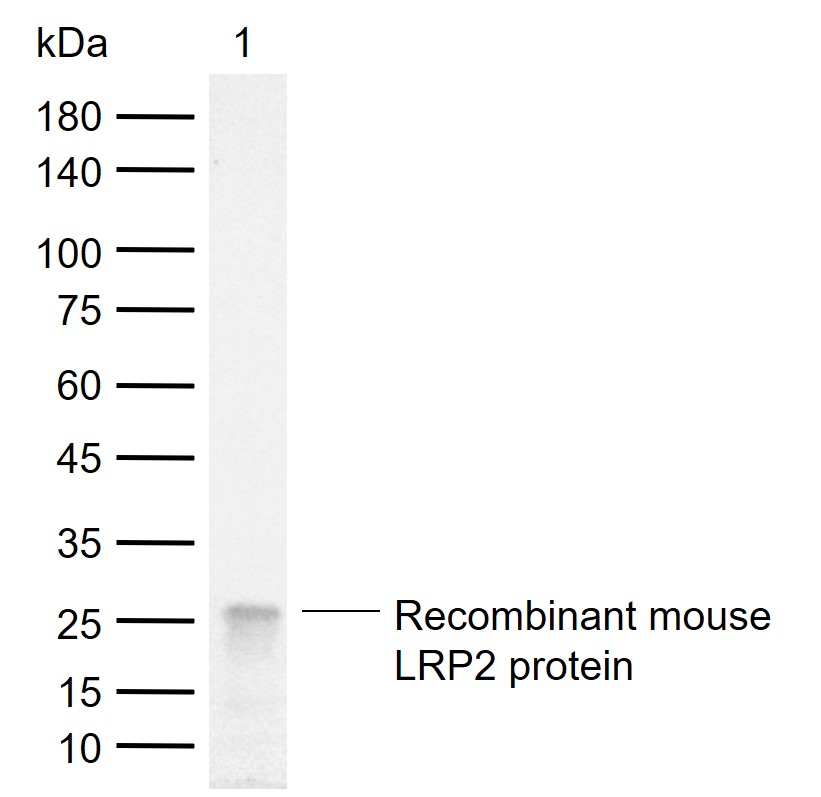
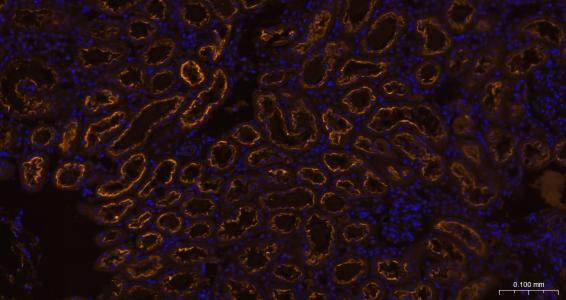
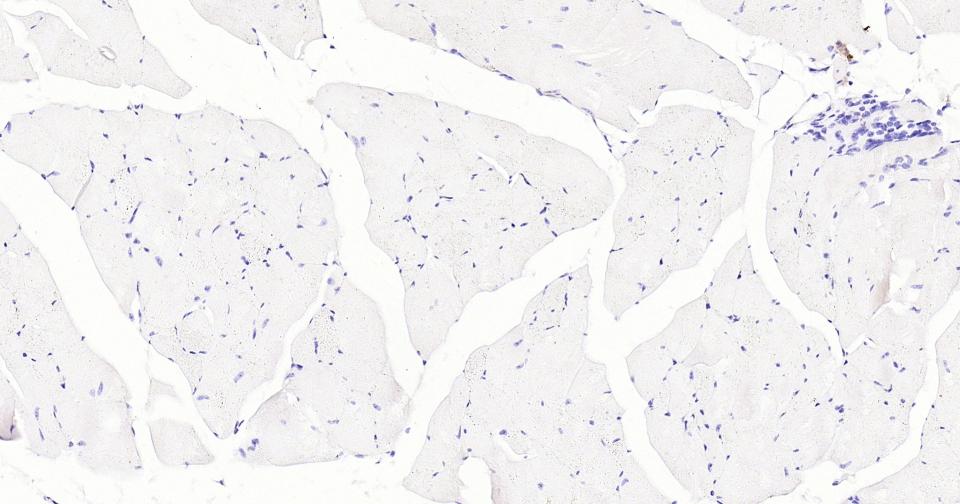
- 产品详情
- 实验流程
- 背景知识
Application 
| WB, IHC-P, IHC-F, IF |
|---|---|
| Primary Accession | A2ARV4 |
| Reactivity | Rat, Human, Mouse |
| Host | Rabbit |
| Clonality | Recombinant |
| Calculated MW | 519208 Da |
| Physical State | Liquid |
| Immunogen | Recombinant mouse LRP2 protein |
| Epitope Specificity | 4551-4660/4660 |
| Isotype | IgG |
| Purity | affinity purified by Protein A |
| Buffer | 0.01M TBS (pH7.4) with 1% BSA, 0.02% Proclin300 and 50% Glycerol. |
| SUBCELLULAR LOCATION | Membrane; Single-pass type I membrane protein. Membrane, coated pit. |
| DISEASE | Defects in LRP2 are the cause of Donnai-Barrow syndrome (DBS) [MIM:222448]; also known as faciooculoacousticorenal syndrome (FOAR syndrome). DBS is a rare autosomal recessive disorder characterized by major malformations including agenesis of the corpus callosum, congenital diaphragmatic hernia, facial dysmorphology, ocular anomalies, sensorineural hearing loss and developmental delay. The FOAR syndrome was first described as comprising facial anomalies, ocular anomalies, sensorineural hearing loss, and proteinuria. DBS and FOAR were first described as distinct disorders but the classic distinguishing features between the 2 disorders were presence of proteinuria and absence of diaphragmatic hernia and corpus callosum anomalies in FOAR. Early reports noted that the 2 disorders shared many phenotypic features and may be identical. Although there is variability in the expression of some features (e.g. agenesis of the corpus callosum and proteinuria), DBS and FOAR are now considered to represent the same entity. |
| Important Note | This product as supplied is intended for research use only, not for use in human, therapeutic or diagnostic applications. |
| Background Descriptions | The protein encoded by this gene, low density lipoprotein-related protein 2 (LRP2) or megalin, is a multi-ligand endocytic receptor that is expressed in many different tissues but primarily in absorptive epithilial tissues such as the kidney. This glycoprotein has a large amino-terminal extracellular domain, a single transmembrane domain, and a short carboxy-terminal cytoplasmic tail. The extracellular ligand-binding-domains bind diverse macromolecules including albumin, apolipoproteins B and E, and lipoprotein lipase. The LRP2 protein is critical for the reuptake of numerous ligands, including lipoproteins, sterols, vitamin-binding proteins, and hormones. This protein also has a role in cell-signaling; extracellular ligands include parathyroid horomones and the morphogen sonic hedgehog while cytosolic ligands include MAP kinase scaffold proteins and JNK interacting proteins. Recycling of this membrane receptor is regulated by phosphorylation of its cytoplasmic domain. Mutations in this gene cause Donnai-Barrow syndrome (DBS) and facio-oculoacoustico-renal syndrome (FOAR).[provided by RefSeq, Aug 2009]. |
| Gene ID | 14725 |
|---|---|
| Other Names | Low-density lipoprotein receptor-related protein 2, LRP-2, Glycoprotein 330, gp330, Megalin, Lrp2 |
| Dilution | IHC-P=1:100-500,WB=1:500-2000,IF=1:100-500,IHC-F=1:100-500,ICC/IF=1:50-200 |
| Storage | Store at -20 °C for one year. Avoid repeated freeze/thaw cycles. When reconstituted in sterile pH 7.4 0.01M PBS or diluent of antibody the antibody is stable for at least two weeks at 2-4 °C. |
For Research Use Only. Not For Use In Diagnostic Procedures.
| Name | Lrp2 |
|---|---|
| Function | Multiligand endocytic receptor. Acts together with CUBN to mediate endocytosis of high-density lipoproteins (PubMed:10766831). Mediates receptor-mediated uptake of polybasic drugs such as aprotinin, aminoglycosides and polymyxin B (By similarity). In the kidney, mediates the tubular uptake and clearance of leptin (PubMed:22841573). Also mediates transport of leptin across the blood-brain barrier through endocytosis at the choroid plexus epithelium (By similarity). Endocytosis of leptin in neuronal cells is required for hypothalamic leptin signaling and leptin-mediated regulation of feeding and body weight (PubMed:24825475). Mediates endocytosis and subsequent lysosomal degradation of CST3 in kidney proximal tubule cells (PubMed:17462596). Mediates renal uptake of 25-hydroxyvitamin D3 in complex with the vitamin D3 transporter GC/DBP (PubMed:10052453). Mediates renal uptake of metallothionein-bound heavy metals (By similarity). Together with CUBN, mediates renal reabsorption of myoglobin (By similarity). Mediates renal uptake and subsequent lysosomal degradation of APOM (By similarity). Plays a role in kidney selenium homeostasis by mediating renal endocytosis of selenoprotein SEPP1 (PubMed:18174160). Mediates renal uptake of the antiapoptotic protein BIRC5/survivin which may be important for functional integrity of the kidney (PubMed:23825075). Mediates renal uptake of matrix metalloproteinase MMP2 in complex with metalloproteinase inhibitor TIMP1 (PubMed:28659595). Mediates endocytosis of Sonic hedgehog protein N-product (ShhN), the active product of SHH (By similarity). Also mediates ShhN transcytosis (By similarity). In the embryonic neuroepithelium, mediates endocytic uptake and degradation of BMP4, is required for correct SHH localization in the ventral neural tube and plays a role in patterning of the ventral telencephalon (PubMed:15623804). Required at the onset of neurulation to sequester SHH on the apical surface of neuroepithelial cells of the rostral diencephalon ventral midline and to control PTCH1-dependent uptake and intracellular trafficking of SHH (PubMed:22340494). During neurulation, required in neuroepithelial cells for uptake of folate bound to the folate receptor FOLR1 which is necessary for neural tube closure (PubMed:24639464). In the adult brain, negatively regulates BMP signaling in the subependymal zone which enables neurogenesis to proceed (PubMed:20460439). In astrocytes, mediates endocytosis of ALB which is required for the synthesis of the neurotrophic factor oleic acid (By similarity). Involved in neurite branching (PubMed:20637285). During optic nerve development, required for SHH-mediated migration and proliferation of oligodendrocyte precursor cells (PubMed:22354480). Mediates endocytic uptake and clearance of SHH in the retinal margin which protects retinal progenitor cells from mitogenic stimuli and keeps them quiescent (PubMed:26439398). Plays a role in reproductive organ development by mediating uptake in reproductive tissues of androgen and estrogen bound to the sex hormone binding protein SHBG (PubMed:16143106). Mediates endocytosis of angiotensin-2 (By similarity). Also mediates endocytosis of angiotensin 1-7 (By similarity). Binds to the complex composed of beta-amyloid protein 40 and CLU/APOJ and mediates its endocytosis and lysosomal degradation (By similarity). Required for embryonic heart development (PubMed:26822476). Required for normal hearing, possibly through interaction with estrogen in the inner ear (PubMed:17846082). |
| Cellular Location | Apical cell membrane; Single-pass type I membrane protein. Endosome lumen {ECO:0000250|UniProtKB:P98158}. Membrane, coated pit. Cell projection, dendrite. Cell projection, axon. Note=Localizes to brush border membranes in the kidney. In the endolymphatic sac of the inner ear, located in the lumen of endosomes as a soluble form {ECO:0000250|UniProtKB:P98158} |
| Tissue Location | In the inner ear, strongly expressed in the marginal cells of the stria vascularis (at protein level) (PubMed:17846082). In the female reproductive tract, expressed on the luminal side of the uterine epithelium (at protein level) (PubMed:16143106). In the adult brain, expressed in ependymal cells of the lateral ventricles where expression is restricted to the ependyma that faces the stem cell niche (at protein level) (PubMed:20460439) Expressed in neurons throughout the brain including in the hippocampus, limbic cortices and cerebellum (at protein level) (PubMed:20637285). In the developing optic nerve, expressed exclusively in astrocytes at 14.5 dpc, 16.5 dpc and 18.5 dpc (at protein level) (PubMed:22354480) |
Research Areas
Application Protocols
Provided below are standard protocols that you may find useful for product applications.
BACKGROUND
This product as supplied is intended for research use only, not for use in human, therapeutic or diagnostic applications.

终于等到您。ABCEPTA(百远生物)抗体产品。
点击下方“我要评价 ”按钮提交您的反馈信息,您的反馈和评价是我们最宝贵的财富之一,
我们将在1-3个工作日内处理您的反馈信息。
如有疑问,联系:0512-88856768 tech-china@abcepta.com.


