


 癌症的基本特征包括细胞增殖、血管生成、迁移、凋亡逃避机制和细胞永生等。找到癌症发生过程中这些通路的关键标记物和对应的抗体用于检测至关重要。
 为您推荐一个泛素化位点预测神器——泛素化分析工具,可以为您的蛋白的泛素化位点作出预测和评分。
 细胞自噬受体图形绘图工具为你的蛋白的细胞受体结合位点作出预测和评分,识别结合到自噬通路中的蛋白是非常重要的,便于让我们理解自噬在正常生理、病理过程中的作用,如发育、细胞分化、神经退化性疾病、压力条件下、感染和癌症。
TL1A Antibody
- 产品详情
- 实验流程
- 背景知识
Application 
| WB, E |
|---|---|
| Primary Accession | O95150 |
| Other Accession | AAM77366, 21745392 |
| Reactivity | Human, Mouse, Rat |
| Host | Rabbit |
| Clonality | Polyclonal |
| Isotype | IgG |
| Calculated MW | 28087 Da |
| Concentration (mg/ml) | 1 mg/mL |
| Conjugate | Unconjugated |
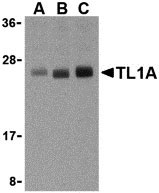
| Application Notes | TL1A antibody can be used for detection of TL1A by Western blot at 0.5 to 2 µg/mL. |
| Gene ID | 9966 |
|---|---|
| Other Names | TL1A Antibody: TL1, TL1A, VEGI, VEGI192A, TL1, Tumor necrosis factor ligand superfamily member 15, TNF ligand-related molecule 1, tumor necrosis factor (ligand) superfamily, member 15 |
| Target/Specificity | TNFSF15; This polyclonal antibody will not cross-react with TL1. |
| Reconstitution & Storage | TL1A antibody can be stored at 4℃ for three months and -20℃, stable for up to one year. As with all antibodies care should be taken to avoid repeated freeze thaw cycles. Antibodies should not be exposed to prolonged high temperatures. |
| Precautions | TL1A Antibody is for research use only and not for use in diagnostic or therapeutic procedures. |
For Research Use Only. Not For Use In Diagnostic Procedures.
| Name | TNFSF15 |
|---|---|
| Synonyms | TL1, TL1A {ECO:0000303|PubMed:21300286}, |
| Function | Cytokine that signals through TNFRSF25 receptor (PubMed:11911831). Functions as a T-cell costimulator, that increases IL-2 responsiveness and secretion of proinflammatory cytokines which enhances T-cell activation, proliferation and the survival of activated T-cells (PubMed:10597252, PubMed:11911831). Inhibits vascular endothelial growth and angiogenesis (in vitro) (PubMed:11923219, PubMed:9872942). Binds to the decoy receptor TNFRSF6B, blocking the activation normally triggered by TNFSF15 and leading to decreased T- cell activation and reduced inflammation (PubMed:21300286). |
| Cellular Location | Membrane; Single-pass type II membrane protein |
| Tissue Location | Specifically expressed in endothelial cells. Detected in monocytes, placenta, lung, liver, kidney, skeletal muscle, pancreas, spleen, prostate, small intestine and colon |
Provided below are standard protocols that you may find useful for product applications.
BACKGROUND
TL1A Antibody: Members in the TNF and its receptor superfamilies regulate immune responses and induce apoptosis. DR3 (also termed Wsl-1, Apo-3, TRAMP, and LARD) is preferentially expressed by T lymphocytes and upregulated during T cell activation. The ligand for DR3 was recently identified and designated TL1A. TL1A also binds decoy receptor DcR3/TR6, which is expressed in several lung and colon carcinomas and in some normal tissues. TL1A induces apoptosis and NF-κB activation in DR3 expressing cells, which is antagonized by DcR3. TL1A is upregulated by proinflammatory cytokines TNF and IL-1. TL1A is a longer variant of TL1 (also called VEGI).
REFERENCES
Chinnayan AM, O’Rourke K, Yu GL, et al. Signal transduction by DR3, a death domain-containing receptor related to TNFR-1 and CD95. Science 1996; 274:990-2.
Kitson J, Raven T, Jiang YP, et al. A death-domain-containing receptor that mediates apoptosis. Nature 1996; 384:372-5.
Screaton GR, Xu XN, Olsen AL, et al. LARD: a new lymphoid-specific death domain containing receptor regulated by pre-mRNA splicing. Proc. Natl. Acad. Sci. USA 1997; 94:4615-9.
Bodmer JL, Burns K, Schneider P. TRAMP, a novel apoptosis-mediating receptor with sequence homology to tumor necrosis factor receptor 1 and Fas (Apo-1/CD95). Immunity 1997; 6:79-88.

终于等到您。ABCEPTA(百远生物)抗体产品。
点击下方“我要评价 ”按钮提交您的反馈信息,您的反馈和评价是我们最宝贵的财富之一,
我们将在1-3个工作日内处理您的反馈信息。
如有疑问,联系:0512-88856768 tech-china@abcepta.com.


