


 癌症的基本特征包括细胞增殖、血管生成、迁移、凋亡逃避机制和细胞永生等。找到癌症发生过程中这些通路的关键标记物和对应的抗体用于检测至关重要。
 为您推荐一个泛素化位点预测神器——泛素化分析工具,可以为您的蛋白的泛素化位点作出预测和评分。
 细胞自噬受体图形绘图工具为你的蛋白的细胞受体结合位点作出预测和评分,识别结合到自噬通路中的蛋白是非常重要的,便于让我们理解自噬在正常生理、病理过程中的作用,如发育、细胞分化、神经退化性疾病、压力条件下、感染和癌症。
LAMP-2 Antibody
- 产品详情
- 实验流程
- 背景知识
Application 
| WB, ICC, E |
|---|---|
| Primary Accession | P17047 |
| Other Accession | NP_054701, 31543108 |
| Reactivity | Human, Mouse |
| Host | Rabbit |
| Clonality | Polyclonal |
| Isotype | IgG |
| Calculated MW | 45681 Da |
| Concentration (mg/ml) | 1 mg/mL |
| Conjugate | Unconjugated |
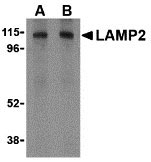
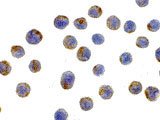
| Application Notes | LAMP-2 antibody can be used for the detection of LAMP-2 by Western blot at 1 - 2 µg/mL. Antibody can also be used for immunocytochemistry starting at 10 µg/mL. |
| Gene ID | 16784 |
|---|---|
| Other Names | LAMP-2 Antibody: Mac3, LGP-B, CD107b, Lamp-2, Lamp II, Lamp-2a, Lamp-2b, Lamp-2c, Lysosome-associated membrane glycoprotein 2, CD107 antigen-like family member B, LAMP-2, lysosomal-associated membrane protein 2 |
| Target/Specificity | Lamp2; |
| Reconstitution & Storage | LAMP-2 antibody can be stored at 4℃ for three months and -20℃, stable for up to one year. As with all antibodies care should be taken to avoid repeated freeze thaw cycles. Antibodies should not be exposed to prolonged high temperatures. |
| Precautions | LAMP-2 Antibody is for research use only and not for use in diagnostic or therapeutic procedures. |
For Research Use Only. Not For Use In Diagnostic Procedures.
| Name | Lamp2 |
|---|---|
| Synonyms | Lamp-2 |
| Function | Lysosomal membrane glycoprotein which plays an important role in lysosome biogenesis, lysosomal pH regulation and autophagy (PubMed:10972293, PubMed:30718432). Acts as an important regulator of lysosomal lumen pH regulation by acting as a direct inhibitor of the proton channel TMEM175, facilitating lysosomal acidification for optimal hydrolase activity (By similarity). Plays an important role in chaperone-mediated autophagy, a process that mediates lysosomal degradation of proteins in response to various stresses and as part of the normal turnover of proteins with a long biological half-live (PubMed:30718432). Functions by binding target proteins, such as GAPDH, GPX4, NLRP3 and MLLT11, and targeting them for lysosomal degradation (PubMed:30718432). In the chaperone-mediated autophagy, acts downstream of chaperones, such as HSPA8/HSC70, which recognize and bind substrate proteins and mediate their recruitment to lysosomes, where target proteins bind LAMP2 (By similarity). Plays a role in lysosomal protein degradation in response to starvation (PubMed:27628032). Required for the fusion of autophagosomes with lysosomes during autophagy (PubMed:27628032). Cells that lack LAMP2 express normal levels of VAMP8, but fail to accumulate STX17 on autophagosomes, which is the most likely explanation for the lack of fusion between autophagosomes and lysosomes (PubMed:27628032). Required for normal degradation of the contents of autophagosomes (PubMed:10972293, PubMed:12221139). Required for efficient MHC class II-mediated presentation of exogenous antigens via its function in lysosomal protein degradation; antigenic peptides generated by proteases in the endosomal/lysosomal compartment are captured by nascent MHC II subunits (By similarity). Is not required for efficient MHC class II-mediated presentation of endogenous antigens (By similarity). |
| Cellular Location | Lysosome membrane; Single-pass type I membrane protein {ECO:0000255|PROSITE-ProRule:PRU00740}. Endosome membrane {ECO:0000250|UniProtKB:P13473}; Single-pass type I membrane protein {ECO:0000255|PROSITE-ProRule:PRU00740}. Cytoplasmic vesicle, autophagosome membrane. Cell membrane {ECO:0000250|UniProtKB:P13473}; Single-pass type I membrane protein {ECO:0000255|PROSITE-ProRule:PRU00740}. Note=This protein shuttles between lysosomes, endosomes, and the plasma membrane {ECO:0000250|UniProtKB:P13473} |
| Tissue Location | Detected in liver and kidney (at protein level). Detected in liver and kidney. |
Provided below are standard protocols that you may find useful for product applications.
BACKGROUND
LAMP-2 Antibody: Autophagy, the process of bulk degradation of cellular proteins through an autophagosomic-lysosomal pathway is important for normal growth control and may be defective in tumor cells. It is involved in the preservation of cellular nutrients under starvation conditions as well as the normal turnover of cytosolic components and is negatively regulated by TOR (Target of rapamycin). LAMP-2, a highly glycosylated protein associated with the lysosome, has recently been shown to be important in autophagy as mice deficient in this protein failed to convert autophagic vacuoles into vacuoles leading to impaired degradation of long-lived proteins. This correlates with the finding that human LAMP-2 deficiency causing Danon's disease is associated with the accumulation of autophagic material in striated myocytes. LAMP-2 exists in multiple isoforms.
REFERENCES
Gozuacik D and Kimchi A. Autophagy as a cell death and tumor suppressor mechanism. Oncogene. 2004; 23:2891-906.
Kisen GO, Tessitore L, Costelli P, et al. Reduced autophagic activity in primary rat hepatocellular carcinoma and ascites hepatoma cells. Carcinogenesis1993; 14:2501-5.
Kamada Y, Funakoshi T, Shintani T, et al. Tor-mediated induction of autophagy via Apg1 protein kinase complex. J. Cell. Biol.2000; 150:1507-13.
Granger BL, Green SA, Gabel CA, et al. Characterization and cloning of the lgp110, a lysosomal glycoprotein from mouse and rat cells. J. Biol. Chem.1990; 265:12036-43.

终于等到您。ABCEPTA(百远生物)抗体产品。
点击下方“我要评价 ”按钮提交您的反馈信息,您的反馈和评价是我们最宝贵的财富之一,
我们将在1-3个工作日内处理您的反馈信息。
如有疑问,联系:0512-88856768 tech-china@abcepta.com.


