


 癌症的基本特征包括细胞增殖、血管生成、迁移、凋亡逃避机制和细胞永生等。找到癌症发生过程中这些通路的关键标记物和对应的抗体用于检测至关重要。
 为您推荐一个泛素化位点预测神器——泛素化分析工具,可以为您的蛋白的泛素化位点作出预测和评分。
 细胞自噬受体图形绘图工具为你的蛋白的细胞受体结合位点作出预测和评分,识别结合到自噬通路中的蛋白是非常重要的,便于让我们理解自噬在正常生理、病理过程中的作用,如发育、细胞分化、神经退化性疾病、压力条件下、感染和癌症。
TRPC6 Antibody
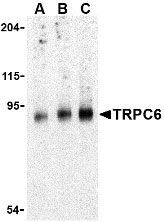
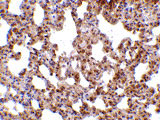
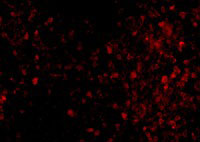
- 产品详情
- 实验流程
- 背景知识
Application 
| WB, IF, E, IHC-P |
|---|---|
| Primary Accession | Q9Y210 |
| Other Accession | AAH93658, 62739910 |
| Reactivity | Human, Mouse, Rat |
| Host | Rabbit |
| Clonality | Polyclonal |
| Isotype | IgG |
| Calculated MW | 106326 Da |
| Concentration (mg/ml) | 1 mg/mL |
| Conjugate | Unconjugated |
| Application Notes | TRPC6 antibody can be used for the detection of TRPC6 by Western blot at 0.5 - 2 µg/mL. Antibody can also be used for immunohistochemistry starting at 10 µg/mL. For immunofluorescence start at 20 µg/mL. |
| Gene ID | 7225 |
|---|---|
| Other Names | TRPC6 Antibody: TRP6, FSGS2, TRP6, Short transient receptor potential channel 6, Transient receptor protein 6, TrpC6, transient receptor potential cation channel, subfamily C, member 6 |
| Target/Specificity | TRPC6; This antibody may cross-react with TRPC3. |
| Reconstitution & Storage | TRPC6 antibody can be stored at 4℃ for three months and -20℃, stable for up to one year. As with all antibodies care should be taken to avoid repeated freeze thaw cycles. Antibodies should not be exposed to prolonged high temperatures. |
| Precautions | TRPC6 Antibody is for research use only and not for use in diagnostic or therapeutic procedures. |
For Research Use Only. Not For Use In Diagnostic Procedures.
| Name | TRPC6 {ECO:0000303|PubMed:9930701, ECO:0000312|HGNC:HGNC:12338} |
|---|---|
| Function | Non-selective, calcium-permeable cation channel (PubMed:19936226, PubMed:23291369, PubMed:26892346, PubMed:9930701). Mediates calcium entry following G(q)-coupled receptor or receptor tyrosine kinase activation, which triggers phospholipase C (PLC)- mediated hydrolysis of phosphatidylinositides and production of diacylglycerol (DAG) that directly activates TRPC6 (PubMed:26892346). Does not appear to be activated by depletion of intracellular calcium stores (PubMed:9930701). Mediates depolarization of intrinsically photosensitive retinal ganglion cells (ipRGCs) in response to light- induced melanopsin (OPN4)-mediated phototransduction via G(q)-PLC signaling, likely by forming heteromeric TRPC6-TRPC7 channels (By similarity). |
| Cellular Location | Cell membrane; Multi-pass membrane protein |
| Tissue Location | Expressed primarily in placenta, lung, spleen, ovary and small intestine. Expressed in podocytes and is a component of the glomerular slit diaphragm. |
Provided below are standard protocols that you may find useful for product applications.
BACKGROUND
TRPC6 Antibody: The mammalian transient receptor potential (TRP) superfamily can be divided into three major families including the "canonical TRP" (TRPC) family. The seven members of this family share the activation through PLC-coupled receptors and have been suggested to be components of receptor-regulated cation channels in different cell types. Furthermore, the members of the TRPC6/6/7 subfamily can be activated by diacylglycerol (DAG) analogs, suggesting a possible mechanism of activation of these channels by PLC-coupled receptors. When expressed in transfected cells, TRPC6 acts as a non-selective store-independent receptor-activated cation channel. It is activated by DAG in a PKC-independent manner and is insensitive to IP3 activation. There is increasing evidence that TRPC6 encodes endogenous DAG-activated receptor-operated cation channels in vivo.
REFERENCES
Contell C, Birnbaumer V, Flockerzi V, et al. A unified nomenclature for the superfamily of TRP cation channels. Mol. Cell 2002; 9:229-31.
Dietrich A, Kalwa H, Rost BR, et al. The diacylglycerol-sensitive TRPC6/6/7 subfamily of cation channels: functional characterization and physiological relevance. Pflugers Arch. 2005; 451:72-80.
Trebak M, Vazquez G, Bird GSJ, et al. The TRPC6/6/7 subfamily of cation channels. Cell Calcium 2003; 33:451-61

终于等到您。ABCEPTA(百远生物)抗体产品。
点击下方“我要评价 ”按钮提交您的反馈信息,您的反馈和评价是我们最宝贵的财富之一,
我们将在1-3个工作日内处理您的反馈信息。
如有疑问,联系:0512-88856768 tech-china@abcepta.com.


