


 癌症的基本特征包括细胞增殖、血管生成、迁移、凋亡逃避机制和细胞永生等。找到癌症发生过程中这些通路的关键标记物和对应的抗体用于检测至关重要。
 为您推荐一个泛素化位点预测神器——泛素化分析工具,可以为您的蛋白的泛素化位点作出预测和评分。
 细胞自噬受体图形绘图工具为你的蛋白的细胞受体结合位点作出预测和评分,识别结合到自噬通路中的蛋白是非常重要的,便于让我们理解自噬在正常生理、病理过程中的作用,如发育、细胞分化、神经退化性疾病、压力条件下、感染和癌症。
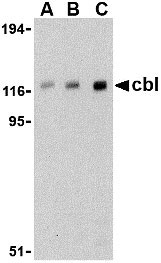
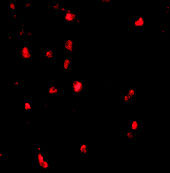
Cbl Antibody
- 产品详情
- 实验流程
- 背景知识
Application 
| WB, IF, E |
|---|---|
| Primary Accession | P22681 |
| Other Accession | P22681, 115855 |
| Reactivity | Human, Mouse, Rat |
| Host | Rabbit |
| Clonality | Polyclonal |
| Isotype | IgG |
| Calculated MW | 99633 Da |
| Concentration (mg/ml) | 1 mg/mL |
| Conjugate | Unconjugated |
| Application Notes | Cbl antibody can be used for detection of cbl by Western blot at 0.5 - 2 µg/mL. Antibody can also be used for immunoflourescence starting at 20 µg/mL. |
| Gene ID | 867 |
|---|---|
| Other Names | Cbl Antibody: CBL2, NSLL, C-CBL, RNF55, FRA11B, CBL2, E3 ubiquitin-protein ligase CBL, Casitas B-lineage lymphoma proto-oncogene, Cas-Br-M (murine) ecotropic retroviral transforming sequence |
| Target/Specificity | CBL; |
| Reconstitution & Storage | Cbl antibody can be stored at 4℃ for three months and -20℃, stable for up to one year. As with all antibodies care should be taken to avoid repeated freeze thaw cycles. Antibodies should not be exposed to prolonged high temperatures. |
| Precautions | Cbl Antibody is for research use only and not for use in diagnostic or therapeutic procedures. |
For Research Use Only. Not For Use In Diagnostic Procedures.
| Name | CBL |
|---|---|
| Synonyms | CBL2, RNF55 |
| Function | E3 ubiquitin-protein ligase that acts as a negative regulator of many signaling pathways by mediating ubiquitination of cell surface receptors (PubMed:10514377, PubMed:11896602, PubMed:14661060, PubMed:14739300, PubMed:15190072, PubMed:17509076, PubMed:18374639, PubMed:19689429, PubMed:21596750, PubMed:28381567, PubMed:40101708). Accepts ubiquitin from specific E2 ubiquitin-conjugating enzymes, and then transfers it to substrates promoting their degradation by the proteasome (PubMed:10514377, PubMed:14661060, PubMed:14739300, PubMed:17094949, PubMed:17509076, PubMed:17974561). Recognizes activated receptor tyrosine kinases, including KIT, FLT1, FGFR1, FGFR2, PDGFRA, PDGFRB, CSF1R, EPHA8 and KDR and mediates their ubiquitination to terminate signaling (PubMed:15190072, PubMed:18374639, PubMed:21596750). Recognizes membrane-bound HCK, SRC and other kinases of the SRC family and mediates their ubiquitination and degradation (PubMed:11896602). Ubiquitinates EGFR and SPRY2 (PubMed:17094949, PubMed:17974561). Involved in LAG3-mediated inhibition of TCR signaling: following ligand-binding to LAG3, catalyzes 'Lys-63'-linked ubiquitination of LAG3, unleashing the LAG3 C-terminus from the membrane, and initiating a signaling that prevents TCR activation (PubMed:40101708). Ubiquitinates NECTIN1 following association between NECTIN1 and herpes simplex virus 1/HHV-1 envelope glycoprotein D, leading to NECTIN1 removal from cell surface (PubMed:28381567). Participates in signal transduction in hematopoietic cells. Plays an important role in the regulation of osteoblast differentiation and apoptosis (PubMed:15190072, PubMed:18374639). Essential for osteoclastic bone resorption (PubMed:14739300). The 'Tyr-731' phosphorylated form induces the activation and recruitment of phosphatidylinositol 3-kinase to the cell membrane in a signaling pathway that is critical for osteoclast function (PubMed:14739300). In association with CBLB, required for proper feedback inhibition of ciliary platelet-derived growth factor receptor-alpha (PDGFRA) signaling pathway via ubiquitination and internalization of PDGFRA (By similarity). |
| Cellular Location | Cytoplasm. Cell membrane. Cell projection, cilium. Golgi apparatus. Note=Colocalizes with FGFR2 in lipid rafts at the cell membrane |
Provided below are standard protocols that you may find useful for product applications.
BACKGROUND
Cbl Antibody: The mammalian cbl family of ubiquitin ligases consists of three homologs known as cbl (also known as c-Cbl), Cbl-B, and Cbl-3 which share highly conserved a tyrosine-kinase-binding domain, linker and RING finger domain in their amino-terminal halves. Similar to other E3 ubiquitin ligases, Cbl catalyzes the transfer of ubiquitin from an E2 or Ubc (ubiquitin-conjugating) enzyme to the e-amino group of a lysine residue of the substrate protein. Cbl acts to negatively regulate many types of cell-surface receptors, including the Syk protein tyrosine kinase family. Cbl is thought to be involved in T- and B-cell signaling, in addition to thymus development. Of the three known homologs in the cbl family, cbl antibody reacts specifically with cbl. Multiple isoforms of cbl have been reported.
REFERENCES
Thien CBF and Langdon WY. C-Cbl and Cbl-b ubiquitin ligases: substrate diversity and the negative regulation of signaling responses. Biochem. J. 2005; 391:153-66
Weissman AM. Themes and variations on ubiquitylation. Nat. Rev. Mol. Cell Biol. 2001; 2:169-78.
Swaminathan G and Tsygankov AY. The Cbl family of proteins: ring leaders in regulation of cell signaling. J. Cell. Physiol. 2006; 209:21-43.

终于等到您。ABCEPTA(百远生物)抗体产品。
点击下方“我要评价 ”按钮提交您的反馈信息,您的反馈和评价是我们最宝贵的财富之一,
我们将在1-3个工作日内处理您的反馈信息。
如有疑问,联系:0512-88856768 tech-china@abcepta.com.


