


 癌症的基本特征包括细胞增殖、血管生成、迁移、凋亡逃避机制和细胞永生等。找到癌症发生过程中这些通路的关键标记物和对应的抗体用于检测至关重要。
 为您推荐一个泛素化位点预测神器——泛素化分析工具,可以为您的蛋白的泛素化位点作出预测和评分。
 细胞自噬受体图形绘图工具为你的蛋白的细胞受体结合位点作出预测和评分,识别结合到自噬通路中的蛋白是非常重要的,便于让我们理解自噬在正常生理、病理过程中的作用,如发育、细胞分化、神经退化性疾病、压力条件下、感染和癌症。
IL-33 Antibody
- 产品详情
- 实验流程
- 背景知识
Application 
| WB, IF, E |
|---|---|
| Primary Accession | O95760 |
| Other Accession | NP_254274, 15559209 |
| Reactivity | Human |
| Host | Rabbit |
| Clonality | Polyclonal |
| Isotype | IgG |
| Calculated MW | 30759 Da |
| Concentration (mg/ml) | 1 mg/mL |
| Conjugate | Unconjugated |
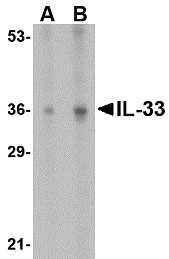
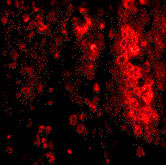
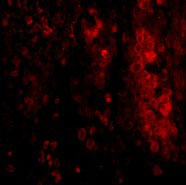
| Application Notes | IL-33 antibody can be used for the detection of IL-33 by Western blot at 1 - 2 µg/mL. Despite its predicted molecular weight, IL-33 will often run at higher molecular weight in SDS-PAGE. Antibody can also be used for immunocytochemistry starting at 20 µg/mL. For immunofluorescence start at 20 µg/mL. |
| Gene ID | 90865 |
|---|---|
| Other Names | Interleukin-33, IL-33, Interleukin-1 family member 11, IL-1F11, Nuclear factor from high endothelial venules, NF-HEV, Interleukin-33 (95-270), Interleukin-33 (99-270), Interleukin-33 (109-270), IL33, C9orf26, IL1F11, NFHEV |
| Target/Specificity | IL33; |
| Reconstitution & Storage | IL-33 antibody can be stored at 4℃ for three months and -20℃, stable for up to one year. As with all antibodies care should be taken to avoid repeated freeze thaw cycles. Antibodies should not be exposed to prolonged high temperatures. |
| Precautions | IL-33 Antibody is for research use only and not for use in diagnostic or therapeutic procedures. |
For Research Use Only. Not For Use In Diagnostic Procedures.
| Name | IL33 (HGNC:16028) |
|---|---|
| Synonyms | C9orf26, IL1F11, NFHEV |
| Function | Cytokine that binds to and signals through the IL1RL1/ST2 receptor which in turn activates NF-kappa-B and MAPK signaling pathways in target cells (PubMed:16286016, PubMed:19841166). Involved in the maturation of Th2 cells inducing the secretion of T-helper type 2- associated cytokines (PubMed:17853410, PubMed:18836528). Also involved in activation of mast cells, basophils, eosinophils and natural killer cells (PubMed:17853410, PubMed:18836528). Acts as an enhancer of polarization of alternatively activated macrophages (PubMed:19841166). Acts as a chemoattractant for Th2 cells, and may function as an 'alarmin', that amplifies immune responses during tissue injury (PubMed:17853410, PubMed:18836528). Induces rapid UCP2-dependent mitochondrial rewiring that attenuates the generation of reactive oxygen species and preserves the integrity of Krebs cycle required for persistent production of itaconate and subsequent GATA3-dependent differentiation of inflammation-resolving alternatively activated macrophages (By similarity). |
| Cellular Location | Nucleus. Chromosome. Cytoplasm Cytoplasmic vesicle, secretory vesicle Secreted Note=Secreted and released in the extracellular milieu by passing through the gasdermin-D (GSDMD) pore following cleavage by CELA1 (PubMed:35794369). Associates with heterochromatin and mitotic chromosomes (PubMed:17185418). The secretion is dependent on protein unfolding and facilitated by the cargo receptor TMED10; it results in protein translocation from the cytoplasm into the ERGIC (endoplasmic reticulum-Golgi intermediate compartment) followed by vesicle entry and secretion (PubMed:32272059). |
| Tissue Location | Expressed at high level in high endothelial venules found in tonsils, Peyer patches and mesenteric lymph nodes. Almost undetectable in placenta. |
Provided below are standard protocols that you may find useful for product applications.
BACKGROUND
IL-33 Antibody: Interleukin-33 (IL-33) is a recently identified member of the IL-1 family of cytokines whose other members include IL-1α/beta, IL-1Ra and IL-18. Its receptor has been shown to be ST2, an IL-1 receptor family member that also acts as a negative regulator of TLR-IL-1R signaling and IL-1R accessory protein (IL-1RAcP). Receptor binding of IL-33 activates NF-κB and MAP kinases and induces the expression of TH2-associated cytokines such as IL-4, IL-5 and IL-6. Prolonged IL-33 treatment of mice led to the development of eosinophilia, splenomegaly, and severe pathological changes in mucosal organs such as lungs, esophagus and small intestine. Recent experiments have shown that IL-33 can also co-localize with heterochromatin and possesses transcriptional repressor activities, indicating that IL-33 may function as both a proinflammatory cytokine and an intracellular nuclear factor with transcriptional regulatory properties.
REFERENCES
Schmitz J, Owyang A, Oldham E, et al. IL-33, and interleukin-1-like cytokine that signals via the IL-1 receptor-related protein ST2 and induces T helper type 2-associated cytokines. Immunity2005; 23:479-90.
Dinarello CA. Interleukin-18, a proinflammatory cytokine. Eur. Cytokine Netw.2000; 11:483-6.
Brint EK, Xu D, Liu H, et al. ST2 is an inhibitor of interleukin 1 receptor and Toll-like receptor 4 signaling and maintains endotoxin tolerance. Nat. Immunol.2004; 5:373-9.
Chackerian AA, Oldham ER, Murphy EE, et al. IL-1 receptor accessory protein and ST2 comprise the IL-33 receptor complex. J. Immunol.2007; 179:2551-5.

终于等到您。ABCEPTA(百远生物)抗体产品。
点击下方“我要评价 ”按钮提交您的反馈信息,您的反馈和评价是我们最宝贵的财富之一,
我们将在1-3个工作日内处理您的反馈信息。
如有疑问,联系:0512-88856768 tech-china@abcepta.com.


