


 癌症的基本特征包括细胞增殖、血管生成、迁移、凋亡逃避机制和细胞永生等。找到癌症发生过程中这些通路的关键标记物和对应的抗体用于检测至关重要。
 为您推荐一个泛素化位点预测神器——泛素化分析工具,可以为您的蛋白的泛素化位点作出预测和评分。
 细胞自噬受体图形绘图工具为你的蛋白的细胞受体结合位点作出预测和评分,识别结合到自噬通路中的蛋白是非常重要的,便于让我们理解自噬在正常生理、病理过程中的作用,如发育、细胞分化、神经退化性疾病、压力条件下、感染和癌症。
BRCC36 Antibody
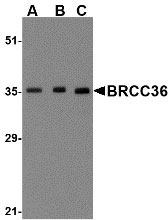
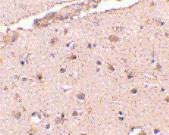
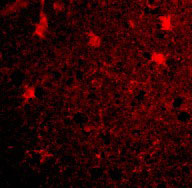
- 产品详情
- 实验流程
- 背景知识
Application 
| WB, IF, E, IHC-P |
|---|---|
| Primary Accession | P46736 |
| Other Accession | NP_077308, 13236583 |
| Reactivity | Human, Mouse, Rat |
| Host | Rabbit |
| Clonality | Polyclonal |
| Isotype | IgG |
| Calculated MW | 36072 Da |
| Concentration (mg/ml) | 1 mg/mL |
| Conjugate | Unconjugated |
| Application Notes | BRCC36 antibody can be used for detection of BRCC36 by Western blot at 0.5 - 2 µg/mL. Antibody can also be used for immunohistochemistry starting at 2.5 µg/mL. For immunofluorescence start at 20 µg/mL. |
| Gene ID | 79184 |
|---|---|
| Other Names | Lys-63-specific deubiquitinase BRCC36, 3.4.19.-, BRCA1-A complex subunit BRCC36, BRCA1/BRCA2-containing complex subunit 3, BRCA1/BRCA2-containing complex subunit 36, BRISC complex subunit BRCC36, BRCC3, BRCC36, C6.1A, CXorf53 |
| Target/Specificity | BRCC3; |
| Reconstitution & Storage | BRCC36 antibody can be stored at 4℃ for three months and -20℃, stable for up to one year. As with all antibodies care should be taken to avoid repeated freeze thaw cycles. Antibodies should not be exposed to prolonged high temperatures. |
| Precautions | BRCC36 Antibody is for research use only and not for use in diagnostic or therapeutic procedures. |
For Research Use Only. Not For Use In Diagnostic Procedures.
| Name | BRCC3 |
|---|---|
| Synonyms | BRCC36, C6.1A, CXorf53 |
| Function | Metalloprotease that specifically cleaves 'Lys-63'-linked polyubiquitin chains (PubMed:19214193, PubMed:20656690, PubMed:24075985, PubMed:26344097). Does not have activity toward 'Lys- 48'-linked polyubiquitin chains (PubMed:19214193, PubMed:20656690, PubMed:24075985, PubMed:26344097). Component of the BRCA1-A complex, a complex that specifically recognizes 'Lys-63'-linked ubiquitinated histones H2A and H2AX at DNA lesions sites, leading to target the BRCA1-BARD1 heterodimer to sites of DNA damage at double-strand breaks (DSBs) (PubMed:14636569, PubMed:16707425, PubMed:17525341, PubMed:19202061, PubMed:19261746, PubMed:19261748, PubMed:19261749). In the BRCA1-A complex, it specifically removes 'Lys-63'-linked ubiquitin on histones H2A and H2AX, antagonizing the RNF8-dependent ubiquitination at double-strand breaks (DSBs) (PubMed:20656690). Catalytic subunit of the BRISC complex, a multiprotein complex that specifically cleaves 'Lys-63'-linked ubiquitin in various substrates (PubMed:20656690, PubMed:24075985, PubMed:26195665, PubMed:26344097). Mediates the specific 'Lys-63'-specific deubiquitination associated with the COP9 signalosome complex (CSN), via the interaction of the BRISC complex with the CSN complex (PubMed:19214193). The BRISC complex is required for normal mitotic spindle assembly and microtubule attachment to kinetochores via its role in deubiquitinating NUMA1 (PubMed:26195665). Plays a role in interferon signaling via its role in the deubiquitination of the interferon receptor IFNAR1; deubiquitination increases IFNAR1 activity by enhancing its stability and cell surface expression (PubMed:24075985, PubMed:26344097). Acts as a regulator of the NLRP3 inflammasome by mediating deubiquitination of NLRP3, leading to NLRP3 inflammasome assembly (By similarity). Down- regulates the response to bacterial lipopolysaccharide (LPS) via its role in IFNAR1 deubiquitination (PubMed:24075985). Deubiquitinates HDAC1 and PWWP2B leading to their stabilization (By similarity). |
| Cellular Location | Nucleus. Cytoplasm. Cytoplasm, cytoskeleton, spindle pole Note=Localizes at sites of DNA damage at double-strand breaks (DSBs) (PubMed:20656690, PubMed:26344097). Interaction with ABRAXAS2 retains BRCC3 in the cytoplasm (PubMed:20656690). |
| Tissue Location | Heart, brain, placenta, lung, liver, skeletal muscle, kidney and pancreas. Aberrantly expressed in the vast majority of breast tumors. |
Provided below are standard protocols that you may find useful for product applications.
BACKGROUND
BRCC36 Antibody: Together with the breast and ovarian predisposition proteins BRCA1 and BRCA2 and RAD51 and BRCC45, BRCC36 forms a holoenzyme complex that possesses a ubiquitin E3 ligase activity. Aberrant levels of BRCC36 were detected in sporadic breast tumors and depletion of either BRCC36 or BRCC45 by siRNA resulted in increased sensitivity to ionizing radiation and defects in the G2/M checkpoint, indicating that BRCC36 acts to enhance cellular survival following DNA damage. Recent experiments have shown that BRCC36 is essential for ionizing radiation-induced BRCA1 phosphorylation and nuclear foci formation, suggesting that BRCC36 may be an important target in the treatment of radiation-resistant breast tumors. At least two isoforms of BRCC36 are known to exist.
REFERENCES
Dong Y, Hakimi MA, Chen X, et al. Regulation of BRCC, a holoenzyme complex containing BRCA1 and BRCA2, by a signalsome-like subunit and its role in DNA repair. Mol. Cell2003; 12:1087-99.
Chen X, Arciero CA, Wang C, et al. BRCC36 is essential for ionizing radiation-induced BRCA1 phosphorylation and nuclear foci formation. Cancer Res.2006; 66:5039-46.

终于等到您。ABCEPTA(百远生物)抗体产品。
点击下方“我要评价 ”按钮提交您的反馈信息,您的反馈和评价是我们最宝贵的财富之一,
我们将在1-3个工作日内处理您的反馈信息。
如有疑问,联系:0512-88856768 tech-china@abcepta.com.


