


 癌症的基本特征包括细胞增殖、血管生成、迁移、凋亡逃避机制和细胞永生等。找到癌症发生过程中这些通路的关键标记物和对应的抗体用于检测至关重要。
 为您推荐一个泛素化位点预测神器——泛素化分析工具,可以为您的蛋白的泛素化位点作出预测和评分。
 细胞自噬受体图形绘图工具为你的蛋白的细胞受体结合位点作出预测和评分,识别结合到自噬通路中的蛋白是非常重要的,便于让我们理解自噬在正常生理、病理过程中的作用,如发育、细胞分化、神经退化性疾病、压力条件下、感染和癌症。
SATB1 Antibody
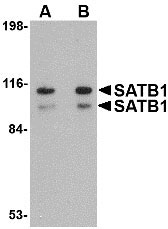
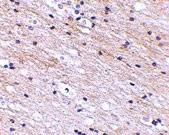
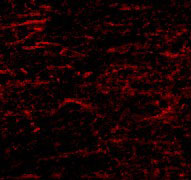
- 产品详情
- 实验流程
- 背景知识
Application 
| WB, IF, E, IHC-P |
|---|---|
| Primary Accession | Q01826 |
| Other Accession | Q01826, 417747 |
| Reactivity | Human, Mouse, Rat |
| Host | Rabbit |
| Clonality | Polyclonal |
| Isotype | IgG |
| Calculated MW | 85957 Da |
| Concentration (mg/ml) | 1 mg/mL |
| Conjugate | Unconjugated |
| Application Notes | SATB1 antibody can be used for detection of SATB1 by Western blot at 1 - 2 µg/mL. Antibody can also be used for immunohistochemistry starting at 2.5 µg/mL. For immunofluorescence start at 20 µg/mL. |
| Gene ID | 6304 |
|---|---|
| Other Names | DNA-binding protein SATB1, Special AT-rich sequence-binding protein 1, SATB1 |
| Target/Specificity | SATB1; |
| Reconstitution & Storage | SATB1 antibody can be stored at 4℃ for three months and -20℃, stable for up to one year. As with all antibodies care should be taken to avoid repeated freeze thaw cycles. Antibodies should not be exposed to prolonged high temperatures. |
| Precautions | SATB1 Antibody is for research use only and not for use in diagnostic or therapeutic procedures. |
For Research Use Only. Not For Use In Diagnostic Procedures.
| Name | SATB1 (HGNC:10541) |
|---|---|
| Function | Crucial silencing factor contributing to the initiation of X inactivation mediated by Xist RNA that occurs during embryogenesis and in lymphoma (By similarity). Binds to DNA at special AT-rich sequences, the consensus SATB1-binding sequence (CSBS), at nuclear matrix- or scaffold-associated regions. Thought to recognize the sugar-phosphate structure of double-stranded DNA. Transcriptional repressor controlling nuclear and viral gene expression in a phosphorylated and acetylated status-dependent manner, by binding to matrix attachment regions (MARs) of DNA and inducing a local chromatin-loop remodeling. Acts as a docking site for several chromatin remodeling enzymes (e.g. PML at the MHC-I locus) and also by recruiting corepressors (HDACs) or coactivators (HATs) directly to promoters and enhancers. Modulates genes that are essential in the maturation of the immune T-cell CD8SP from thymocytes. Required for the switching of fetal globin species, and beta- and gamma-globin genes regulation during erythroid differentiation. Plays a role in chromatin organization and nuclear architecture during apoptosis. Interacts with the unique region (UR) of cytomegalovirus (CMV). Alu-like motifs and SATB1-binding sites provide a unique chromatin context which seems preferentially targeted by the HIV-1 integration machinery. Moreover, HIV-1 Tat may overcome SATB1- mediated repression of IL2 and IL2RA (interleukin) in T-cells by binding to the same domain as HDAC1. Delineates specific epigenetic modifications at target gene loci, directly up-regulating metastasis- associated genes while down-regulating tumor-suppressor genes. Reprograms chromatin organization and the transcription profiles of breast tumors to promote growth and metastasis. Promotes neuronal differentiation of neural stem/progenitor cells in the adult subventricular zone, possibly by positively regulating the expression of NEUROD1 (By similarity). |
| Cellular Location | Nucleus matrix. Nucleus, PML body. Note=Organized into a cage-like network anchoring loops of heterochromatin and tethering specialized DNA sequences (PubMed:12692553). When sumoylated, localized in promyelocytic leukemia nuclear bodies (PML NBs) (PubMed:18408014) |
| Tissue Location | Expressed predominantly in thymus. |
Provided below are standard protocols that you may find useful for product applications.
BACKGROUND
SATB1 Antibody: Human special AT-rich sequence-binding protein-1 (SATB1) is a nuclear matrix/scaffold-associated region DNA-binding protein, predominantly expressed in the thymus and pre-B cells. Like its homolog SATB2, SATB1 selectively binds double-stranded, special AT-rich DNA sequences in which one strand exclusively consists of well-mixed A, T, and C nucleotides. SATB1 contains a dimerization domain that shares similarity with the PDZ motif, identified as an indispensable element for high-affinity binding of SATB1 to DNA. SATB1 constitutes a functional nuclear architecture that has a 'cage-like' protein distribution surrounding heterochromatin and regulates gene expression through chromatin remodeling/HDAC (histone deacetylase complex) and transcription factors recruitment. SATB1 functions as a 'genome organizer' essential for proper T-cell development. Recent studies show that SATB1 is necessary for breast cancer cells to become metastatic, and when ectopically expressed in non-metastatic cells, can induce invasive activity in vivo. At least two isoforms of SATB1 are known to exist.
REFERENCES
Dickinson LA and Kohwi-Shigematsu T. Nucleolin is a matrix attachment region DNA-binding protein that specifically recognizes a region with high base-unpairing potential. Mol. Cell. Biol.1995; 15:456-65.
Szemes M, Gyorgy A, Pawaletz C, et al. Isolation and characterization of SATB2, a novel AT-rich DNA binding protein expressed in development- and cell-specific manner in the rat brain. Neurochem. Res.2006; 31:237-46.
Purbey PK, Singh S, Kumar PP, et al. PDZ domain-mediated dimerization and homeodomain-directed specificity are required for high-affinity DNA binding by SATB1. Nucleic Acids Res.2008; 36:2107-22.
Cai S, Han HJ and Kohwi-Shigematsu T. Tissue-specific nuclear architecture and gene expression regulated by SATB1. Nat. Genet.2003; 34:42-50.

终于等到您。ABCEPTA(百远生物)抗体产品。
点击下方“我要评价 ”按钮提交您的反馈信息,您的反馈和评价是我们最宝贵的财富之一,
我们将在1-3个工作日内处理您的反馈信息。
如有疑问,联系:0512-88856768 tech-china@abcepta.com.


