


 癌症的基本特征包括细胞增殖、血管生成、迁移、凋亡逃避机制和细胞永生等。找到癌症发生过程中这些通路的关键标记物和对应的抗体用于检测至关重要。
 为您推荐一个泛素化位点预测神器——泛素化分析工具,可以为您的蛋白的泛素化位点作出预测和评分。
 细胞自噬受体图形绘图工具为你的蛋白的细胞受体结合位点作出预测和评分,识别结合到自噬通路中的蛋白是非常重要的,便于让我们理解自噬在正常生理、病理过程中的作用,如发育、细胞分化、神经退化性疾病、压力条件下、感染和癌症。
CPEB1 Antibody
- 产品详情
- 实验流程
- 背景知识
Application 
| WB, E |
|---|---|
| Primary Accession | Q9BZB8 |
| Other Accession | Q9BZB8, 74762720 |
| Reactivity | Human, Mouse, Rat |
| Host | Rabbit |
| Clonality | Polyclonal |
| Isotype | IgG |
| Calculated MW | 62595 Da |
| Concentration (mg/ml) | 1 mg/mL |
| Conjugate | Unconjugated |
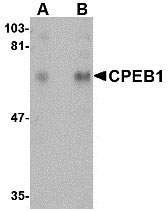
| Application Notes | CPEB1 antibody can be used for detection of CPEB1 by Western blot at 1 - 2 µg/mL. |
| Gene ID | 64506 |
|---|---|
| Other Names | Cytoplasmic polyadenylation element-binding protein 1, CPE-BP1, CPE-binding protein 1, h-CEBP, hCPEB-1, CPEB1, CPEB |
| Target/Specificity | CPEB1; |
| Reconstitution & Storage | CPEB1 antibody can be stored at 4℃ for three months and -20℃, stable for up to one year. As with all antibodies care should be taken to avoid repeated freeze thaw cycles. Antibodies should not be exposed to prolonged high temperatures. |
| Precautions | CPEB1 Antibody is for research use only and not for use in diagnostic or therapeutic procedures. |
For Research Use Only. Not For Use In Diagnostic Procedures.
| Name | CPEB1 |
|---|---|
| Synonyms | CPEB |
| Function | Sequence-specific RNA-binding protein that regulates mRNA cytoplasmic polyadenylation and translation initiation during oocyte maturation, early development and at postsynapse sites of neurons. Binds to the cytoplasmic polyadenylation element (CPE), an uridine-rich sequence element (consensus sequence 5'-UUUUUAU-3') within the mRNA 3'- UTR. RNA binding results in a clear conformational change analogous to the Venus fly trap mechanism (PubMed:24990967). In absence of phosphorylation and in association with TACC3 is also involved as a repressor of translation of CPE-containing mRNA; a repression that is relieved by phosphorylation or degradation (By similarity). Involved in the transport of CPE-containing mRNA to dendrites; those mRNAs may be transported to dendrites in a translationally dormant form and translationally activated at synapses (By similarity). Its interaction with APLP1 promotes local CPE-containing mRNA polyadenylation and translation activation (By similarity). Induces the assembly of stress granules in the absence of stress. Required for cell cycle progression, specifically for prophase entry (PubMed:26398195). |
| Cellular Location | Cytoplasm. Nucleus Cytoplasm, P-body. Cytoplasmic granule. Synapse. Membrane. Postsynaptic density. Cell projection, dendrite Note=Continuously shuttling between nucleus and cytoplasm (PubMed:18923137). Also found in stress granules. Recruited to stress granules (SGs) upon arsenite treatment. In dendrites (By similarity) Localizes in synaptosomes at dendritic synapses of neurons (By similarity). Strongly enriched in postsynaptic density (PSD) fractions (By similarity). Transported into dendrites in a microtubule-dependent fashion and colocalizes in mRNA-containing particles with TACC3, dynein and kinesin (By similarity). Membrane-associated (By similarity) Colocalizes at excitatory synapses with members of the polyadenylation and translation complex factors (CPSF, APLP1, TACC3, AURKA, SYP, etc.) including CPE-containing RNAs (By similarity). {ECO:0000250, ECO:0000269|PubMed:18923137} |
| Tissue Location | Isoform 1 is expressed in immature oocytes, ovary, brain and heart. Isoform 2 is expressed in brain and heart. Isoform 3 and isoform 4 are expressed in brain. Expressed in breast tumors and several tumor cell lines. |
Provided below are standard protocols that you may find useful for product applications.
BACKGROUND
CPEB1 Antibody: CPEB1 is an RNA binding protein that contains an RNA-recognition motif and a zinc finger-containing region found in a wide range of vertebrates and invertebrates. CPEB1 forms the nucleus of a complex of factors that regulate poly(A) elongation and promotes polyadenylation-induced translation. CPEB1 mediates many diverse biological processes such as germ cell development, cell division and senescence, and synaptic plasticity. Recently, it was discovered that CPEB1 is involved in beta-catenin mRNA translation and cell migration in astrocytes as well as regulating hypoxia-inducible factor (HIF)-1 expression, demonstrating the wide range of processes in which CPEB1 plays a role. At least four isoforms of CPEB1 are known to exist.
REFERENCES
Richter JD. CPEB: a life in translation. Trends in Biochem. Sci.2007; 32:179-85.
Jones KJ, Korb E, Kundel MA, et al. CPEB1 regulates beta-catenin mRNA translation and cell migration in astrocytes. Glia2008; 56:1401-13.
Hagele S, Kuhn U, Boning M, et al. Cytoplasmic polyadenylation element binding protein (CPEB)1 and 2 bind to the HIF-1alpha mRNA 3’UTR and modulate HIF-1 alpha protein expression. Biochem. J.2008; epub.

终于等到您。ABCEPTA(百远生物)抗体产品。
点击下方“我要评价 ”按钮提交您的反馈信息,您的反馈和评价是我们最宝贵的财富之一,
我们将在1-3个工作日内处理您的反馈信息。
如有疑问,联系:0512-88856768 tech-china@abcepta.com.


