


 癌症的基本特征包括细胞增殖、血管生成、迁移、凋亡逃避机制和细胞永生等。找到癌症发生过程中这些通路的关键标记物和对应的抗体用于检测至关重要。
 为您推荐一个泛素化位点预测神器——泛素化分析工具,可以为您的蛋白的泛素化位点作出预测和评分。
 细胞自噬受体图形绘图工具为你的蛋白的细胞受体结合位点作出预测和评分,识别结合到自噬通路中的蛋白是非常重要的,便于让我们理解自噬在正常生理、病理过程中的作用,如发育、细胞分化、神经退化性疾病、压力条件下、感染和癌症。
MettL7A Antibody

- 产品详情
- 实验流程
- 背景知识
Application 
| WB, IF, ICC, E |
|---|---|
| Primary Accession | Q9H8H3 |
| Other Accession | NP_054752, 89145417 |
| Reactivity | Human, Mouse |
| Host | Rabbit |
| Clonality | Polyclonal |
| Isotype | IgG |
| Calculated MW | 28319 Da |
| Concentration (mg/ml) | 1 mg/mL |
| Conjugate | Unconjugated |
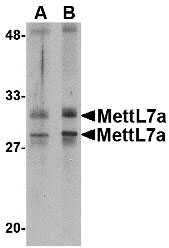
| Application Notes | MettL7A antibody can be used for detection of MettL7A by Western blot at 2 µg/mL. Antibody can also be used for immunocytochemistry starting at 2 µg/mL. For immunofluorescence start at 2 µg/mL. |
| Gene ID | 25840 |
|---|---|
| Other Names | Methyltransferase-like protein 7A, 2.1.1.-, Protein AAM-B, METTL7A |
| Target/Specificity | METTL7A; At least two isoforms of MettL7A are known to exist. This antibody is predicted to not cross-react with MettL7B. |
| Reconstitution & Storage | MettL7A antibody can be stored at 4℃ for three months and -20℃, stable for up to one year. As with all antibodies care should be taken to avoid repeated freeze thaw cycles. Antibodies should not be exposed to prolonged high temperatures. |
| Precautions | MettL7A Antibody is for research use only and not for use in diagnostic or therapeutic procedures. |
For Research Use Only. Not For Use In Diagnostic Procedures.
| Name | TMT1A {ECO:0000303|PubMed:37137720, ECO:0000312|HGNC:HGNC:24550} |
|---|---|
| Function | Thiol S-methyltransferase that catalyzes the transfer of a methyl group from S-adenosyl-L-methionine to alkyl and phenolic thiol- containing acceptor substrates. Together with TMT1B accounts for most of S-thiol methylation activity in the endoplasmic reticulum of hepatocytes (PubMed:37137720). Able to methylate the N6 position of adenosine residues in long non-coding RNAs (lncRNAs). May facilitate lncRNAs transfer into exosomes at the tumor-stroma interface (PubMed:34980213). Promotes osteogenic and odontogenic differentiation by regulating the expression of genes involved in stem cell differentiation and survival (PubMed:34226523, PubMed:34790668). Targeted from the endoplasmic reticulum to lipid droplets, where it recruits cellular proteins to form functional organelles (PubMed:19773358). |
| Cellular Location | Lipid droplet. Endoplasmic reticulum. Membrane. Microsome Cytoplasm, cytosol. Note=Inserted in the ER membrane and migrates from the inserted site to lipid droplet |
| Tissue Location | Expressed in the liver. |
Provided below are standard protocols that you may find useful for product applications.
BACKGROUND
MettL7A Antibody: MettL7A belongs to the methyltransferase superfamily. It is a probable methyltransferase. Methyltransferase is a type of transferase enzyme which transfers a methyl group from a donor to an acceptor. Often methylation occurs on nucleic bases in DNA or amino acids in protein structures. DNA methylation is often utilized to silence and regulate genes without changing the original DNA sequence. DNA methylation may be necessary for normal growth from embryonic stages in mammals. When mutant embryonic stem cells lacking the murine DNA methyltransferase gene were introduced to a germline of mice they caused a recessive lethal phenotype. Methylation may also be linked to cancer development as methylation of tumor suppressor genes promotes tumorgenesis and metastasis.
REFERENCES
Clark HF, Gurney AL, Abaya E, et al. The secreted protein discovery initiative (SPDI), a large-scale effort to identify novel human secreted and transmembrane proteins: a bioinformatics assessment. Genome Res.2003; 13:2265-70.
Li E, Bestor TH, and Jaenisch R. Targeted mutation of the DNA methyltransferase gene results in embryonic lethality. Cell1992; 69:915-26.
Laird PW and Jaenisch R. DNA Methylation and Cancer. Human Molecular Genetics1994; 3:1487-95.

终于等到您。ABCEPTA(百远生物)抗体产品。
点击下方“我要评价 ”按钮提交您的反馈信息,您的反馈和评价是我们最宝贵的财富之一,
我们将在1-3个工作日内处理您的反馈信息。
如有疑问,联系:0512-88856768 tech-china@abcepta.com.


