


 癌症的基本特征包括细胞增殖、血管生成、迁移、凋亡逃避机制和细胞永生等。找到癌症发生过程中这些通路的关键标记物和对应的抗体用于检测至关重要。
 为您推荐一个泛素化位点预测神器——泛素化分析工具,可以为您的蛋白的泛素化位点作出预测和评分。
 细胞自噬受体图形绘图工具为你的蛋白的细胞受体结合位点作出预测和评分,识别结合到自噬通路中的蛋白是非常重要的,便于让我们理解自噬在正常生理、病理过程中的作用,如发育、细胞分化、神经退化性疾病、压力条件下、感染和癌症。
ATOH8 Antibody
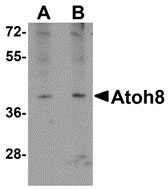
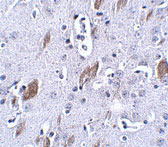
- 产品详情
- 实验流程
- 背景知识
Application 
| WB, E, IHC-P |
|---|---|
| Primary Accession | Q96SQ7 |
| Other Accession | NP_116216, 226498192 |
| Reactivity | Human, Mouse, Rat |
| Host | Rabbit |
| Clonality | Polyclonal |
| Isotype | IgG |
| Calculated MW | 34644 Da |
| Concentration (mg/ml) | 1 mg/mL |
| Conjugate | Unconjugated |
| Application Notes | ATOH8 antibody can be used for detection of ATOH8 by Western blot at 1 - 2 µg/mL. Antibody can also be used for immunohistochemistry starting at 5 µg/mL. |
| Gene ID | 84913 |
|---|---|
| Other Names | Protein atonal homolog 8, Class A basic helix-loop-helix protein 21, bHLHa21, Helix-loop-helix protein hATH-6, hATH6, ATOH8, ATH6, BHLHA21 |
| Target/Specificity | ATOH8; |
| Reconstitution & Storage | ATOH8 antibody can be stored at 4℃ for three months and -20℃, stable for up to one year. As with all antibodies care should be taken to avoid repeated freeze thaw cycles. Antibodies should not be exposed to prolonged high temperatures. |
| Precautions | ATOH8 Antibody is for research use only and not for use in diagnostic or therapeutic procedures. |
For Research Use Only. Not For Use In Diagnostic Procedures.
| Name | ATOH8 (HGNC:24126) |
|---|---|
| Synonyms | ATH6, BHLHA21 |
| Function | Transcription factor that binds a palindromic (canonical) core consensus DNA sequence 5'-CANNTG- 3' known as an E-box element, possibly as a heterodimer with other bHLH proteins (PubMed:24236640). Regulates endothelial cell proliferation, migration and tube-like structures formation (PubMed:24463812). Modulates endothelial cell differentiation through NOS3 (PubMed:24463812). May be implicated in specification and differentiation of neuronal cell lineages in the brain (By similarity). May participate in kidney development and may be involved in podocyte differentiation (By similarity). During early embryonic development is involved in tissue-specific differentiation processes that are dependent on class II bHLH factors and namely modulates the differentiation program initiated by the pro-endocrine factor NEUROG3 (By similarity). During myogenesis, may play a role during the transition of myoblasts from the proliferative phase to the differentiation phase (By similarity). Positively regulates HAMP transcription in two ways, firstly by acting directly on the HAMP promoter via E-boxes binding and indirectly through increased phosphorylation of SMAD protein complex (PubMed:24236640). Repress NEUROG3-dependent gene activation in a gene-specific manner through at least two mechanisms; requires only either the sequestering of a general partner such as TCF3 through heterodimerization, either also requires binding of the bHLH domain to DNA via a basic motif (By similarity). |
| Cellular Location | Nucleus. Nucleus speckle. Cytoplasm {ECO:0000250|UniProtKB:Q99NA2} |
| Tissue Location | Expressed in lung, liver, kidney, heart and pancreas. Expressed in endothel of umbilical vessels |
Provided below are standard protocols that you may find useful for product applications.
BACKGROUND
ATOH8 Antibody: Basic helix-loop-helix (bHLH) transcription factors play important roles in differentiation processes during embryonic development of vertebrates. ATOH8 (MATH6) is a tissue-restricted member of the atonal superfamily of bHLH transcription factors that exhibits 43-57% identity in the bHLH domain with other mammalian atonal paralogs including the NeuroD and Neurogenin factors. In the mouse, ATOH8 has been implicated in the specification and differentiation of neuronal cell lineages in the brain and may also participate in kidney development. Recent studies show that ATOH8 is a novel component of the pancreatic transcriptional network during embryonic development and suggest a potential role as a modulator of the differentiation program initiated by the pro-endocrine factor Neurog3. It is indispensable for early embryonic development, suggesting a more widespread function for this factor in tissue-specific differentiation processes that are dependent on class II bHLH genes.
REFERENCES
Wasserman SM, Mehraban F, Komuves LG, et al. Gene expression profile of human endothelial cells exposed to sustained fluid shear stress. Physiol. Genomics 2002;12:13-23.
Ledent V and Vervoort M. The basic helix-loop-helix protein family: comparative genomics and phylogenetic analysis. Genome Res. 2001; 11:754-770.
Inoue C, Bae SK, Takatsuka K, et al. Math6, a bHLH gene expressed in the developing nervous system, regulates neuronal versus glial differentiation. Genes Cells 2001; 6:977-986.
Ross MD, Martinka S, Mukherjee A, et al. Math6 expression during kidney development and altered expression in a mouse model of glomerulosclerosis. Dev Dyn. 2006; 235:3102-3109.

终于等到您。ABCEPTA(百远生物)抗体产品。
点击下方“我要评价 ”按钮提交您的反馈信息,您的反馈和评价是我们最宝贵的财富之一,
我们将在1-3个工作日内处理您的反馈信息。
如有疑问,联系:0512-88856768 tech-china@abcepta.com.


