


 癌症的基本特征包括细胞增殖、血管生成、迁移、凋亡逃避机制和细胞永生等。找到癌症发生过程中这些通路的关键标记物和对应的抗体用于检测至关重要。
 为您推荐一个泛素化位点预测神器——泛素化分析工具,可以为您的蛋白的泛素化位点作出预测和评分。
 细胞自噬受体图形绘图工具为你的蛋白的细胞受体结合位点作出预测和评分,识别结合到自噬通路中的蛋白是非常重要的,便于让我们理解自噬在正常生理、病理过程中的作用,如发育、细胞分化、神经退化性疾病、压力条件下、感染和癌症。
TNFAIP3 Antibody
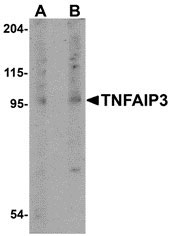
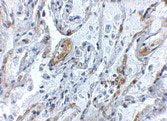
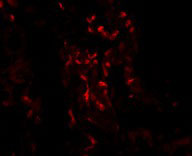
- 产品详情
- 实验流程
- 背景知识
Application 
| WB, IF, E, IHC-P |
|---|---|
| Primary Accession | Q60769 |
| Other Accession | Q60769, 2498097 |
| Reactivity | Human, Mouse, Rat |
| Host | Rabbit |
| Clonality | Polyclonal |
| Isotype | IgG |
| Calculated MW | 87654 Da |
| Concentration (mg/ml) | 1 mg/mL |
| Conjugate | Unconjugated |
| Application Notes | TNFAIP3 antibody can be used for detection of TNFAIP3 by Western blot at 1 - 2 µg/mL. Antibody can also be used for immunohistochemistry starting at 5 µg/mL. For immunofluorescence start at 20 µg/mL. |
| Gene ID | 21929 |
|---|---|
| Other Names | Tumor necrosis factor alpha-induced protein 3, TNF alpha-induced protein 3, 3.4.19.12, 6.3.2.-, Putative DNA-binding protein A20, Zinc finger protein A20, Tnfaip3, Tnfip3 |
| Target/Specificity | Tnfaip3; |
| Reconstitution & Storage | TNFAIP3 antibody can be stored at 4℃ for three months and -20℃, stable for up to one year. As with all antibodies care should be taken to avoid repeated freeze thaw cycles. Antibodies should not be exposed to prolonged high temperatures. |
| Precautions | TNFAIP3 Antibody is for research use only and not for use in diagnostic or therapeutic procedures. |
For Research Use Only. Not For Use In Diagnostic Procedures.
| Name | Tnfaip3 |
|---|---|
| Synonyms | Tnfip3 |
| Function | Ubiquitin-editing enzyme that contains both ubiquitin ligase and deubiquitinase activities. Involved in immune and inflammatory responses signaled by cytokines, such as TNF and IL-1 beta, or pathogens via Toll-like receptors (TLRs) through terminating NF-kappa-B activity. Essential component of a ubiquitin-editing protein complex, comprising also RNF11, ITCH and TAX1BP1, that ensures the transient nature of inflammatory signaling pathways. In cooperation with TAX1BP1 promotes disassembly of E2-E3 ubiquitin protein ligase complexes in IL- 1R and TNFR-1 pathways; affected are at least E3 ligases TRAF6, TRAF2 and BIRC2, and E2 ubiquitin-conjugating enzymes UBE2N and UBE2D3. In cooperation with TAX1BP1 promotes ubiquitination of UBE2N and proteasomal degradation of UBE2N and UBE2D3. Upon TNF stimulation, deubiquitinates 'Lys-63'-polyubiquitin chains on RIPK1 and catalyzes the formation of 'Lys-48'-polyubiquitin chains. This leads to RIPK1 proteasomal degradation and consequently termination of the TNF- or LPS-mediated activation of NF-kappa-B. Deubiquitinates TRAF6 probably acting on 'Lys-63'-linked polyubiquitin. Upon T-cell receptor (TCR)- mediated T-cell activation, deubiquitinates 'Lys-63'-polyubiquitin chains on MALT1 thereby mediating disassociation of the CBM (CARD11:BCL10:MALT1) and IKK complexes and preventing sustained IKK activation. Deubiquitinates NEMO/IKBKG; the function is facilitated by TNIP1 and leads to inhibition of NF-kappa-B activation. Upon stimulation by bacterial peptidoglycans, probably deubiquitinates RIPK2. Can also inhibit I-kappa-B-kinase (IKK) through a non-catalytic mechanism which involves polyubiquitin; polyubiquitin promotes association with IKBKG and prevents IKK MAP3K7-mediated phosphorylation. Targets TRAF2 for lysosomal degradation. In vitro able to deubiquitinate 'Lys-11'-, 'Lys-48'- and 'Lys-63' polyubiquitin chains. Inhibitor of programmed cell death. Has a role in the function of the lymphoid system. Required for LPS-induced production of pro- inflammatory cytokines and IFN beta in LPS-tolerized macrophages. |
| Cellular Location | Cytoplasm. Nucleus. Lysosome |
| Tissue Location | Found in most tissues during development. Strikingly high levels are found in lymphoid organs, including the thymus, spleen, and gut-associated lymphoid tissue. Constitutively expressed in immature and mature thymocyte subpopulations as well as in resting peripheral T-cells; activation of these leads to down- regulation |
Provided below are standard protocols that you may find useful for product applications.
BACKGROUND
TNFAIP3 Antibody: TNFAIP3, also known as A20, is located in chromosome band 6q23, a region that is often deleted in B cell lymphomas. Recently, it was identified as a tumor suppressor gene in Hodgkin lymphoma and several subtypes of non-Hodgkin lymphomas. TNFAIP3 was initially identified as a zinc-finger protein that is rapidly and transiently induced by TNF-α, inhibiting NF-κB-dependent gene expression, and protecting cells from TNF-α-cytotoxicity. Overexpression of TNFAIP3 also inhibits the TLR2- and TLR4-mediated interleukin-8 synthesis in airway epithelial cells, suggesting that TNFAIP3 also acts as a negative regulator of TLR-mediated inflammatory responses, thereby protecting the host against harmful over-responses to pathogens. At least two isoforms of TNFAIP3 are known to exist.
REFERENCES
Zhang YP, Matthiesen S, Harder R, et al. A 3-cM commonly deleted region in 6q21 in leukemias and lymphomas delineated by fluorescence in situ hybridization. Genes Chromosomes Cancer2000; 27:52-58.
Schmitz R, Hansmann M-L, Bohle V, et al. TNFAIP3 (A20) is a tumor suppressor gene in Hodgkin lymphoma and primary mediastinal B cell lymphoma. J. Exp. Med.2009; 206:981-9.
Honma K, Tsuzuki S, Nakagawa M, et al. TNFAIP3/A20 functions as a novel tumor suppressor gene in several subtypes of non-Hodgkins lymphomas. Blood2009; epub.
Opipari AW Jr, Hu MN, Yabkowitz R, et al. The A20 zinc finger protein protects cells from tumor necrosis factor cytotoxicity. J. Biol. Chem.1992; 267:12424-7.

终于等到您。ABCEPTA(百远生物)抗体产品。
点击下方“我要评价 ”按钮提交您的反馈信息,您的反馈和评价是我们最宝贵的财富之一,
我们将在1-3个工作日内处理您的反馈信息。
如有疑问,联系:0512-88856768 tech-china@abcepta.com.


