


 癌症的基本特征包括细胞增殖、血管生成、迁移、凋亡逃避机制和细胞永生等。找到癌症发生过程中这些通路的关键标记物和对应的抗体用于检测至关重要。
 为您推荐一个泛素化位点预测神器——泛素化分析工具,可以为您的蛋白的泛素化位点作出预测和评分。
 细胞自噬受体图形绘图工具为你的蛋白的细胞受体结合位点作出预测和评分,识别结合到自噬通路中的蛋白是非常重要的,便于让我们理解自噬在正常生理、病理过程中的作用,如发育、细胞分化、神经退化性疾病、压力条件下、感染和癌症。
Seasonal H1N1 Nucleocapsid Protein Antibody
- 产品详情
- 实验流程
- 背景知识
Application 
| E |
|---|---|
| Primary Accession | I3QSJ8 |
| Other Accession | AFK14863, 260593857 |
| Reactivity | Virus |
| Host | Rabbit |
| Clonality | Polyclonal |
| Isotype | IgG |
| Concentration (mg/ml) | 1 mg/mL |
| Conjugate | Unconjugated |
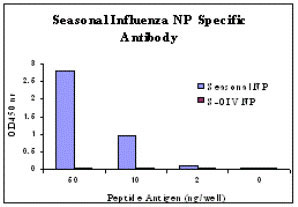
| Application Notes | NP antibody can be used for the detection of the NP protein from the H1N1 strain of Seasonal Influenza A in ELISA. |
| Target/Specificity | NP; This antibody is specific for the seasonal H1N1 influenza NP and will not recognize the corresponding NP sequence from the swine-origin H1N1 influenza (A/California/14/2009 (H1N1)). |
|---|---|
| Reconstitution & Storage | Seasonal H1N1 Nucleocapsid Protein antibody can be stored at 4℃ for three months and -20℃, stable for up to one year. As with all antibodies care should be taken to avoid repeated freeze thaw cycles. Antibodies should not be exposed to prolonged high temperatures. |
| Precautions | Seasonal H1N1 Nucleocapsid Protein Antibody is for research use only and not for use in diagnostic or therapeutic procedures. |
For Research Use Only. Not For Use In Diagnostic Procedures.
Provided below are standard protocols that you may find useful for product applications.
BACKGROUND
Seasonal H1N1 Nucleocapsid Protein Antibody: Influenza A virus is a major public health threat, killing more than 30, 000 people per year in the USA. In early 2009, a novel swine-origin influenza A (H1N1) virus (S-OIV) was identified in specimens obtained from patients in Mexico and the United States. The influenza A virus polymerase transcribes and replicates eight virion RNA (vRNA) segments, among which the nucleocapsid protein (NP), thought to control whether mRNA or cRNA is produced. The nucleoprotein (NP), which has multiple functions during the virus life cycle, possesses regions that are highly conserved among influenza A, B, and C viruses. It was recently found several NP mutations that affected the efficient incorporation of multiple viral-RNA (vRNA) segments into progeny virions even though a single vRNA segment was incorporated efficiently. This indicates that the respective conserved amino acids in NP may be critical for the assembly and/or incorporation of sets of eight vRNA segments.
REFERENCES
Thompson WW, Shay DK, Weintraub, et al. Mortality associated with influenza and respiratory syncytial virus in the United States. JAMA2003; 289:179-186.
Novel Swine-Origin Influenza A (H1N1) Virus Investigation Team, Dawood FS, Jain S, et al. Emergence of a novel swine-origin influenza A (H1N1) virus in humans. N. Engl. J. Med.2009; 360:2605-15.
Li Z, Watanabe T, Hatta M, et al. Mutational analysis of conserved amino acids in the influenza A virus nucleoprotein. J. Virol.2009; 83:4153-62.
Newcomb LL, Kuo RL, Ye Q, et al. Interaction of the influenza a virus nucleocapsid protein with the viral RNA polymerase potentiates unprimed viral RNA replication. J. Virol.2009; 83:29-36.

终于等到您。ABCEPTA(百远生物)抗体产品。
点击下方“我要评价 ”按钮提交您的反馈信息,您的反馈和评价是我们最宝贵的财富之一,
我们将在1-3个工作日内处理您的反馈信息。
如有疑问,联系:0512-88856768 tech-china@abcepta.com.


