


 癌症的基本特征包括细胞增殖、血管生成、迁移、凋亡逃避机制和细胞永生等。找到癌症发生过程中这些通路的关键标记物和对应的抗体用于检测至关重要。
 为您推荐一个泛素化位点预测神器——泛素化分析工具,可以为您的蛋白的泛素化位点作出预测和评分。
 细胞自噬受体图形绘图工具为你的蛋白的细胞受体结合位点作出预测和评分,识别结合到自噬通路中的蛋白是非常重要的,便于让我们理解自噬在正常生理、病理过程中的作用,如发育、细胞分化、神经退化性疾病、压力条件下、感染和癌症。
Girdin Antibody
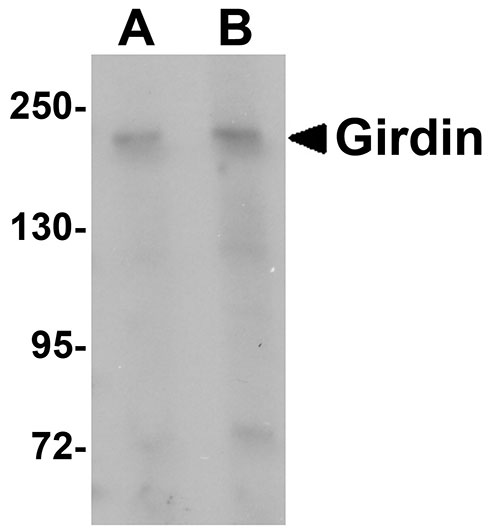
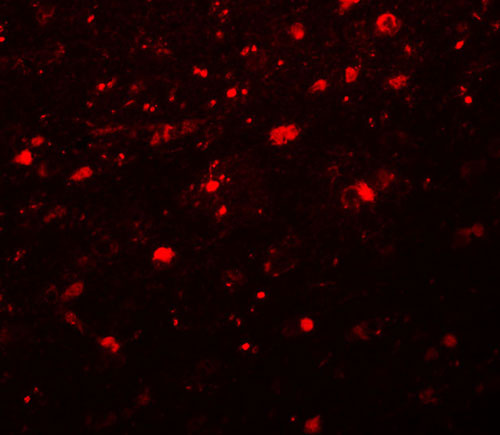
- 产品详情
- 实验流程
- 背景知识
Application 
| WB, IF, E |
|---|---|
| Primary Accession | Q3V6T2 |
| Other Accession | NP_060554, 50897852 |
| Reactivity | Human, Mouse, Rat |
| Host | Rabbit |
| Clonality | Polyclonal |
| Isotype | IgG |
| Calculated MW | 216042 Da |
| Concentration (mg/ml) | 1 mg/mL |
| Conjugate | Unconjugated |
| Application Notes | Girdin antibody can be used for detection of Girdin by Western blot at 1 - 2 µg/mL. For immunofluorescence start at 20 µg/mL. |
| Gene ID | 55704 |
|---|---|
| Other Names | Girdin, Akt phosphorylation enhancer, APE, Coiled-coil domain-containing protein 88A, G alpha-interacting vesicle-associated protein, GIV, Girders of actin filament, Hook-related protein 1, HkRP1, CCDC88A |
| Target/Specificity | CCDC88A; |
| Reconstitution & Storage | Girdin antibody can be stored at 4℃ for three months and -20℃, stable for up to one year. As with all antibodies care should be taken to avoid repeated freeze thaw cycles. Antibodies should not be exposed to prolonged high temperatures. |
| Precautions | Girdin Antibody is for research use only and not for use in diagnostic or therapeutic procedures. |
For Research Use Only. Not For Use In Diagnostic Procedures.
| Name | CCDC88A |
|---|---|
| Function | Bifunctional modulator of guanine nucleotide-binding proteins (G proteins) (PubMed:19211784, PubMed:27621449). Acts as a non-receptor guanine nucleotide exchange factor which binds to and activates guanine nucleotide-binding protein G(i) alpha subunits (PubMed:19211784, PubMed:21954290, PubMed:23509302, PubMed:25187647). Also acts as a guanine nucleotide dissociation inhibitor for guanine nucleotide- binding protein G(s) subunit alpha GNAS (PubMed:27621449). Essential for cell migration (PubMed:16139227, PubMed:19211784, PubMed:20462955, PubMed:21954290). Interacts in complex with G(i) alpha subunits with the EGFR receptor, retaining EGFR at the cell membrane following ligand stimulation and promoting EGFR signaling which triggers cell migration (PubMed:20462955). Binding to Gi-alpha subunits displaces the beta and gamma subunits from the heterotrimeric G protein complex which enhances phosphoinositide 3-kinase (PI3K)-dependent phosphorylation and kinase activity of AKT1/PKB (PubMed:19211784). Phosphorylation of AKT1/PKB induces the phosphorylation of downstream effectors GSK3 and FOXO1/FKHR, and regulates DNA replication and cell proliferation (By similarity). Binds in its tyrosine-phosphorylated form to the phosphatidylinositol 3-kinase (PI3K) regulatory subunit PIK3R1 which enables recruitment of PIK3R1 to the EGFR receptor, enhancing PI3K activity and cell migration (PubMed:21954290). Plays a role as a key modulator of the AKT-mTOR signaling pathway, controlling the tempo of the process of newborn neuron integration during adult neurogenesis, including correct neuron positioning, dendritic development and synapse formation (By similarity). Inhibition of G(s) subunit alpha GNAS leads to reduced cellular levels of cAMP and suppression of cell proliferation (PubMed:27621449). Essential for the integrity of the actin cytoskeleton (PubMed:16139227, PubMed:19211784). Required for formation of actin stress fibers and lamellipodia (PubMed:15882442). May be involved in membrane sorting in the early endosome (PubMed:15882442). Plays a role in ciliogenesis and cilium morphology and positioning and this may partly be through regulation of the localization of scaffolding protein CROCC/Rootletin (PubMed:27623382). |
| Cellular Location | Cell membrane; Peripheral membrane protein. Cytoplasm, cytosol. Cytoplasmic vesicle. Cell projection, lamellipodium. Cytoplasm, cytoskeleton, cilium basal body. Cytoplasm, cytoskeleton, microtubule organizing center, centrosome, centriole. Note=Localizes to the cytosol in unstimulated cells while EGF stimulation promotes membrane localization and guanine nucleotide exchange factor activity (PubMed:27864364) Localizes to the cell membrane through interaction with phosphoinositides (PubMed:15882442, PubMed:16139227) |
| Tissue Location | Expressed ubiquitously. |
Provided below are standard protocols that you may find useful for product applications.
BACKGROUND
Girdin Antibody: Girdin is a Galpha-interacting protein that can enhance the activation of the protein kinase Akt, remodel the actin cytoskeleton, and is thought to be involved in the regulation of cell migration and cancer metastasis. It has recently been shown that Girdin interacts with Disrupted-in-Schizophrenia 1 (DISC1), a susceptibility gene for major psychiatric disorders. DISC1 is thought to be involved in the migration, positioning and differentiation of dentate granule cells (DGCs) during development; depletion of Girdin or blocking the Girdin-DISC1 interaction results in defects in axonal sprouting in the CA3 region of the hippocampus and overextended migration of mispositioning of DGCs, suggesting the Girdin plays a role in postnatal neurogenesis in the dentate gyrus.
REFERENCES
Le-Niculescu H, Niesman I, Fischer T, et al. Identification and characterization of GIV, a novel Galpha i/s-interacting protein found on COPI, endoplasmic reticulum-Golgi transport vesicles. J. Biol. Chem.2005; 280:22012-20.
Anai M, Shojima N, Katagiri H, et al. A novel protein kinase B (PKB)/Akt-binding protein enhances PKB kinase activity and regulates DNA synthesis. J. Biol. Chem.2005; 280:18525-35.
Enomoto A, Murakami H, Asai N, et al. Akt/PKB regulated actin organization and cell motility via Girdin/APE. Dev. Cell2005; 9:389-402.
Enomoto A, Asai N, Namba T, et al. Roles of disrupted-in-schizophrenia 1-interacting protein girdin in postnatal development of the dentate gyrus. Neuron2009; 63:774-87.

终于等到您。ABCEPTA(百远生物)抗体产品。
点击下方“我要评价 ”按钮提交您的反馈信息,您的反馈和评价是我们最宝贵的财富之一,
我们将在1-3个工作日内处理您的反馈信息。
如有疑问,联系:0512-88856768 tech-china@abcepta.com.


