


 癌症的基本特征包括细胞增殖、血管生成、迁移、凋亡逃避机制和细胞永生等。找到癌症发生过程中这些通路的关键标记物和对应的抗体用于检测至关重要。
 为您推荐一个泛素化位点预测神器——泛素化分析工具,可以为您的蛋白的泛素化位点作出预测和评分。
 细胞自噬受体图形绘图工具为你的蛋白的细胞受体结合位点作出预测和评分,识别结合到自噬通路中的蛋白是非常重要的,便于让我们理解自噬在正常生理、病理过程中的作用,如发育、细胞分化、神经退化性疾病、压力条件下、感染和癌症。
VASH1 Antibody
- 产品详情
- 实验流程
- 背景知识
Application 
| WB, IF, E, IHC-P |
|---|---|
| Primary Accession | Q7L8A9 |
| Other Accession | NP_055724, 7662454 |
| Reactivity | Human, Mouse, Rat |
| Host | Rabbit |
| Clonality | Polyclonal |
| Isotype | IgG |
| Calculated MW | 40957 Da |
| Concentration (mg/ml) | 1 mg/mL |
| Conjugate | Unconjugated |
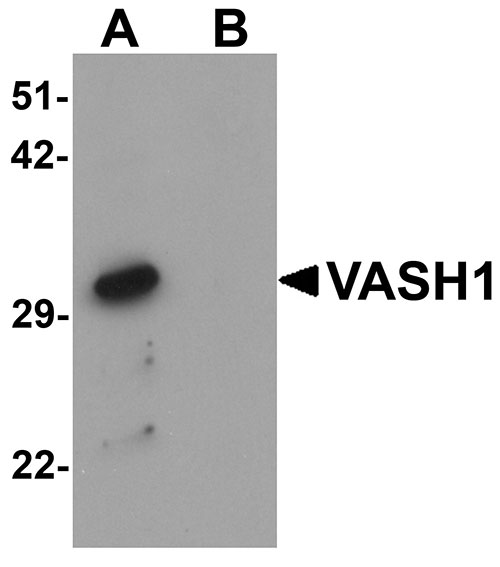
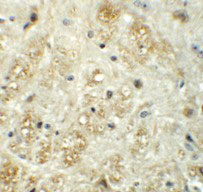
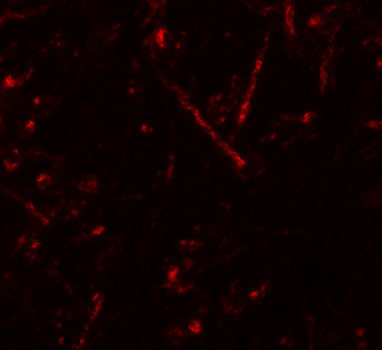
| Application Notes | VASH1 antibody can be used for detection of VASH1 by Western blot at 1 µg/mL. Antibody can also be used for immunohistochemistry starting at 5 µg/mL. For immunofluorescence start at 20 µg/mL. |
| Gene ID | 22846 |
|---|---|
| Other Names | Vasohibin-1, VASH1, KIAA1036, VASH |
| Target/Specificity | VASH1; VASH1 antibody is predicted to not cross-react with other vasohibin protein family members. At least two isoforms are known to exist; this antibody will recognize only the long isoform. |
| Reconstitution & Storage | VASH1 antibody can be stored at 4 ℃, stable for one year. As with all antibodies care should be taken to avoid repeated freeze thaw cycles. Antibodies should not be exposed to prolonged high temperatures. |
| Precautions | VASH1 Antibody is for research use only and not for use in diagnostic or therapeutic procedures. |
For Research Use Only. Not For Use In Diagnostic Procedures.
| Name | VASH1 (HGNC:19964) |
|---|---|
| Function | Tyrosine carboxypeptidase that removes the C-terminal tyrosine residue of alpha-tubulin, thereby regulating microtubule dynamics and function (PubMed:29146869, PubMed:31171830, PubMed:31235910, PubMed:31235911, PubMed:31270470). Critical for spindle function and accurate chromosome segregation during mitosis since microtubule detyrosination regulates mitotic spindle length and postioning (PubMed:31171830). Acts as an angiogenesis inhibitor: inhibits migration, proliferation and network formation by endothelial cells as well as angiogenesis (PubMed:15467828, PubMed:16488400, PubMed:16707096, PubMed:19204325). This inhibitory effect is selective to endothelial cells as it does not affect the migration of smooth muscle cells or fibroblasts (PubMed:15467828, PubMed:16488400, PubMed:16707096). |
| Cellular Location | Cytoplasm. Secreted. Note=Mainly localizes in the cytoplasm (PubMed:27879017). Some fraction is secreted via a non-canonical secretion system; interaction with SVBP promotes secretion (PubMed:27879017). |
| Tissue Location | Preferentially expressed in endothelial cells (PubMed:15467828, PubMed:16707096). Highly expressed in fetal organs (PubMed:15467828). Expressed in brain and placenta, and at lower level in heart and kidney (PubMed:15467828). Highly detected in microvessels endothelial cells of atherosclerotic lesions (PubMed:16707096) |
Provided below are standard protocols that you may find useful for product applications.
BACKGROUND
VASH1 Antibody: VASH1 was originally identified as an endothelium-derived vascular endothelial growth factor (VEGF)-inducible angiogenesis inhibitor that acts in a negative feedback manner. VASH1 mRNA is expressed brain, heart, kidney and placenta in the adult, with robust expression in various organs during embryonic development. VASH1 expression in tumor cells and tumor vasculature is silenced by methylation by increased expression of Zeste homolog 2 (EZH2). The increase of EZH2 expression is induced by VEGF stimulation, leading to poor clinical prognosis. Recombinant adenovirus expressing VASH prevented tumor angiogenesis and inhibited tumor growth, suggesting that it may be a potentially valuable antitumor therapy in the clinic.
REFERENCES
Watanabe K, Hasegawa Y, Yamashita H, et al. Vasohibin as an endothelium-derived negative feedback regulator of angiogenesis. J. Clin. Invest. 2004; 114:989-907
Lu C, Han HD, Mangala LS, et al. Regulation of tumor angiogenesis by EZH2. Cancer Cell 2010; 18:185-97.
Li D, Zhou K, Wang S, et al. Recombinant adenovirus encoding vasohibin prevents tumor angiogenesis and inhibits tumor growth. Cancer Sci. 2010; 101:448-52.

终于等到您。ABCEPTA(百远生物)抗体产品。
点击下方“我要评价 ”按钮提交您的反馈信息,您的反馈和评价是我们最宝贵的财富之一,
我们将在1-3个工作日内处理您的反馈信息。
如有疑问,联系:0512-88856768 tech-china@abcepta.com.


