


 癌症的基本特征包括细胞增殖、血管生成、迁移、凋亡逃避机制和细胞永生等。找到癌症发生过程中这些通路的关键标记物和对应的抗体用于检测至关重要。
 为您推荐一个泛素化位点预测神器——泛素化分析工具,可以为您的蛋白的泛素化位点作出预测和评分。
 细胞自噬受体图形绘图工具为你的蛋白的细胞受体结合位点作出预测和评分,识别结合到自噬通路中的蛋白是非常重要的,便于让我们理解自噬在正常生理、病理过程中的作用,如发育、细胞分化、神经退化性疾病、压力条件下、感染和癌症。
PIWI-L2 Antibody
- 产品详情
- 实验流程
- 背景知识
Application 
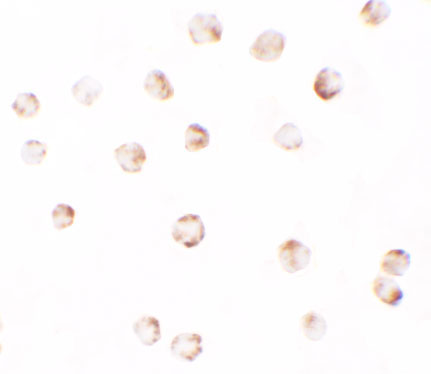
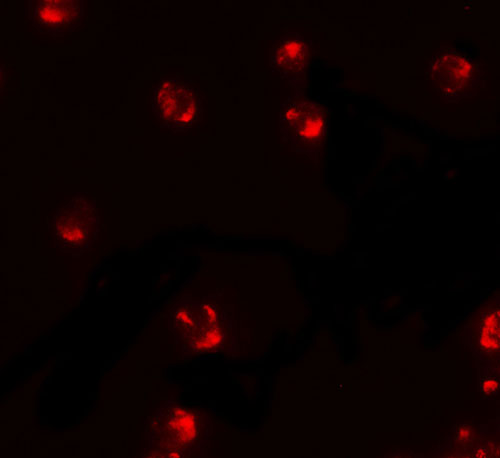
| WB, IF, ICC, E |
|---|---|
| Primary Accession | Q8TC59 |
| Other Accession | NP_00129193, 24431985 |
| Reactivity | Human, Mouse |
| Host | Rabbit |
| Clonality | Polyclonal |
| Isotype | IgG |
| Calculated MW | 109849 Da |
| Concentration (mg/ml) | 1 mg/mL |
| Conjugate | Unconjugated |
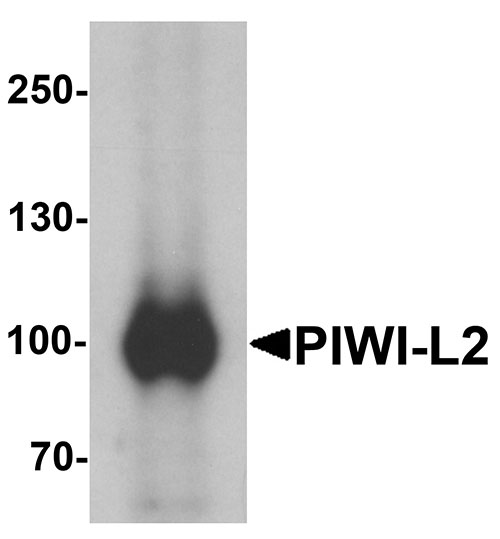
| Application Notes | PIWI-L2 antibody can be used for detection of PIWI-L2 by Western blot at 1 µg/mL. |
| Gene ID | 55124 |
|---|---|
| Other Names | Piwi-like protein 2, Cancer/testis antigen 80, CT80, PIWIL2, HILI |
| Target/Specificity | PIWIL2; At least three isoforms of PIWI-L2 are known to exist; this antibody will only detect the two longest isoforms. PIWI-L2 antibody is predicted to not cross-react with other PIWI protein family members. |
| Reconstitution & Storage | PIWI-L2 antibody can be stored at 4℃ for three months and -20℃, stable for up to one year. As with all antibodies care should be taken to avoid repeated freeze thaw cycles. Antibodies should not be exposed to prolonged high temperatures. |
| Precautions | PIWI-L2 Antibody is for research use only and not for use in diagnostic or therapeutic procedures. |
For Research Use Only. Not For Use In Diagnostic Procedures.
| Name | PIWIL2 |
|---|---|
| Synonyms | HILI |
| Function | Endoribonuclease that plays a central role during spermatogenesis by repressing transposable elements and preventing their mobilization, which is essential for the germline integrity (By similarity). Plays an essential role in meiotic differentiation of spermatocytes, germ cell differentiation and in self-renewal of spermatogonial stem cells (By similarity). Acts via the piRNA metabolic process, which mediates the repression of transposable elements during meiosis by forming complexes composed of piRNAs and Piwi proteins and govern the methylation and subsequent repression of transposons (By similarity). During piRNA biosynthesis, plays a key role in the piRNA amplification loop, also named ping-pong amplification cycle, by acting as a 'slicer-competent' piRNA endoribonuclease that cleaves primary piRNAs, which are then loaded onto 'slicer-incompetent' PIWIL4 (By similarity). PIWIL2 slicing produces a pre-miRNA intermediate, which is then processed in mature piRNAs, and as well as a 16 nucleotide by- product that is degraded (By similarity). Required for PIWIL4/MIWI2 nuclear localization and association with secondary piRNAs antisense (By similarity). Besides their function in transposable elements repression, piRNAs are probably involved in other processes during meiosis such as translation regulation (By similarity). Indirectly modulates expression of genes such as PDGFRB, SLC2A1, ITGA6, GJA7, THY1, CD9 and STRA8 (By similarity). When overexpressed, acts as an oncogene by inhibition of apoptosis and promotion of proliferation in tumors (PubMed:16377660). Represses circadian rhythms by promoting the stability and activity of core clock components BMAL1 and CLOCK by inhibiting GSK3B-mediated phosphorylation and ubiquitination-dependent degradation of these proteins (PubMed:28903391). |
| Cellular Location | Cytoplasm {ECO:0000250|UniProtKB:Q8CDG1}. Note=Present in chromatoid body. Probable component of the meiotic nuage, also named P granule, a germ-cell-specific organelle required to repress transposon activity during meiosis {ECO:0000250|UniProtKB:Q8CDG1} |
| Tissue Location | Expressed in adult testis and in most tumors. |
Provided below are standard protocols that you may find useful for product applications.
BACKGROUND
PIWI-L2 Antibody: PIWI-L2 is a member of the PIWI subfamily of Argonaute proteins, evolutionarily conserved proteins containing both PAZ and Piwi motifs that are crucial for the biogenesis and function of small non-coding RNAs and play important roles in stem cell self-renewal, RNA silencing, and translational regulation in diverse organisms. PIWI-L2 has been implicated in multiple roles including stem cell self-renewal and is highly expressed in many breast cancers. In these tumors, PIWI-L2 silences the expression of STAT3, a regulator of Bcl-XL and cyclin D1, allowing the proliferation and survival of breast cancer stem cells. Recent studies have shown that overexpression of PIWI-like proteins are potential biomarkers for colon and other cancers.
REFERENCES
Kuramochi-Miyagawa S, Kimura T, Yomogida K, et al. Two mouse piwi-related genes: miwi and mili. Mech. Dev. 108:121-33
Thomson T and Lin H. The biogenesis and function PIWI proteins and piRNAs: progress and prospect. Annu. Rev. Cell Dev. Biol. 2009; 25:355-76.
Lee JH, Jung C, Javadian-Elyaderani P, et al. Pathways of proliferation and antiapoptosis driven in breast cancer stem cells by stem cell protein Piwil2. Cancer Res. 2010; 70:4569-79.
Li L, Yu C, Gao H, et al. Argonaute proteins: potential biomarkers for human colon cancer. BMC Cancer 2010; 10:38

终于等到您。ABCEPTA(百远生物)抗体产品。
点击下方“我要评价 ”按钮提交您的反馈信息,您的反馈和评价是我们最宝贵的财富之一,
我们将在1-3个工作日内处理您的反馈信息。
如有疑问,联系:0512-88856768 tech-china@abcepta.com.


