


 癌症的基本特征包括细胞增殖、血管生成、迁移、凋亡逃避机制和细胞永生等。找到癌症发生过程中这些通路的关键标记物和对应的抗体用于检测至关重要。
 为您推荐一个泛素化位点预测神器——泛素化分析工具,可以为您的蛋白的泛素化位点作出预测和评分。
 细胞自噬受体图形绘图工具为你的蛋白的细胞受体结合位点作出预测和评分,识别结合到自噬通路中的蛋白是非常重要的,便于让我们理解自噬在正常生理、病理过程中的作用,如发育、细胞分化、神经退化性疾病、压力条件下、感染和癌症。
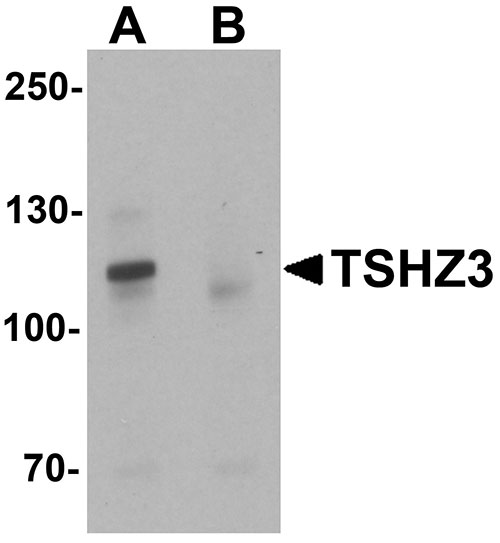
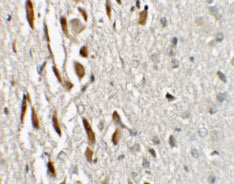
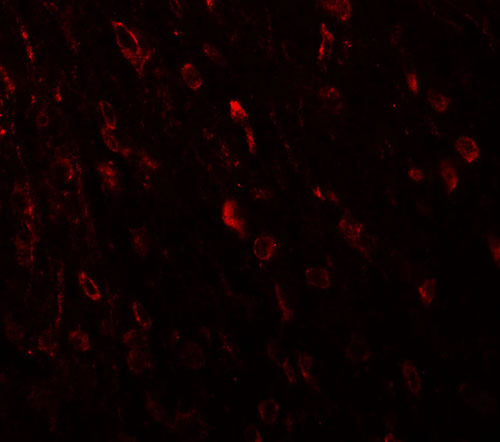
TSHZ3 Antibody
- 产品详情
- 实验流程
- 背景知识
Application 
| WB, IF, E, IHC-P |
|---|---|
| Primary Accession | Q63HK5 |
| Other Accession | NP_065907, 127138957 |
| Reactivity | Human, Mouse, Rat |
| Host | Rabbit |
| Clonality | Polyclonal |
| Isotype | IgG |
| Calculated MW | 118566 Da |
| Concentration (mg/ml) | 1 mg/mL |
| Conjugate | Unconjugated |
| Application Notes | TSHZ3 antibody can be used for detection of TSHZ3 by Western blot at 1 µg/mL. Antibody can also be used for immunohistochemistry starting at 2.5 µg/mL. For immunofluorescence start at 2.5 µg/mL. |
| Gene ID | 57616 |
|---|---|
| Other Names | Teashirt homolog 3, Zinc finger protein 537, TSHZ3, KIAA1474, TSH3, ZNF537 |
| Target/Specificity | TSHZ3; |
| Reconstitution & Storage | TSHZ3 antibody can be stored at 4℃ for three months and -20℃, stable for up to one year. As with all antibodies care should be taken to avoid repeated freeze thaw cycles. Antibodies should not be exposed to prolonged high temperatures. |
| Precautions | TSHZ3 Antibody is for research use only and not for use in diagnostic or therapeutic procedures. |
For Research Use Only. Not For Use In Diagnostic Procedures.
| Name | TSHZ3 |
|---|---|
| Synonyms | KIAA1474, TSH3, ZNF537 |
| Function | Transcriptional regulator involved in developmental processes. Functions in association with APBB1, SET and HDAC factors as a transcriptional repressor, that inhibits the expression of CASP4. TSHZ3-mediated transcription repression involves the recruitment of histone deacetylases HDAC1 and HDAC2. Associates with chromatin in a region surrounding the CASP4 transcriptional start site(s) (PubMed:19343227). Regulates the development of neurons involved in both respiratory rhythm and airflow control. Promotes maintenance of nucleus ambiguus (nA) motoneurons, which govern upper airway function, and establishes a respiratory rhythm generator (RRG) activity compatible with survival at birth. Involved in the differentiation of the proximal uretic smooth muscle cells during developmental processes. Involved in the up-regulation of myocardin, that directs the expression of smooth muscle cells in the proximal ureter (By similarity). Involved in the modulation of glutamatergic synaptic transmission and long-term synaptic potentiation (By similarity). |
| Cellular Location | Nucleus {ECO:0000255|PROSITE-ProRule:PRU00108, ECO:0000269|PubMed:19343227}. Cell projection, growth cone. Note=Colocalizes with APBB1 in axonal growth cone (By similarity). Colocalizes with APBB1 in the nucleus. |
| Tissue Location | Expressed in brain; strongly reduced in post-mortem elderly subjects with Alzheimer disease (PubMed:18776146, PubMed:19343227). Expressed in the fetal neocortex (PubMed:27668656) |
Provided below are standard protocols that you may find useful for product applications.
BACKGROUND
TSHZ3 Antibody: The Teashirt zinc finger homeobox (TSHZ) family comprise a family of evolutionarily conserved transcription factors that, in Drosophila, are active in specific body parts for patterning, but whose function in vertebrates is less clear. In mice, the known three TSHZ proteins are expressed in distinct patterns in the developing and adult brain, suggesting that they play a role in the establishment of regional identity and specification of cell types within the brain. Both TSHZ3 and TSHZ1 have been found to interact with FE65, an adapter protein that binds to the amyloid protein precursor (APP) in neurons. Together with SET, a component of the inhibitor of acetyl transferase, and histone deacetylases, these proteins formed a gene-silencing complex whose target includes caspase-4. Recent experiments have also suggested this family of proteins may be involved in carcinogenesis.
REFERENCES
Caubit X, Core N, Boned A, et al. Vertebrate orthologues of the Drosophila region-specific patterning gene teashirt. Mech. Dev. 2000; 91:445-8.
Santos JS, Fonseca NA, Vieira CP, et al. Phylogeny of the Teashirt-related zinc finger (tshz) gene family and analysis of the developmental expression of tshz2 and tshz3 in the zebrafish. Dev. Dyn. 2010; 239:1010-8.
Caubit X, Tiveron MC, Cremer H, et al. Expression patterns of the three Teashirt-related genes define specific boundaries in the developing and postnatal mouse forebrain. J. Comp. Neurol. 2005; 486:76-88.
Kajiwara Y, Akram A, Katsel P, et al. FE65 binds teashirt, inhibiting expression of the primate-specific caspase-4. PLoS One 2009; 4:e5071

终于等到您。ABCEPTA(百远生物)抗体产品。
点击下方“我要评价 ”按钮提交您的反馈信息,您的反馈和评价是我们最宝贵的财富之一,
我们将在1-3个工作日内处理您的反馈信息。
如有疑问,联系:0512-88856768 tech-china@abcepta.com.


