


 癌症的基本特征包括细胞增殖、血管生成、迁移、凋亡逃避机制和细胞永生等。找到癌症发生过程中这些通路的关键标记物和对应的抗体用于检测至关重要。
 为您推荐一个泛素化位点预测神器——泛素化分析工具,可以为您的蛋白的泛素化位点作出预测和评分。
 细胞自噬受体图形绘图工具为你的蛋白的细胞受体结合位点作出预测和评分,识别结合到自噬通路中的蛋白是非常重要的,便于让我们理解自噬在正常生理、病理过程中的作用,如发育、细胞分化、神经退化性疾病、压力条件下、感染和癌症。
ESRRB Antibody
- 产品详情
- 实验流程
- 背景知识
Application 
| WB, IF, E, IHC-P |
|---|---|
| Primary Accession | O95718 |
| Other Accession | NP_004443, 238550159 |
| Reactivity | Human |
| Host | Rabbit |
| Clonality | Polyclonal |
| Isotype | IgG |
| Calculated MW | 48054 Da |
| Concentration (mg/ml) | 1 mg/mL |
| Conjugate | Unconjugated |
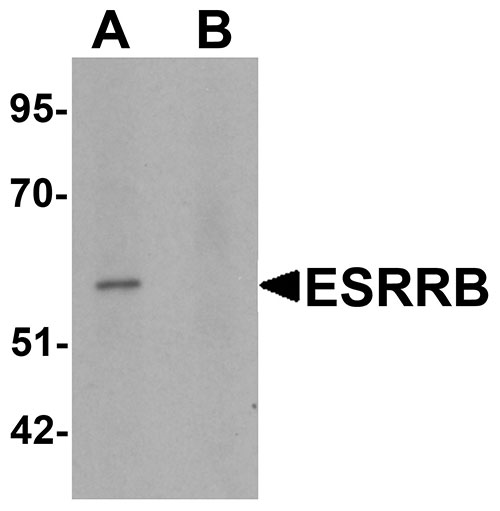
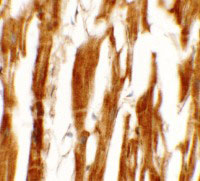
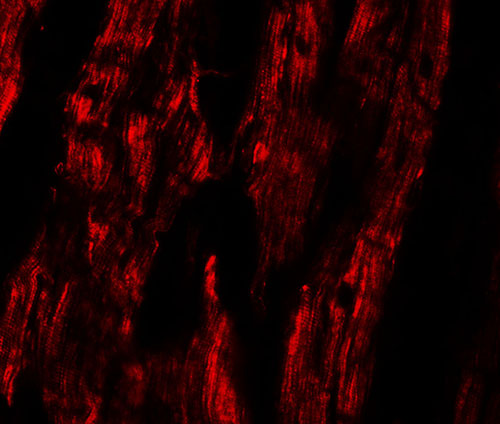
| Application Notes | ESRRB antibody can be used for detection of ESRRB by Western blot at 1 µg/mL. Antibody can also be used for immunohistochemistry starting at 5 µg/mL. For immunofluorescence start at 5 µg/mL. |
| Gene ID | 2103 |
|---|---|
| Other Names | Steroid hormone receptor ERR2, ERR beta-2, Estrogen receptor-like 2, Estrogen-related receptor beta, ERR-beta, Nuclear receptor subfamily 3 group B member 2, ESRRB, ERRB2, ESRL2, NR3B2 |
| Target/Specificity | ESRRB; |
| Reconstitution & Storage | ESRRB antibody can be stored at 4℃ for three months and -20℃, stable for up to one year. As with all antibodies care should be taken to avoid repeated freeze thaw cycles. Antibodies should not be exposed to prolonged high temperatures. |
| Precautions | ESRRB Antibody is for research use only and not for use in diagnostic or therapeutic procedures. |
For Research Use Only. Not For Use In Diagnostic Procedures.
| Name | ESRRB (HGNC:3473) |
|---|---|
| Synonyms | ERRB2, ESRL2, NR3B2 |
| Function | [Isoform 3]: Transcription factor that binds a canonical ESRRB recognition (ERRE) sequence 5'TCAAGGTCA-3' localized on promoter and enhancer of targets genes regulating their expression or their transcription activity (PubMed:17920186, PubMed:19755138). Plays a role, in a LIF-independent manner, in maintainance of self-renewal and pluripotency of embryonic and trophoblast stem cells through different signaling pathways including FGF signaling pathway and Wnt signaling pathways. Involved in morula development (2-16 cells embryos) by acting as a regulator at the 8-cell stage (By similarity). Upon FGF signaling pathway activation, interacts with KDM1A by directly binding to enhancer site of ELF5 and EOMES and activating their transcription leading to self-renewal of trophoblast stem cells. Also regulates expression of multiple rod-specific genes and is required for survival of this cell type (By similarity). Plays a role as transcription factor activator of GATA6, NR0B1, POU5F1 and PERM1 (PubMed:23836911). Plays a role as transcription factor repressor of NFE2L2 transcriptional activity and ESR1 transcriptional activity (PubMed:17920186, PubMed:19755138). During mitosis remains bound to a subset of interphase target genes, including pluripotency regulators, through the canonical ESRRB recognition (ERRE) sequence, leading to their transcriptional activation in early G1 phase. Can coassemble on structured DNA elements with other transcription factors like SOX2, POU5F1, KDM1A and NCOA3 to trigger ESRRB-dependent gene activation. This mechanism, in the case of SOX2 corecruitment prevents the embryonic stem cells (ESCs) to epiblast stem cells (EpiSC) transition through positive regulation of NR0B1 that inhibits the EpiSC transcriptional program. Also plays a role inner ear development by controlling expression of ion channels and transporters and in early placentation (By similarity). |
| Cellular Location | Nucleus. Cytoplasm {ECO:0000250|UniProtKB:Q61539}. Chromosome {ECO:0000250|UniProtKB:Q61539} |
Provided below are standard protocols that you may find useful for product applications.
BACKGROUND
ESRRB Antibody: The estrogen-related receptor beta (ESRRB) was initially identified in mouse embryonic carcinoma stem cells and was found to be expressed exclusively in trophoblast progenitor cells between days 6.5 and 7.5 post coitum. Recent studies have shown that ESRRB is part of an POU5F1/Oct4-centered protein interaction network in embryonic stem (ES) cells. It is thought to interact with other ES transcription factors such as NANOG within this network, activating POU5F1 transcription and thereby sustaining self-renewal and pluripotency in ES cells.
REFERENCES
Pettersson K, Svensson K, Mattsson R, et al. Expression of a novel member of estrogen response element-binding nuclear receptors is restricted to the early stages of chorion formation during mouse embryogenesis. Mech. Dev. 1996; 54:211-23.
van den Berg DL, Snoek T, Mullin NP, et al. An Oct4-centered protein interaction network in embryonic stem cells. Cell Stem Cell 2010; 6:369-81.
Zhang X, Zhang J, Wang T, et al. Esrrb activates Oct4 transcription and sustains self-renewal and pluripotency in embryonic stem cells. J. Biol. Chem. 2008; 283:35825-33.

终于等到您。ABCEPTA(百远生物)抗体产品。
点击下方“我要评价 ”按钮提交您的反馈信息,您的反馈和评价是我们最宝贵的财富之一,
我们将在1-3个工作日内处理您的反馈信息。
如有疑问,联系:0512-88856768 tech-china@abcepta.com.


