


 癌症的基本特征包括细胞增殖、血管生成、迁移、凋亡逃避机制和细胞永生等。找到癌症发生过程中这些通路的关键标记物和对应的抗体用于检测至关重要。
 为您推荐一个泛素化位点预测神器——泛素化分析工具,可以为您的蛋白的泛素化位点作出预测和评分。
 细胞自噬受体图形绘图工具为你的蛋白的细胞受体结合位点作出预测和评分,识别结合到自噬通路中的蛋白是非常重要的,便于让我们理解自噬在正常生理、病理过程中的作用,如发育、细胞分化、神经退化性疾病、压力条件下、感染和癌症。
CCDC22 Antibody
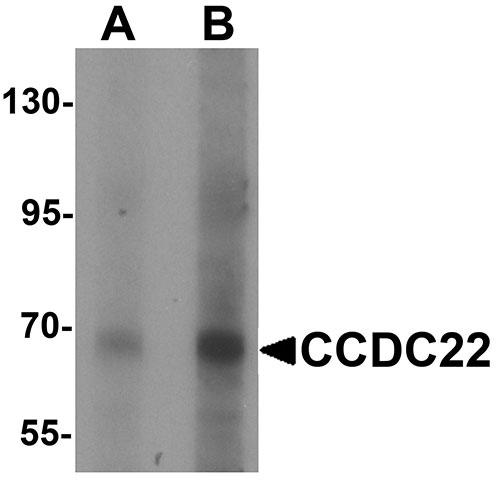
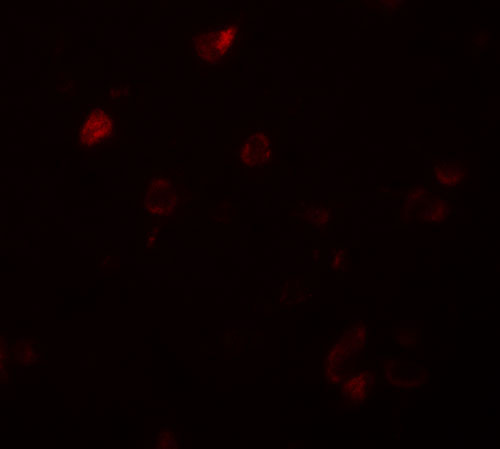
- 产品详情
- 实验流程
- 背景知识
Application 
| WB, IF, E |
|---|---|
| Primary Accession | O60826 |
| Other Accession | NP_054727, 7661844 |
| Reactivity | Human, Mouse, Rat |
| Host | Rabbit |
| Clonality | Polyclonal |
| Isotype | IgG |
| Calculated MW | 70756 Da |
| Concentration (mg/ml) | 1 mg/mL |
| Conjugate | Unconjugated |
| Application Notes | CCDC22 antibody can be used for detection of CCDC22 by Western blot at 1 - 2 µg/mL. For immunofluorescence start at 20 µg/mL. |
| Gene ID | 28952 |
|---|---|
| Other Names | Coiled-coil domain-containing protein 22, CCDC22, CXorf37 |
| Target/Specificity | CCDC22; At least three isoforms of CCDC22 are known to exist; this antibody will detect the two largest isoforms. |
| Reconstitution & Storage | CCDC22 antibody can be stored at 4℃ for three months and -20℃, stable for up to one year. As with all antibodies care should be taken to avoid repeated freeze thaw cycles. Antibodies should not be exposed to prolonged high temperatures. |
| Precautions | CCDC22 Antibody is for research use only and not for use in diagnostic or therapeutic procedures. |
For Research Use Only. Not For Use In Diagnostic Procedures.
| Name | CCDC22 |
|---|---|
| Synonyms | CXorf37 |
| Function | Component of the commander complex that is essential for endosomal recycling of transmembrane cargos; the Commander complex is composed of composed of the CCC subcomplex and the retriever subcomplex (PubMed:37172566, PubMed:38459129). Component of the CCC complex, which is involved in the regulation of endosomal recycling of surface proteins, including integrins, signaling receptor and channels (PubMed:37172566, PubMed:38459129). Involved in regulation of NF-kappa- B signaling (PubMed:23563313). Promotes ubiquitination of I-kappa-B- kinase subunit IKBKB and its subsequent proteasomal degradation leading to NF-kappa-B activation; the function may involve association with COMMD8 and a CUL1-dependent E3 ubiquitin ligase complex (PubMed:23563313). May down-regulate NF-kappa-B activity via association with COMMD1 and involving a CUL2-dependent E3 ubiquitin ligase complex. Regulates the cellular localization of COMM domain- containing proteins, such as COMMD1 and COMMD10 (PubMed:23563313). Component of the CCC complex, which is involved in the regulation of endosomal recycling of surface proteins, including integrins, signaling receptor and channels. The CCC complex associates with SNX17, retriever and WASH complexes to prevent lysosomal degradation and promote cell surface recycling of numerous cargos such as integrins ITGA5:ITGB1 (PubMed:25355947, PubMed:28892079). Plays a role in copper ion homeostasis (PubMed:25355947). Involved in copper-dependent ATP7A trafficking between the trans-Golgi network and vesicles in the cell periphery; the function is proposed to depend on its association within the CCC complex and cooperation with the WASH complex on early endosomes (PubMed:25355947). |
| Cellular Location | Endosome. Cytoplasm, cytoskeleton, microtubule organizing center, centrosome |
| Tissue Location | Widely expressed in adult tissues and in fetal liver and brain, with highest levels in prostate and lowest in skeletal muscle. |
Provided below are standard protocols that you may find useful for product applications.
BACKGROUND
CCDC22 Antibody: CCDC22 is a recently identified coiled-coil domain-containing protein that has been shown to bind copines, which are calcium-dependent, membrane-binding proteins that may function in calcium signaling. In rat, CCDC22 has been observed to localize in multiple regions of the brain, including the prefrontal and somatosensory cortex, dentate gyrus and thalamus, and in the ipsilateral motor neurons of the spinal cord after sciatic nerve transection suggesting that it may play a role in neuronal injury response. The human CCDC22 gene has been identified as a novel candidate gene for syndromic X-linked intellectual disability (XLID).
REFERENCES
Tomsig JL, Snyder SL, and Creutz CE. Identification of targets for calcium signaling through the copine family of proteins. J. Biol. Chem. 2003; 278:10048-54.
Mulder J, Bjorling E, Jonasson K, et al. Tissue profiling of the mammalian central nervous system using human antibody-based proteomics. Mol. Cell Prot. 2009; 8:1612-22.
Mulder J, Wernerus H, Shi TJ, et al. Systematically generated antibodies against human gene products: high throughput screening on sections from the rat nervous system. Neurosci.2007; 146:1689-703
Voineagu I, Huang L, Winden K, et al. CCDC22: a novel candidate gene for syndromic X-linked intellectual disability. Mol. Psych. 2012; 17:4-7.

终于等到您。ABCEPTA(百远生物)抗体产品。
点击下方“我要评价 ”按钮提交您的反馈信息,您的反馈和评价是我们最宝贵的财富之一,
我们将在1-3个工作日内处理您的反馈信息。
如有疑问,联系:0512-88856768 tech-china@abcepta.com.


