


 癌症的基本特征包括细胞增殖、血管生成、迁移、凋亡逃避机制和细胞永生等。找到癌症发生过程中这些通路的关键标记物和对应的抗体用于检测至关重要。
 为您推荐一个泛素化位点预测神器——泛素化分析工具,可以为您的蛋白的泛素化位点作出预测和评分。
 细胞自噬受体图形绘图工具为你的蛋白的细胞受体结合位点作出预测和评分,识别结合到自噬通路中的蛋白是非常重要的,便于让我们理解自噬在正常生理、病理过程中的作用,如发育、细胞分化、神经退化性疾病、压力条件下、感染和癌症。
EED Antibody
- 产品详情
- 实验流程
- 背景知识
Application 
| WB, IF, E |
|---|---|
| Primary Accession | O75530 |
| Other Accession | NP_003788, 24041020 |
| Reactivity | Human, Mouse, Rat |
| Host | Rabbit |
| Clonality | Polyclonal |
| Isotype | IgG |
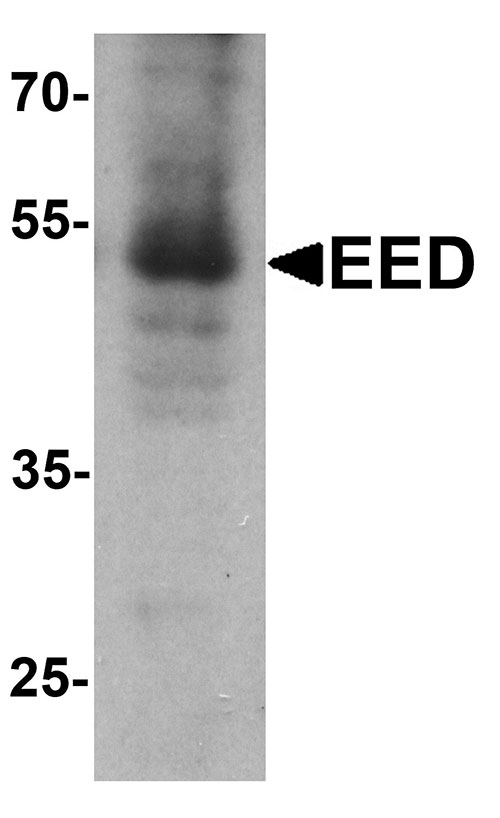
| Calculated MW | 50198 Da |
| Concentration (mg/ml) | 1 mg/mL |
| Conjugate | Unconjugated |
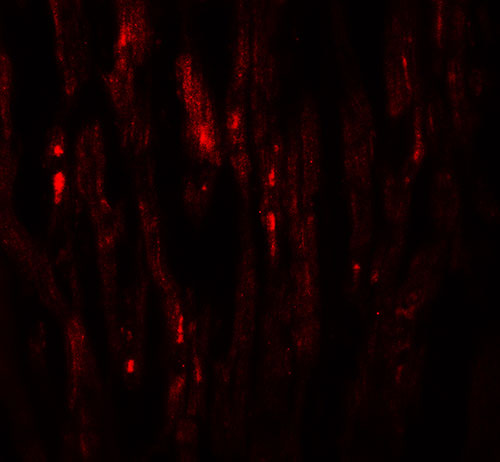
| Application Notes | EED antibody can be used for detection of EED by Western blot at 1 µg/mL. For immunofluorescence start at 20 µg/mL. |
| Gene ID | 8726 |
|---|---|
| Other Names | Polycomb protein EED, hEED, WD protein associating with integrin cytoplasmic tails 1, WAIT-1, EED |
| Target/Specificity | EED; Four alternatively spliced transcript variants have been observed. |
| Reconstitution & Storage | EED antibody can be stored at 4℃ for three months and -20℃, stable for up to one year. As with all antibodies care should be taken to avoid repeated freeze thaw cycles. Antibodies should not be exposed to prolonged high temperatures. |
| Precautions | EED Antibody is for research use only and not for use in diagnostic or therapeutic procedures. |
For Research Use Only. Not For Use In Diagnostic Procedures.
| Name | EED (HGNC:3188) |
|---|---|
| Function | Polycomb group (PcG) protein. Component of the PRC2/EED-EZH2 complex, which methylates 'Lys-9' and 'Lys-27' of histone H3, leading to transcriptional repression of the affected target gene. Also recognizes 'Lys-26' trimethylated histone H1 with the effect of inhibiting PRC2 complex methyltransferase activity on nucleosomal histone H3 'Lys-27', whereas H3 'Lys-27' recognition has the opposite effect, enabling the propagation of this repressive mark. The PRC2/EED- EZH2 complex may also serve as a recruiting platform for DNA methyltransferases, thereby linking two epigenetic repression systems. Genes repressed by the PRC2/EED-EZH2 complex include HOXC8, HOXA9, MYT1 and CDKN2A. |
| Cellular Location | Nucleus. Chromosome. Note=Transiently colocalizes with XIST at inactive X chromosomes |
| Tissue Location | Expressed in brain, colon, heart, kidney, liver, lung, muscle, ovary, peripheral blood leukocytes, pancreas, placenta, prostate, spleen, small intestine, testis, thymus and uterus. Appears to be overexpressed in breast and colon cancer |
Provided below are standard protocols that you may find useful for product applications.
BACKGROUND
EED Antibody: The EED protein (WAIT-1 or WD protein associated with integrin cytoplasmic tails-1), also called embryonic ectoderm development, is a member of the superfamily of WD-40 repeat proteins and widely conserved polycomb group (PcG) family of proteins. The polycomb group (PcG) is a large and evolutionarily conserved set of genes whose products act in multimeric complexes to modify histones, which are then thought to cause stable and heritable states of transcriptional repression. EED shuttles between the nucleus and the plasma membrane and can interact with the cytoplasmic tail of integrin β7 subunit. EED exerted an antiviral activity at the late stage of HIV-1 replication.
REFERENCES
Rietzler M, Bittner M, Kolanus W, et al. The human WD repeat protein WAIT-1 specifically interacts with the cytoplasmic tails of beta7-integrins. J. Biol. Chem. 1998; 273:27459-66.
Brock HW and Fisher CL. Maintenance of gene expression patterns. Dev Dyn. 2005; 232:633-55.
Levine SS, King IF, Kingston RE, et al. Division of labor in polycomb group repression. Trends Biochem. Sci. 2004; 29: 478-85.
Van der Vlag J and Otte AP. Transcriptional repression mediated by the human Polycomb-group protein EED involves histone deacetylation. Nat. Genet.1999; 23:474-8.

终于等到您。ABCEPTA(百远生物)抗体产品。
点击下方“我要评价 ”按钮提交您的反馈信息,您的反馈和评价是我们最宝贵的财富之一,
我们将在1-3个工作日内处理您的反馈信息。
如有疑问,联系:0512-88856768 tech-china@abcepta.com.


