


 癌症的基本特征包括细胞增殖、血管生成、迁移、凋亡逃避机制和细胞永生等。找到癌症发生过程中这些通路的关键标记物和对应的抗体用于检测至关重要。
 为您推荐一个泛素化位点预测神器——泛素化分析工具,可以为您的蛋白的泛素化位点作出预测和评分。
 细胞自噬受体图形绘图工具为你的蛋白的细胞受体结合位点作出预测和评分,识别结合到自噬通路中的蛋白是非常重要的,便于让我们理解自噬在正常生理、病理过程中的作用,如发育、细胞分化、神经退化性疾病、压力条件下、感染和癌症。
BATF Antibody
- 产品详情
- 实验流程
- 背景知识
Application 
| WB, IF, E |
|---|---|
| Primary Accession | Q16520 |
| Other Accession | NP_006390, 5453563 |
| Reactivity | Human, Mouse, Rat |
| Host | Rabbit |
| Clonality | Polyclonal |
| Isotype | IgG |
| Calculated MW | 14120 Da |
| Concentration (mg/ml) | 1 mg/mL |
| Conjugate | Unconjugated |
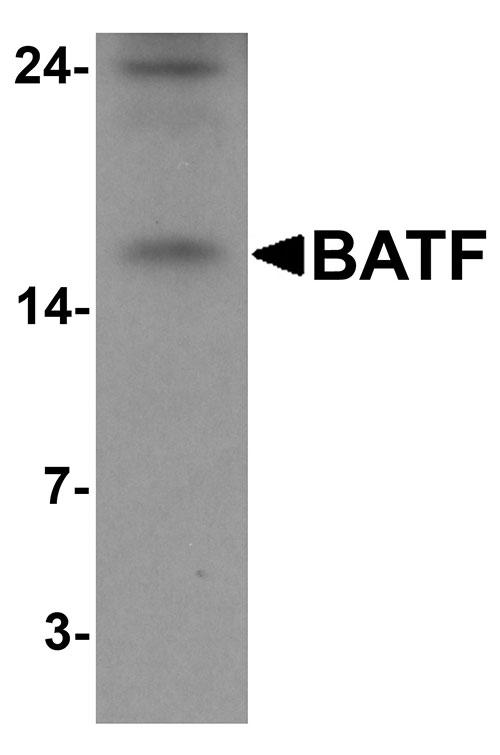
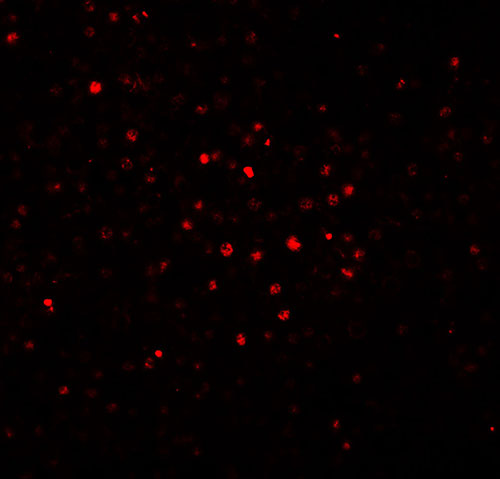
| Application Notes | BATF antibody can be used for detection of BATF by Western blot at 0.5 µg/mL. For immunofluorescence start at 20 µg/mL. |
| Gene ID | 10538 |
|---|---|
| Other Names | Basic leucine zipper transcriptional factor ATF-like, B-cell-activating transcription factor, B-ATF, SF-HT-activated gene 2 protein, SFA-2, BATF |
| Target/Specificity | BATF; Multiple isoforms of BATF are known to exist. Despite its predicted molecular weight, BATF often migrates at a higher than expected molecular weight. |
| Reconstitution & Storage | BATF antibody can be stored at 4℃ for three months and -20℃, stable for up to one year. As with all antibodies care should be taken to avoid repeated freeze thaw cycles. Antibodies should not be exposed to prolonged high temperatures. |
| Precautions | BATF Antibody is for research use only and not for use in diagnostic or therapeutic procedures. |
For Research Use Only. Not For Use In Diagnostic Procedures.
| Name | BATF |
|---|---|
| Function | AP-1 family transcription factor that controls the differentiation of lineage-specific cells in the immune system: specifically mediates the differentiation of T-helper 17 cells (Th17), follicular T-helper cells (TfH), CD8(+) dendritic cells and class- switch recombination (CSR) in B-cells. Acts via the formation of a heterodimer with JUNB that recognizes and binds DNA sequence 5'- TGA[CG]TCA-3'. The BATF-JUNB heterodimer also forms a complex with IRF4 (or IRF8) in immune cells, leading to recognition of AICE sequence (5'- TGAnTCA/GAAA-3'), an immune-specific regulatory element, followed by cooperative binding of BATF and IRF4 (or IRF8) and activation of genes. Controls differentiation of T-helper cells producing interleukin-17 (Th17 cells) by binding to Th17-associated gene promoters: regulates expression of the transcription factor RORC itself and RORC target genes such as IL17 (IL17A or IL17B). Also involved in differentiation of follicular T-helper cells (TfH) by directing expression of BCL6 and MAF. In B-cells, involved in class-switch recombination (CSR) by controlling the expression of both AICDA and of germline transcripts of the intervening heavy-chain region and constant heavy-chain region (I(H)-C(H)). Following infection, can participate in CD8(+) dendritic cell differentiation via interaction with IRF4 and IRF8 to mediate cooperative gene activation. Regulates effector CD8(+) T-cell differentiation by regulating expression of SIRT1. Following DNA damage, part of a differentiation checkpoint that limits self-renewal of hematopoietic stem cells (HSCs): up-regulated by STAT3, leading to differentiation of HSCs, thereby restricting self-renewal of HSCs (By similarity). |
| Cellular Location | Nucleus {ECO:0000255|PROSITE-ProRule:PRU00978}. Cytoplasm. Note=Present in the nucleus and cytoplasm, but shows increased nuclear translocation after activation of T-cells |
| Tissue Location | Expressed at highest levels in lung, and at lower levels in placenta, liver, kidney, spleen, and peripheral blood Detected in SW480 colorectal cancer cell line and several hematopoietic tumor cell lines, including Raji Burkitt's lymphoma. Strongly expressed in mature B- and T-lymphocytes. Also expressed in moderate levels in lymph node and appendix and at low levels in thymus and bone marrow (PubMed:10777209). |
Provided below are standard protocols that you may find useful for product applications.
BACKGROUND
BATF Antibody: BATF is a nuclear basic leucine zipper protein that belongs to the AP-1/ATF superfamily of transcription factors. The leucine zipper of this protein mediates dimerization with members of the Jun family of proteins. This protein is thought to be a negative regulator of AP-1/ATF transcriptional events and blocks cellular transformation by Ras and Fos. BATF also is required for the differentiation of IL-17-producing T helper (TH17) cells, a CD4+ subset of T cells that coordinates the inflammatory response in host defense. In both T cells and B cells, BATF is required for the appropriate regulation of the class-switch recombination.
REFERENCES
Dorsey MJ, Tae HJ, Sollenberger KG, et al. B-ATF: a novel human bZIP protein that associates with members of the AP-1 transcription factor family. Oncogene 1995; 11:2255-65.
Echlin DR, Tae HJ, Mitin N, et al. B-ATF functions as a negative regulator of AP-1 mediated transcription and blocks cellular transformation by Ras and Fos. Oncogene 2000; 19:1752-63.
Schraml BU, Hildner K, Ise W, et al. The AP-1 transcription factor Batf controls TH17 differentiation. Nature 2009; 460:405-9.
Ise W, Kohyama M, Schraml BU, et al. The transcription factor BATF controls the global regulators of class-switch recombination in both B cells and T cells. Nat. Immunol. 2011; 12:536-43.

终于等到您。ABCEPTA(百远生物)抗体产品。
点击下方“我要评价 ”按钮提交您的反馈信息,您的反馈和评价是我们最宝贵的财富之一,
我们将在1-3个工作日内处理您的反馈信息。
如有疑问,联系:0512-88856768 tech-china@abcepta.com.


