


 癌症的基本特征包括细胞增殖、血管生成、迁移、凋亡逃避机制和细胞永生等。找到癌症发生过程中这些通路的关键标记物和对应的抗体用于检测至关重要。
 为您推荐一个泛素化位点预测神器——泛素化分析工具,可以为您的蛋白的泛素化位点作出预测和评分。
 细胞自噬受体图形绘图工具为你的蛋白的细胞受体结合位点作出预测和评分,识别结合到自噬通路中的蛋白是非常重要的,便于让我们理解自噬在正常生理、病理过程中的作用,如发育、细胞分化、神经退化性疾病、压力条件下、感染和癌症。
NELF Antibody
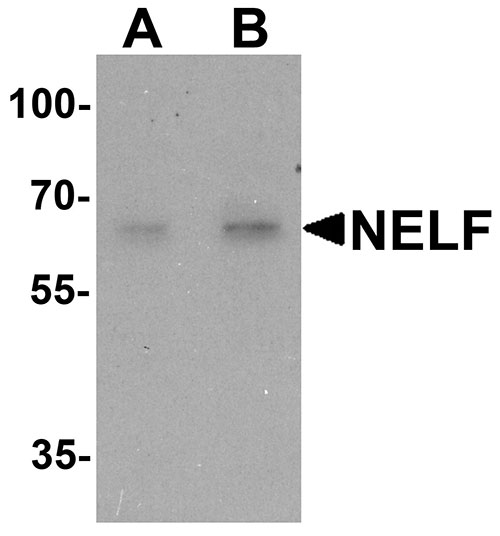
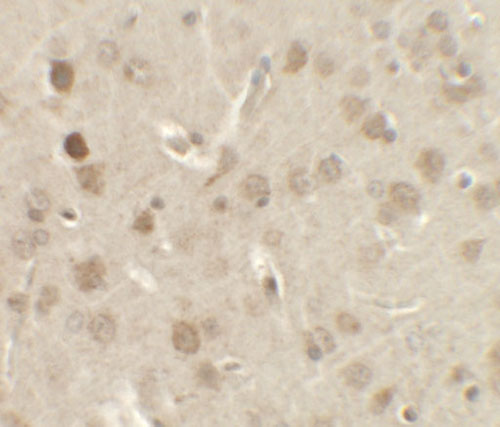
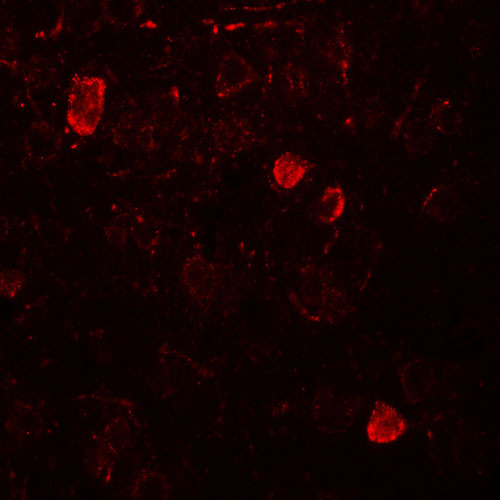
- 产品详情
- 实验流程
- 背景知识
Application 
| WB, IF, E, IHC-P |
|---|---|
| Primary Accession | Q6X4W1 |
| Other Accession | NP_056352, 46397396 |
| Reactivity | Human, Mouse, Rat |
| Host | Rabbit |
| Clonality | Polyclonal |
| Isotype | IgG |
| Calculated MW | 60143 Da |
| Concentration (mg/ml) | 1 mg/mL |
| Conjugate | Unconjugated |
| Application Notes | NELF antibody can be used for detection of NELF by Western blot at 1 - 2 µg/mL. |
| Gene ID | 26012 |
|---|---|
| Other Names | NMDA receptor synaptonuclear signaling and neuronal migration factor, Nasal embryonic luteinizing hormone-releasing hormone factor, Nasal embryonic LHRH factor, NSMF, NELF |
| Target/Specificity | NELF; |
| Reconstitution & Storage | NELF antibody can be stored at 4℃ for three months and -20℃, stable for up to one year. |
| Precautions | NELF Antibody is for research use only and not for use in diagnostic or therapeutic procedures. |
For Research Use Only. Not For Use In Diagnostic Procedures.
| Name | NSMF |
|---|---|
| Synonyms | NELF |
| Function | Couples NMDA-sensitive glutamate receptor signaling to the nucleus and triggers long-lasting changes in the cytoarchitecture of dendrites and spine synapse processes. Part of the cAMP response element-binding protein (CREB) shut-off signaling pathway. Stimulates outgrowth of olfactory axons and migration of gonadotropin-releasing hormone (GnRH) and luteinizing-hormone-releasing hormone (LHRH) neuronal cells. |
| Cellular Location | Nucleus. Nucleus envelope. Nucleus membrane. Nucleus matrix. Cytoplasm. Cytoplasm, cell cortex. Cytoplasm, cytoskeleton. Cell membrane; Peripheral membrane protein. Cell projection, dendrite Synapse. Synapse, synaptosome. Postsynaptic density. Membrane. Note=Found on the outside of the luteinizing-hormone-releasing hormone (LHRH) cell membrane and axons projecting from the olfactory pit and epithelium Associates with transcriptionally active chromatin regions. Detected at the nuclear membranes of CA1 neurons. Cortical cytoskeleton. Localized in proximal apical dendrites. Colocalizes with CABP1 in dendrites and dendritic spines. Myristoylation is a prerequisite for extranuclear localization. Translocates from dendrites to the nucleus during NMDA receptor-dependent long-term potentiation (LTP) induction of synaptic transmission at Schaffer collateral/CA1 synapses of hippocampal primary neurons and in a importin-dependent manner (By similarity) |
| Tissue Location | Highly expressed in adult and fetal brain. Weakly expressed in heart, liver, spleen, testis, small intestine, skeletal muscle, peripheral white blood cells and kidney |
Provided below are standard protocols that you may find useful for product applications.
BACKGROUND
NELF Antibody: NELF (nasal embryonic luteinizing hormone-releasing hormone factor) is a 530 amino acid transcription factor involved in the migration of LHRH neurons, outgrowth of olfactory axons and suppression of transcription elongation. NELF is found in the peripheral and central nervous system during embryonic development, and is highly expressed in adult testis, kidney and brain. Known to couple NMDA receptor signaling to the nucleus, NELF knockdown impaired GnRH neuronal migration of NLT cells in vitro and the gene encoding NELF has been linked to the development of Idiopathic hypogonadotropic hypogonadism (IHH), a disorder resulting in impaired pubertal maturation and reproductive function.
REFERENCES
Kramer PR and Wray S. Novel gene expressed in nasal region influences outgrowth of olfactory axons and migration of luteinizing hormone-releasing hormone (LHRH) neurons. Genes Dev. 2000; 14:1824-34.
Yung TM, Narita T, Komori T, et al. Cellular dynamics of the negative transcription elongation factor NELF. Exp. Cell Res. 2009; 315:1693-705.
Xu N, Bhagavath B, Kim HG, et al. NELF is a nuclear protein involved in hypothalamic GnRH neuronal migration. Mol. Cell Endocrinol. 2010; 319:47-55.
Miura K, Acierno JS and Seminara SB. Characterization of the human nasal embryonic LHRH factor gene, NELF, and a mutation screening among 65 patients with idiopathic hypogonadotropic hypogonadism (IHH). J. Hum. Genet. 2004; 49: 265-8.

终于等到您。ABCEPTA(百远生物)抗体产品。
点击下方“我要评价 ”按钮提交您的反馈信息,您的反馈和评价是我们最宝贵的财富之一,
我们将在1-3个工作日内处理您的反馈信息。
如有疑问,联系:0512-88856768 tech-china@abcepta.com.


