


 癌症的基本特征包括细胞增殖、血管生成、迁移、凋亡逃避机制和细胞永生等。找到癌症发生过程中这些通路的关键标记物和对应的抗体用于检测至关重要。
 为您推荐一个泛素化位点预测神器——泛素化分析工具,可以为您的蛋白的泛素化位点作出预测和评分。
 细胞自噬受体图形绘图工具为你的蛋白的细胞受体结合位点作出预测和评分,识别结合到自噬通路中的蛋白是非常重要的,便于让我们理解自噬在正常生理、病理过程中的作用,如发育、细胞分化、神经退化性疾病、压力条件下、感染和癌症。
DIS3 Antibody
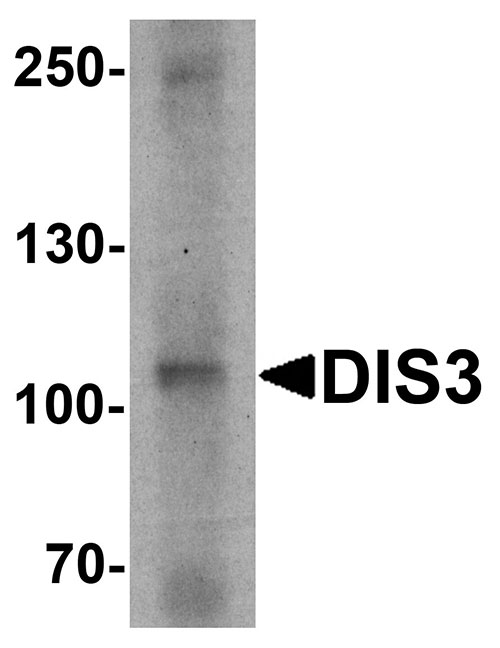
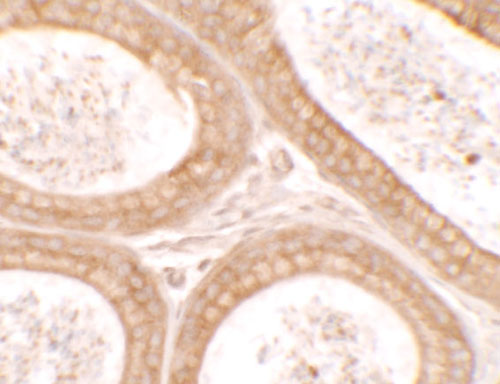

- 产品详情
- 实验流程
- 背景知识
Application 
| WB, IF, E, IHC-P |
|---|---|
| Primary Accession | Q9Y2L1 |
| Other Accession | NP_055768, 190014623 |
| Reactivity | Human, Mouse, Rat |
| Host | Rabbit |
| Clonality | Polyclonal |
| Isotype | IgG |
| Calculated MW | 109003 Da |
| Concentration (mg/ml) | 1 mg/mL |
| Conjugate | Unconjugated |
| Application Notes | DIS3 antibody can be used for detection of DIS3 by Western blot at 1 - 2 µg/mL. |
| Gene ID | 22894 |
|---|---|
| Other Names | Exosome complex exonuclease RRP44, 3.1.13.-, 3.1.26.-, Protein DIS3 homolog, Ribosomal RNA-processing protein 44, DIS3, KIAA1008, RRP44 |
| Target/Specificity | DIS3; Multiple isoforms of DIS3 are known to exist. |
| Reconstitution & Storage | DIS3 antibody can be stored at 4℃ for three months and -20℃, stable for up to one year. |
| Precautions | DIS3 Antibody is for research use only and not for use in diagnostic or therapeutic procedures. |
For Research Use Only. Not For Use In Diagnostic Procedures.
| Name | DIS3 |
|---|---|
| Synonyms | KIAA1008, RRP44 |
| Function | Putative catalytic component of the RNA exosome complex which has 3'->5' exoribonuclease activity and participates in a multitude of cellular RNA processing and degradation events. In the nucleus, the RNA exosome complex is involved in proper maturation of stable RNA species such as rRNA, snRNA and snoRNA, in the elimination of RNA processing by-products and non-coding 'pervasive' transcripts, such as antisense RNA species and promoter-upstream transcripts (PROMPTs), and of mRNAs with processing defects, thereby limiting or excluding their export to the cytoplasm. The RNA exosome may be involved in Ig class switch recombination (CSR) and/or Ig variable region somatic hypermutation (SHM) by targeting AICDA deamination activity to transcribed dsDNA substrates. In the cytoplasm, the RNA exosome complex is involved in general mRNA turnover and specifically degrades inherently unstable mRNAs containing AU-rich elements (AREs) within their 3' untranslated regions, and in RNA surveillance pathways, preventing translation of aberrant mRNAs. It seems to be involved in degradation of histone mRNA. DIS3 has both 3'-5' exonuclease and endonuclease activities. |
| Cellular Location | Cytoplasm. Nucleus, nucleolus. Nucleus, nucleoplasm. Nucleus Note=Predominantly located in the nucleus (PubMed:20531386). According to PubMed:12429849, found in the nucleolus (PubMed:12429849). According to PubMed:20531386, excluded from nucleolus supporting the existence of a nucleolar RNA exosome complex devoid of DIS3 (PubMed:20531386) |
| Tissue Location | Widely expressed. |
Provided below are standard protocols that you may find useful for product applications.
BACKGROUND
DIS3 Antibody: The exosome is involved in a multitude of cellular RNA processing and degradation events. DIS3, also known as exosome complex exonuclease RRP44, is a ribonuclease that acts directly in the processing, turnover, and surveillance of a large number of distinct RNA species. DIS3 localizes to both the cytoplasm and the nucleus and contains one PINc domain. It is widely expressed with highest expression in testis and is required for processing of 7S pre-RNA into a mature nuclear complex and, ultimately, for proper mitotic progression. Abnormal expression levels of DIS3 may be associated with colon cancer, suggesting a role for DIS3 in tumorigenesis.
REFERENCES
Chen CY, Gherzi R, Ong SE, et al. AU binding proteins recruit the exosome to degrade ARE-containing mRNAs. Cell 2001; 107:451-64.
Brouwer R, Allmang C, Raijmakers R, et al. Three novel components of the human exosome. J. Biol. Chem. 2001; 276:6177-84.
Schneider C, Anderson JT, Tollervey D, et al. The exosome subunit Rrp44 plays a direct role in RNA substrate recognition. Mol. Cell 2007; 27:324-31.
Murakami H, Goto DB, Toda T, et al. Ribonuclease activity of DIS3 is required for mitotic progression and provides a possible link between heterochromatin and kinetochore function. PLoS ONE 2007; 2:317.

终于等到您。ABCEPTA(百远生物)抗体产品。
点击下方“我要评价 ”按钮提交您的反馈信息,您的反馈和评价是我们最宝贵的财富之一,
我们将在1-3个工作日内处理您的反馈信息。
如有疑问,联系:0512-88856768 tech-china@abcepta.com.


