


 癌症的基本特征包括细胞增殖、血管生成、迁移、凋亡逃避机制和细胞永生等。找到癌症发生过程中这些通路的关键标记物和对应的抗体用于检测至关重要。
 为您推荐一个泛素化位点预测神器——泛素化分析工具,可以为您的蛋白的泛素化位点作出预测和评分。
 细胞自噬受体图形绘图工具为你的蛋白的细胞受体结合位点作出预测和评分,识别结合到自噬通路中的蛋白是非常重要的,便于让我们理解自噬在正常生理、病理过程中的作用,如发育、细胞分化、神经退化性疾病、压力条件下、感染和癌症。
IL-36G Antibody
- 产品详情
- 实验流程
- 背景知识
Application 
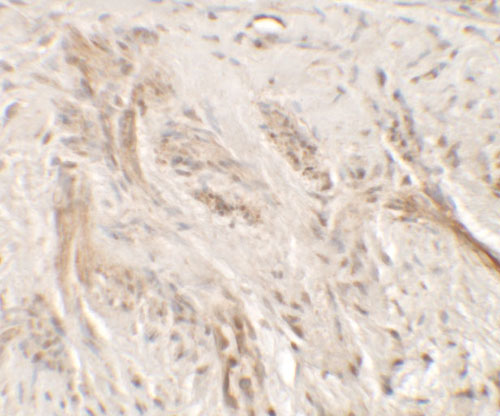
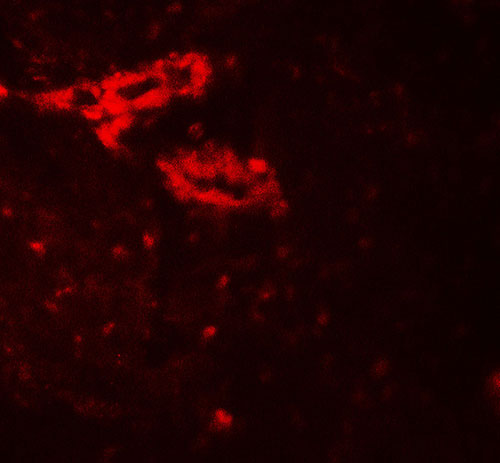
| WB, IF, E, IHC-P |
|---|---|
| Primary Accession | Q9NZH8 |
| Other Accession | NP_062564, 9665234 |
| Reactivity | Human |
| Host | Rabbit |
| Clonality | Polyclonal |
| Isotype | IgG |
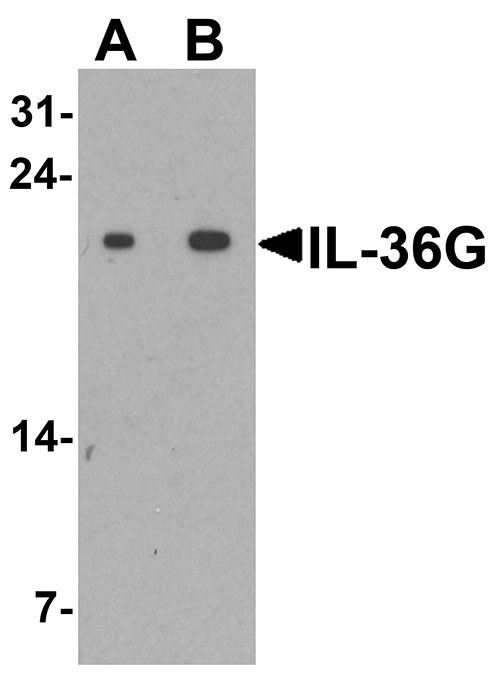
| Calculated MW | 18721 Da |
| Concentration (mg/ml) | 1 mg/mL |
| Conjugate | Unconjugated |
| Application Notes | IL-36G antibody can be used for detection of IL-36G by Western blot at 1 - 2 µg/ml. |
| Gene ID | 56300 |
|---|---|
| Other Names | Interleukin-36 gamma, IL-1-related protein 2, IL-1RP2, Interleukin-1 epsilon, IL-1 epsilon, Interleukin-1 family member 9, IL-1F9, Interleukin-1 homolog 1, IL-1H1, IL36G, IL1E, IL1F9, IL1H1, IL1RP2 |
| Target/Specificity | IL36G; IL-36G antibody is human specific. IL-36G antibody will not cross-react with IL-36A or IL-36B. |
| Reconstitution & Storage | IL-36G antibody can be stored at 4℃ for three months and -20℃, stable for up to one year. |
| Precautions | IL-36G Antibody is for research use only and not for use in diagnostic or therapeutic procedures. |
For Research Use Only. Not For Use In Diagnostic Procedures.
| Name | IL36G (HGNC:15741) |
|---|---|
| Function | Cytokine that binds to and signals through the IL1RL2/IL-36R receptor which in turn activates NF-kappa-B and MAPK signaling pathways in target cells. Part of the IL-36 signaling system that is thought to be present in epithelial barriers and to take part in local inflammatory response; similar to the IL-1 system with which it shares the coreceptor IL1RAP. Seems to be involved in skin inflammatory response by acting on keratinocytes, dendritic cells and indirectly on T-cells to drive tissue infiltration, cell maturation and cell proliferation. In cultured keratinocytes induces the expression of macrophage, T-cell, and neutrophil chemokines, such as CCL3, CCL4, CCL5, CCL2, CCL17, CCL22, CL20, CCL5, CCL2, CCL17, CCL22, CXCL8, CCL20 and CXCL1; also stimulates its own expression and that of the prototypic cutaneous pro-inflammatory parameters TNF, S100A7/psoriasin and inducible NOS. May play a role in pro-inflammatory responses during particular neutrophilic airway inflammation: activates mitogen- activated protein kinases and NF-kappa B in primary lung fibroblasts, and stimulates the expression of IL-8 and CXCL3 and Th17 chemokine CCL20 in lung fibroblasts. May be involved in the innate immune response to fungal pathogens, such as Aspergillus fumigatus. |
| Cellular Location | Cytoplasm. Secreted. Note=The secretion is dependent on protein unfolding and facilitated by the cargo receptor TMED10; it results in protein translocation from the cytoplasm into the ERGIC (endoplasmic reticulum-Golgi intermediate compartment) followed by vesicle entry and secretion. |
| Tissue Location | Highly expressed in tissues containing epithelial cells: skin, lung, stomach and esophagus. Expressed in bronchial epithelial. In skin is expressed only in keratinocytes but not in fibroblasts, endothelial cells or melanocytes. Up-regulated in lesional psoriasis skin. Expressed in monocyte-derived dendritic cells and M1 macrophages. |
Provided below are standard protocols that you may find useful for product applications.
BACKGROUND
IL-36G is is a member of the interleukin 1 cytokine family whose gene and eight other interleukin 1 family genes form a cytokine gene cluster on chromosome 2 (1). IL-36G is thought to activate the NF-kappaB pathway through IL-1 receptor family members IL-1RL2 and IL-1RAcP (2). Like the related proteins IL-36A and IL-36B, IL-36G requires post-translational processing for full agonist activity, but the cleavage mechanism is currently unknown (3). IL-36G expression is stimulated by interferon-gamma, tumor necrosis factor-alpha and interleukin 1 (4). The IL-36 cytokines have been suggested to amplify Th1 responses by enhancing proliferation and Th1 polarization of naive CD4+ T cells (5).
REFERENCES
Smith DE, Renshaw BR, Ketchem RR, et al. Four new members expand the interleukin-1 superfamily. J. Biol. Chem. 2000; 275:1169-75.
Towne JE, Garka KE, Renshaw BR, et al. Interleukin (IL)-1F6, IL-1F8, and IL-1F9 signal through IL-1Rrp2 and IL-1RAcP to activate the pathway leading to NF-kappaB and MAPKs. J. Biol. Chem. 2004; 279:13677-88.
Towne JE, Renshaw BR, Douangpanya J, et al. Interleukin-36 (IL-36) ligands require processing for full agonist agonist (IL-36a, IL-36b, and IL-36g) or antagonist (IL-36Ra) activity. J. Biol. Chem. 2011; 286:42594-602.
Chustz RT, Nagarkar DR, Popowski JA, et al. Regulation and function of the IL-1 family cytokine IL-1F9 in human bronchial epithelial cells. Am. J. Respir. Cell Mol. Biol. 2011; 45:145-53.

终于等到您。ABCEPTA(百远生物)抗体产品。
点击下方“我要评价 ”按钮提交您的反馈信息,您的反馈和评价是我们最宝贵的财富之一,
我们将在1-3个工作日内处理您的反馈信息。
如有疑问,联系:0512-88856768 tech-china@abcepta.com.


