


 癌症的基本特征包括细胞增殖、血管生成、迁移、凋亡逃避机制和细胞永生等。找到癌症发生过程中这些通路的关键标记物和对应的抗体用于检测至关重要。
 为您推荐一个泛素化位点预测神器——泛素化分析工具,可以为您的蛋白的泛素化位点作出预测和评分。
 细胞自噬受体图形绘图工具为你的蛋白的细胞受体结合位点作出预测和评分,识别结合到自噬通路中的蛋白是非常重要的,便于让我们理解自噬在正常生理、病理过程中的作用,如发育、细胞分化、神经退化性疾病、压力条件下、感染和癌症。
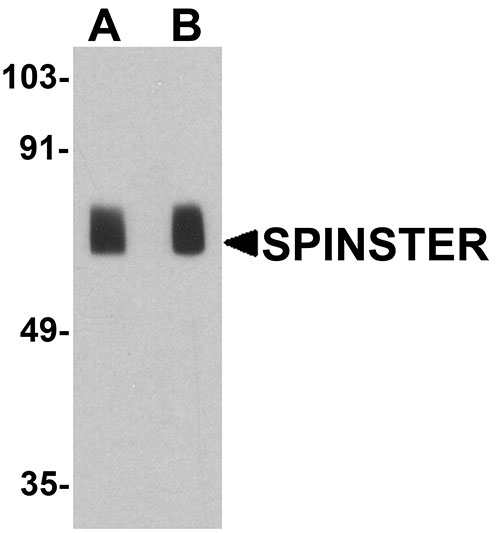
SPINSTER Antibody
- 产品详情
- 实验流程
- 背景知识
Application 
| WB, E |
|---|---|
| Primary Accession | Q9H2V7 |
| Other Accession | NP_001135920, 215490098 |
| Reactivity | Human |
| Host | Rabbit |
| Clonality | Polyclonal |
| Isotype | IgG |
| Calculated MW | 56630 Da |
| Concentration (mg/ml) | 1 mg/mL |
| Conjugate | Unconjugated |
| Application Notes | SPINSTER antibody can be used for detection of SPINSTER by Western blot at 1 - 2 µg/ml. |
| Gene ID | 83985 |
|---|---|
| Other Names | Protein spinster homolog 1, HSpin1, Spinster-like protein 1, SPNS1, SPIN1 |
| Target/Specificity | SPNS1; SPINSTER antibody is human specific. At least four isoforms of SPINSTER are known to exist. This antibody is predicted to not cross-react with other members of the spinster family of proteins. |
| Reconstitution & Storage | SPINSTER antibody can be stored at 4℃ for three months and -20℃, stable for up to one year. |
| Precautions | SPINSTER Antibody is for research use only and not for use in diagnostic or therapeutic procedures. |
For Research Use Only. Not For Use In Diagnostic Procedures.
| Name | SPNS1 |
|---|---|
| Synonyms | SPIN1 |
| Function | Plays a critical role in the phospholipid salvage pathway from lysosomes to the cytosol (PubMed:36161949, PubMed:37075117). Mediates the rate-limiting, proton-dependent, lysosomal efflux of lysophospholipids, which can then be reacylated by acyltransferases in the endoplasmic reticulum to form phospholipids (PubMed:36161949, PubMed:37075117). Selective for zwitterionic headgroups such as lysophosphatidylcholine (LPC) and lysophosphatidylethanolamine (LPE), can also transport lysophosphatidylglycerol (LPG), but not other anionic lysophospholipids, sphingosine, nor sphingomyelin (PubMed:36161949). Transports lysophospholipids with saturated, monounsaturated, and polyunsaturated fatty acids, such as 1- hexadecanoyl-sn-glycero-3-phosphocholine, 1-(9Z-octadecenoyl)-sn- glycero-3-phosphocholine and 1-(4Z,7Z,10Z,13Z,16Z,19Z-docosahexaenoyl)- sn-glycero-3-phosphocholine, respectively (PubMed:36161949, PubMed:37075117). Can also transport lysoplasmalogen (LPC with a fatty alcohol) such as 1-(1Z-hexadecenyl)-sn-glycero-3-phosphocholine (PubMed:36161949). Lysosomal LPC could function as intracellular signaling messenger (PubMed:37075117). Essential player in lysosomal homeostasis (PubMed:36161949). Crucial for cell survival under conditions of nutrient limitation (PubMed:37075117). May be involved in necrotic or autophagic cell death (PubMed:12815463). |
| Cellular Location | Lysosome membrane; Multi-pass membrane protein Mitochondrion inner membrane; Multi-pass membrane protein. Note=Ocassionally localizes to mitochondria. |
Provided below are standard protocols that you may find useful for product applications.
BACKGROUND
SPINSTER, also known as SPNS1 or SPIN1, is a 528 amino acid multi-pass membrane protein that localizes to the inner mitochondrial membrane and belongs to the spinster subfamily of the major facilitator superfamily (1). SPINSTER interacts with Bcl-x and Bcl-2 and, via this interaction, is thought to be involved in necrotic or autophagic cell death (2). The related protein SPNS2 is critical for the normal lymphocyte localization and mammalian immune system function (1,3).
REFERENCES
Saier MH Jr, Beatty JT, Goffeau A, et al. The major facilitator superfamily. J. Mol. Microbiol. Biotechnol. 1999; 1:257-79.
Yanagisawa H, Miyashita T, Nakano Y, et al. HSpin1, a transmembrane protein interacting with Bcl-2/Bcl-xL, induces a caspase-independent autophagic cell death. Cell Death Differ. 2003; 10:798-807.
Nakano Y, Fujitani K, Kurihara J, et al. Mutations in the novel membrane protein spinster interfere with programmed cell death and cause neural degeneration in Drosophila melanogaster. Mol. Cell. Biol. 2001; 21:3775-88.

终于等到您。ABCEPTA(百远生物)抗体产品。
点击下方“我要评价 ”按钮提交您的反馈信息,您的反馈和评价是我们最宝贵的财富之一,
我们将在1-3个工作日内处理您的反馈信息。
如有疑问,联系:0512-88856768 tech-china@abcepta.com.


