


 癌症的基本特征包括细胞增殖、血管生成、迁移、凋亡逃避机制和细胞永生等。找到癌症发生过程中这些通路的关键标记物和对应的抗体用于检测至关重要。
 为您推荐一个泛素化位点预测神器——泛素化分析工具,可以为您的蛋白的泛素化位点作出预测和评分。
 细胞自噬受体图形绘图工具为你的蛋白的细胞受体结合位点作出预测和评分,识别结合到自噬通路中的蛋白是非常重要的,便于让我们理解自噬在正常生理、病理过程中的作用,如发育、细胞分化、神经退化性疾病、压力条件下、感染和癌症。
TERF2 Antibody
- 产品详情
- 实验流程
- 背景知识
Application 
| WB, E, IHC-P |
|---|---|
| Primary Accession | Q15554 |
| Other Accession | NP_005643, 429535832 |
| Reactivity | Human |
| Host | Rabbit |
| Clonality | Polyclonal |
| Isotype | IgG |
| Calculated MW | 59594 Da |
| Concentration (mg/ml) | 1 mg/mL |
| Conjugate | Unconjugated |
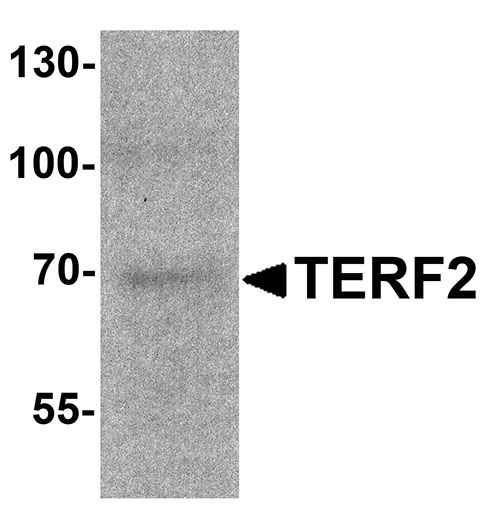
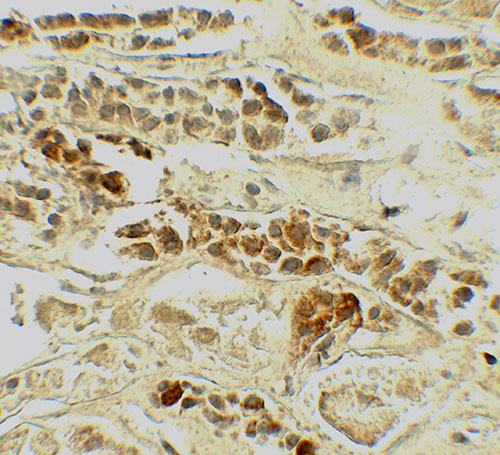
| Application Notes | TERF2 antibody can be used for detection of TERF2 by Western blot at 1 - 2 µg/ml. Antibody can also be used for Immunohistochemistry at 5 µg/mL. |
| Gene ID | 7014 |
|---|---|
| Other Names | Telomeric repeat-binding factor 2, TTAGGG repeat-binding factor 2, Telomeric DNA-binding protein, TERF2, TRBF2, TRF2 |
| Target/Specificity | TERF2; TERF2 antibody is human specific. |
| Reconstitution & Storage | TERF2 antibody can be stored at 4℃ for three months and -20℃, stable for up to one year. |
| Precautions | TERF2 Antibody is for research use only and not for use in diagnostic or therapeutic procedures. |
For Research Use Only. Not For Use In Diagnostic Procedures.
| Name | TERF2 |
|---|---|
| Synonyms | TRBF2, TRF2 {ECO:0000303|PubMed:28216226 |
| Function | Binds the telomeric double-stranded 5'-TTAGGG-3' repeat and plays a central role in telomere maintenance and protection against end-to-end fusion of chromosomes (PubMed:15608617, PubMed:16166375, PubMed:20655466, PubMed:28216226, PubMed:31595153, PubMed:9326950, PubMed:9326951, PubMed:9476899). In addition to its telomeric DNA- binding role, required to recruit a number of factors and enzymes required for telomere protection, including the shelterin complex, TERF2IP/RAP1 and DCLRE1B/Apollo (PubMed:16166375, PubMed:20655466). Component of the shelterin complex (telosome) that is involved in the regulation of telomere length and protection (PubMed:16166375). Shelterin associates with arrays of double-stranded 5'-TTAGGG-3' repeats added by telomerase and protects chromosome ends; without its protective activity, telomeres are no longer hidden from the DNA damage surveillance and chromosome ends are inappropriately processed by DNA repair pathways (PubMed:16166375). Together with DCLRE1B/Apollo, plays a key role in telomeric loop (T loop) formation by generating 3' single-stranded overhang at the leading end telomeres: T loops have been proposed to protect chromosome ends from degradation and repair (PubMed:20655466). Required both to recruit DCLRE1B/Apollo to telomeres and activate the exonuclease activity of DCLRE1B/Apollo (PubMed:20655466, PubMed:28216226). Preferentially binds to positive supercoiled DNA (PubMed:15608617, PubMed:20655466). Together with DCLRE1B/Apollo, required to control the amount of DNA topoisomerase (TOP1, TOP2A and TOP2B) needed for telomere replication during fork passage and prevent aberrant telomere topology (PubMed:20655466). Recruits TERF2IP/RAP1 to telomeres, thereby participating in to repressing homology-directed repair (HDR), which can affect telomere length (By similarity). |
| Cellular Location | Nucleus {ECO:0000255|PROSITE-ProRule:PRU00625, ECO:0000269|PubMed:20655466}. Chromosome, telomere. Note=Colocalizes with telomeric DNA in interphase cells and is located at chromosome ends during metaphase |
| Tissue Location | Ubiquitous. Highly expressed in spleen, thymus, prostate, uterus, testis, small intestine, colon and peripheral blood leukocytes. |
Provided below are standard protocols that you may find useful for product applications.
BACKGROUND
The telomeric repeat binding factor family (TERF1 and TERF2) plays a key role in cellular immortalization and cellular senescence (1). TERF2, as a component of the telomere nucleoprotein complex, is present at telomeres in metaphase of the cell cycle (2). TERF2 is a second negative regulator of telomere length and binds as a dimer to TTAGGG repeats at ends of chromosomes (telomeres), where it blocks inappropriate activation of the ATM/p53 pathway (2,3). TERF1 negatively regulates telomere elongation, while TERF2 protects the chromosome ends by inhibiting end-to-end fusions. Down-regulation of TRF expression in tumor cells may contribute to cell immortalization and malignant progression (4,5).
REFERENCES
Broccoli D, Smogorzewska A, Chong L, et al. Human telomeres contain two distinct Myb-related proteins, TRF1 and TRF2. Nat. Genet. 1997; 17:231-5.
Bilaud T, Brun C, Ancelin K, et al. Telomeric localization of TRF2, a novel human telobox protein. Nat. Genet. 1997; 17:236-9.
van Steensel B and Smogorzewska A. TRF2 protects human telomeres from end-to-end fusions. Cell 1998; 92:401-13.
Matsutani N, Yokozaki H, Tahara E, et al. Expression of TRF1 and 2 and TRF1-interacting nuclear protein 2 in human gastric carcinomas. Int. J. Oncol. 2001; 19:507-12.

终于等到您。ABCEPTA(百远生物)抗体产品。
点击下方“我要评价 ”按钮提交您的反馈信息,您的反馈和评价是我们最宝贵的财富之一,
我们将在1-3个工作日内处理您的反馈信息。
如有疑问,联系:0512-88856768 tech-china@abcepta.com.


