


 癌症的基本特征包括细胞增殖、血管生成、迁移、凋亡逃避机制和细胞永生等。找到癌症发生过程中这些通路的关键标记物和对应的抗体用于检测至关重要。
 为您推荐一个泛素化位点预测神器——泛素化分析工具,可以为您的蛋白的泛素化位点作出预测和评分。
 细胞自噬受体图形绘图工具为你的蛋白的细胞受体结合位点作出预测和评分,识别结合到自噬通路中的蛋白是非常重要的,便于让我们理解自噬在正常生理、病理过程中的作用,如发育、细胞分化、神经退化性疾病、压力条件下、感染和癌症。
UBIAD1 Antibody
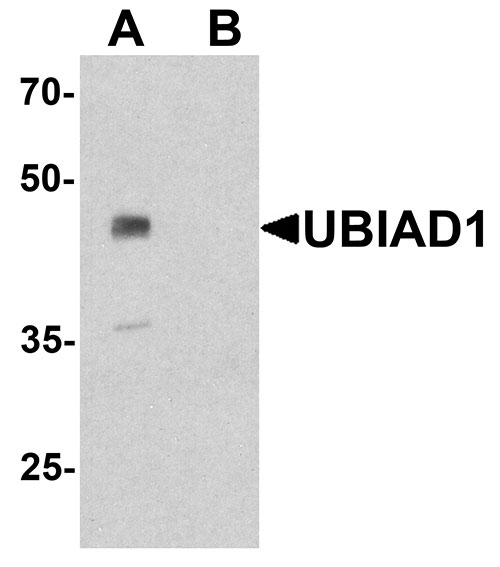
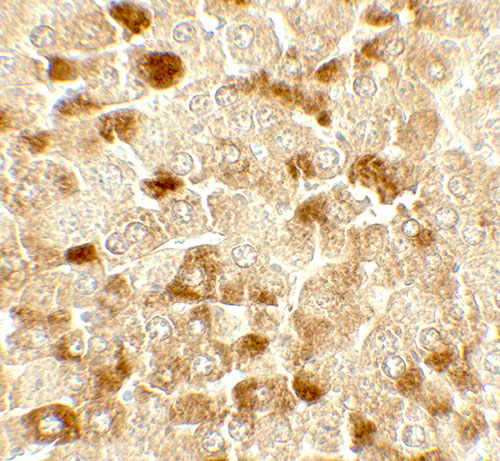
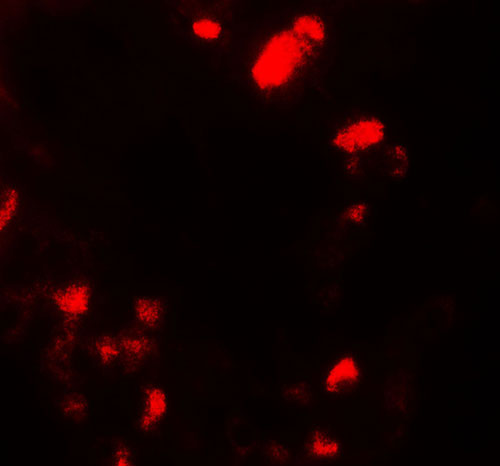
- 产品详情
- 实验流程
- 背景知识
Application 
| WB, IF, E, IHC-P |
|---|---|
| Primary Accession | Q9Y5Z9 |
| Other Accession | NP_037451, 7019551 |
| Reactivity | Human, Mouse, Rat |
| Host | Rabbit |
| Clonality | Polyclonal |
| Isotype | IgG |
| Calculated MW | 36831 Da |
| Concentration (mg/ml) | 1 mg/mL |
| Conjugate | Unconjugated |
| Application Notes | UBIAD1 antibody can be used for detection of UBIAD1 by Western blot at 1 - 2 µg/ml. Antibody can also be used for Immunohistochemistry at 5 µg/mL. For Immunoflorescence start at 20 µg/mL. |
| Gene ID | 29914 |
|---|---|
| Other Names | UbiA prenyltransferase domain-containing protein 1, 2.5.1.-, Transitional epithelial response protein 1, UBIAD1, TERE1 |
| Target/Specificity | UBIAD1; UBIAD1 antibody is human, mouse and rat reactive. |
| Reconstitution & Storage | UBIAD1 antibody can be stored at 4℃ for three months and -20℃, stable for up to one year. |
| Precautions | UBIAD1 Antibody is for research use only and not for use in diagnostic or therapeutic procedures. |
For Research Use Only. Not For Use In Diagnostic Procedures.
| Name | UBIAD1 {ECO:0000303|PubMed:20953171, ECO:0000312|HGNC:HGNC:30791} |
|---|---|
| Function | Prenyltransferase that mediates the formation of menaquinone- 4 (MK-4) and coenzyme Q10 (PubMed:20953171, PubMed:23374346). MK-4 is a vitamin K2 isoform present at high concentrations in the brain, kidney and pancreas, and is required for endothelial cell development (PubMed:20953171). Mediates the conversion of phylloquinone (PK) into MK-4, probably by cleaving the side chain of phylloquinone (PK) to release 2-methyl-1,4-naphthoquinone (menadione; K3) and then prenylating it with geranylgeranyl pyrophosphate (GGPP) to form MK-4 (PubMed:20953171). Also plays a role in cardiovascular development independently of MK-4 biosynthesis, by acting as a coenzyme Q10 biosynthetic enzyme: coenzyme Q10, also named ubiquinone, plays an important antioxidant role in the cardiovascular system (PubMed:23374346). Mediates biosynthesis of coenzyme Q10 in the Golgi membrane, leading to protect cardiovascular tissues from NOS3/eNOS- dependent oxidative stress (PubMed:23374346). |
| Cellular Location | Endoplasmic reticulum membrane; Multi-pass membrane protein. Golgi apparatus membrane; Multi-pass membrane protein. Mitochondrion membrane; Multi-pass membrane protein. Cytoplasm. Nucleus |
| Tissue Location | Ubiquitously expressed. |
Provided below are standard protocols that you may find useful for product applications.
BACKGROUND
The UbiA prenyltransferase domain containing 1 (UBIAD1) protein , also known as TERE1, was initially identified as a down-regulated gene in transitional cell carcinoma of the bladder (1). Recently it has been shown to bind the cholesterol carrier APOE and modulate cellular cholesterol levels (2). Mutations in the UBIAD1 gene can cause Schnyder crystalline corneal dystrophy, an autosomal dominant disease characterized by progressive opacification of the cornea resulting from the local accumulation of lipids (3).
REFERENCES
McGarvey TW, Nguyen T, Tomaszewski JE, et al. Isolation and characterization of TERE1 gene, a gene down-regulated in transitional cell carcinoma of the bladder. Oncogene 2001; 20:1042-51.
Fredericks WJ, McGarvey T, Wang H, et al. The bladder tumor suppressor protein TERE1 (UBIAD1) modulates cell cholesterol: implications for tumor progression. DNA Cell Biol. 2011; 30:851-64.
Orr A, Dube MP, Marcadier J, et al. Mutations in the UBIAD1 gene, encoding a potential prenyltransferase, are causal for Schnyder crystalline corneal dystrophy. PLoS One 2007; 2:e685.

终于等到您。ABCEPTA(百远生物)抗体产品。
点击下方“我要评价 ”按钮提交您的反馈信息,您的反馈和评价是我们最宝贵的财富之一,
我们将在1-3个工作日内处理您的反馈信息。
如有疑问,联系:0512-88856768 tech-china@abcepta.com.


