


 癌症的基本特征包括细胞增殖、血管生成、迁移、凋亡逃避机制和细胞永生等。找到癌症发生过程中这些通路的关键标记物和对应的抗体用于检测至关重要。
 为您推荐一个泛素化位点预测神器——泛素化分析工具,可以为您的蛋白的泛素化位点作出预测和评分。
 细胞自噬受体图形绘图工具为你的蛋白的细胞受体结合位点作出预测和评分,识别结合到自噬通路中的蛋白是非常重要的,便于让我们理解自噬在正常生理、病理过程中的作用,如发育、细胞分化、神经退化性疾病、压力条件下、感染和癌症。
IFIT1 Antibody
- 产品详情
- 实验流程
- 背景知识
Application 
| WB, IF, E, IHC-P |
|---|---|
| Primary Accession | P09914 |
| Other Accession | NP_001539, 116534937 |
| Reactivity | Human, Mouse, Rat |
| Host | Rabbit |
| Clonality | Polyclonal |
| Isotype | IgG |
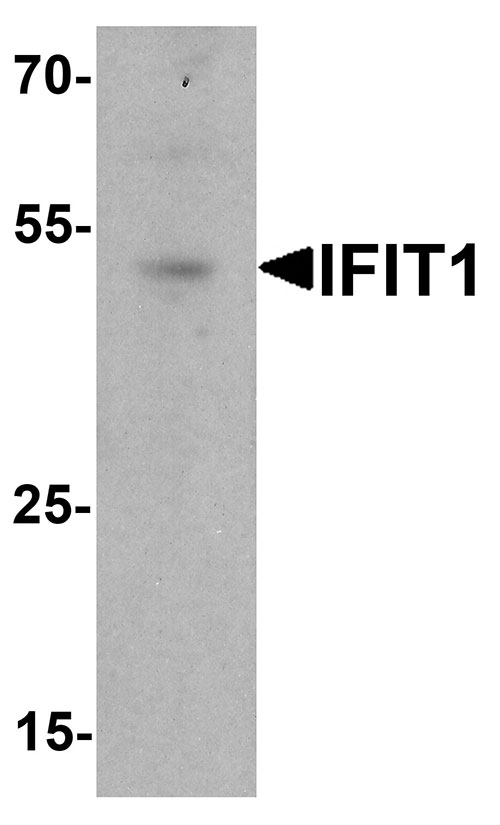
| Calculated MW | 55360 Da |
| Concentration (mg/ml) | 1 mg/mL |
| Conjugate | Unconjugated |
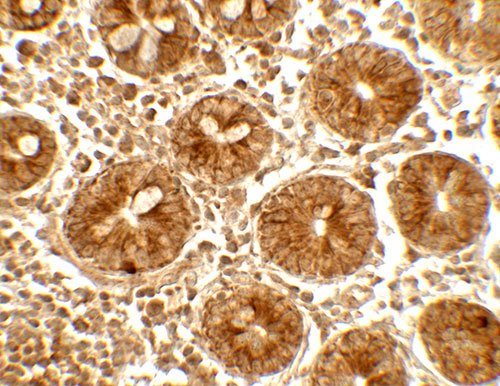
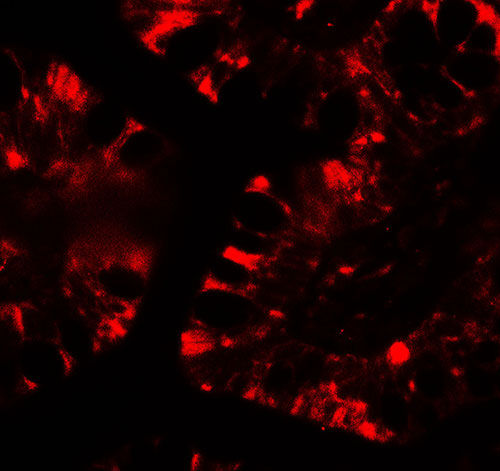
| Application Notes | IFIT1 antibody can be used for detection of IFIT1 by Western blot at 1 - 2 µg/ml. Antibody can also be used for Immunohistochemistry at 5 µg/mL. For Immunoflorescence start at 20 µg/mL. |
| Gene ID | 3434 |
|---|---|
| Other Names | Interferon-induced protein with tetratricopeptide repeats 1, IFIT-1, Interferon-induced 56 kDa protein, IFI-56K, P56, IFIT1, G10P1, IFI56, IFNAI1, ISG56 |
| Target/Specificity | IFIT1; IFIT1 antibody is human, mouse and rat reactive. At least three isoforms of IFIT1 are known to exist. This antibody is predicted to not cross-react with other members of the IFIT protein family. |
| Reconstitution & Storage | IFIT1 antibody can be stored at 4℃ for three months and -20℃, stable for up to one year. |
| Precautions | IFIT1 Antibody is for research use only and not for use in diagnostic or therapeutic procedures. |
For Research Use Only. Not For Use In Diagnostic Procedures.
| Name | IFIT1 (HGNC:5407) |
|---|---|
| Function | Plays a key role in the innate immune response as part of an interferon-dependent multiprotein complex, recognizing and sequestering viral RNAs that lack host-specific 2'-O-methylation at their 5' cap. By distinguishing these RNAs from host mRNAs, inhibits their translation by competing with the translation initiation factor eIF4E (PubMed:21642987, PubMed:27240734, PubMed:39009378, PubMed:23334420, PubMed:28251928, PubMed:36285486). Could also prevent viral replication through its interaction with DNA replication origin-binding protein E1 of several viruses. Causes the translocation of E1 from the nucleus to the cytoplasm and can also inhibit its helicase activity in vitro (PubMed:19008854, PubMed:21976647). Exhibits antiviral activity against many viruses from the Flaviviridae (West Nile virus, Dengue virus, hepatitis C virus), Coronaviridae (human 229E coronavirus, SARS-CoV-2 and SARS-CoV), Poxviridae (vaccinia virus) and Togaviridae (Sindbis virus) families (PubMed:19008854, PubMed:21976647, PubMed:28251928, PubMed:36285486). |
| Cellular Location | Cytoplasm |
Provided below are standard protocols that you may find useful for product applications.
BACKGROUND
The interferon-induced protein with tetratricopeptide repeats 1 (IFIT1) protein is a member of a family of tetratricopeptide repeat-containing proteins whose transcription is upregulated by interferons, virus infection, and molecular patterns such as dsRNA or lipopolysaccharides (1,2). These proteins have been suggested to induce anti-viral cellular activities in response to infection (2). Together with the interferon-induced transmembrane protein 1 (IFITM1), IFIT1 inhibits the replication of the Hepatitis C virus, suggesting that it may be useful in the development of therapeutic treatments (3).
REFERENCES
Wathelet M, Moutschen S, Defilippi P, et al. Molecular cloning, full-length sequence and preliminary characterization of a 56-kDa protein induced by human interferons. Eur. J. Biochem. 1986; 155:11-7.
Fensterl V and Sen GC. The ISG56/IFIT1 gene family. J. Interferon Cytokine Res. 2011; 31:71-8.
Raychoudhuri A, Shrivastava S, Steele R, et al. ISG56 and IFITM1 proteins inhibit hepatitis C virus replication. J. Virol. 2011; 85:12881-9.

终于等到您。ABCEPTA(百远生物)抗体产品。
点击下方“我要评价 ”按钮提交您的反馈信息,您的反馈和评价是我们最宝贵的财富之一,
我们将在1-3个工作日内处理您的反馈信息。
如有疑问,联系:0512-88856768 tech-china@abcepta.com.


