


 癌症的基本特征包括细胞增殖、血管生成、迁移、凋亡逃避机制和细胞永生等。找到癌症发生过程中这些通路的关键标记物和对应的抗体用于检测至关重要。
 为您推荐一个泛素化位点预测神器——泛素化分析工具,可以为您的蛋白的泛素化位点作出预测和评分。
 细胞自噬受体图形绘图工具为你的蛋白的细胞受体结合位点作出预测和评分,识别结合到自噬通路中的蛋白是非常重要的,便于让我们理解自噬在正常生理、病理过程中的作用,如发育、细胞分化、神经退化性疾病、压力条件下、感染和癌症。
TXNIP Antibody
- 产品详情
- 实验流程
- 背景知识
Application 
| WB, E |
|---|---|
| Primary Accession | Q9H3M7 |
| Other Accession | NP_006463, 171184421 |
| Reactivity | Human, Mouse, Rat |
| Host | Rabbit |
| Clonality | Polyclonal |
| Isotype | IgG |
| Calculated MW | 43661 Da |
| Concentration (mg/ml) | 1 mg/mL |
| Conjugate | Unconjugated |
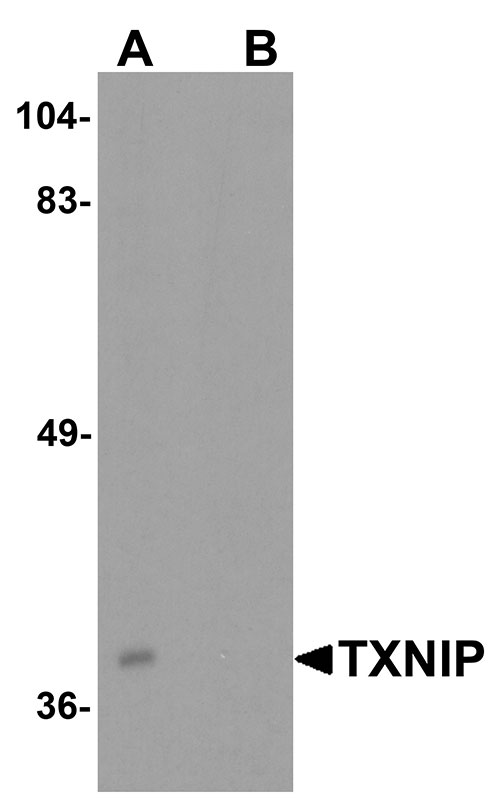
| Application Notes | TXNIP body can be used for detection of TXNIP by Western blot at 0.5 - 1 µg/ml. |
| Gene ID | 10628 |
|---|---|
| Other Names | Thioredoxin-interacting protein, Thioredoxin-binding protein 2, Vitamin D3 up-regulated protein 1, TXNIP, VDUP1 |
| Target/Specificity | TXNIP; TXNIP antibody is human, mouse and rat reactive. |
| Reconstitution & Storage | TXNIP antibody can be stored at 4℃ for three months and -20℃, stable for up to one year. |
| Precautions | TXNIP Antibody is for research use only and not for use in diagnostic or therapeutic procedures. |
For Research Use Only. Not For Use In Diagnostic Procedures.
| Name | TXNIP |
|---|---|
| Synonyms | VDUP1 |
| Function | May act as an oxidative stress mediator by inhibiting thioredoxin activity or by limiting its bioavailability (PubMed:17603038). Interacts with COPS5 and restores COPS5-induced suppression of CDKN1B stability, blocking the COPS5-mediated translocation of CDKN1B from the nucleus to the cytoplasm (By similarity). Functions as a transcriptional repressor, possibly by acting as a bridge molecule between transcription factors and corepressor complexes, and over-expression will induce G0/G1 cell cycle arrest (PubMed:12821938). Required for the maturation of natural killer cells (By similarity). Acts as a suppressor of tumor cell growth (PubMed:18541147). Inhibits the proteasomal degradation of DDIT4, and thereby contributes to the inhibition of the mammalian target of rapamycin complex 1 (mTORC1) (PubMed:21460850). |
| Cellular Location | Cytoplasm. Nucleus |
Provided below are standard protocols that you may find useful for product applications.
BACKGROUND
Thioredoxin-interacting protein (TXNIP) belongs to the arrestin family and plays a critical role in the antioxidant defense mechanisms of hematopoietic cells by activating the p53 pathway during oxidative stress (1,2). It functions as a transcriptional repressor and acts as an oxidative stress mediator by inhibiting thioredoxin activity (2). TXNIP expression is reduced in many types of tumors, and TXNIP overexpression inhibits tumor growth by blocking cell-cycle progression (3). It has recently reported that TXNIP deficiency correlates with a high incidence of hepatocellular carcinoma (HCC) (4). TXNIP and p53 interactions could potentially be a therapeutic target for oxidative stress-related diseases such as hematopoietic malignancies and metabolic diseases (5).
REFERENCES
Chen KS and DeLuca HF. Isolation and characterization of a novel cDNA from HL-60 cells treated with 1, 25-dihydroxyvitamin D-3. Biochim. Biophys. Acta. 1994; 1219:26-32.
Jeong M, Piao ZH, Kim MS, et al. Thioredoxin-interacting protein regulates hematopoietic stem cell quiescence and mobilization under stress conditions. J. Immunol. 2009; 183:2495–505.
Han SH, Jeon JH, Ju HR, et al. VDUP1 upregulated by TGF-beta1 and 1,25-dihydorxyvitamin D3 inhibits tumor cell growth by blocking cell-cycle progression. Oncogene 2003; 22:4035–46.
Kwon HJ, Won YS, Yoon YD, et al. Vitamin D3 up-regulated protein 1 deficiency accelerates liver regeneration after partial hepatectomy in mice. J. Hepatol. 2011; 54:1168–76.

终于等到您。ABCEPTA(百远生物)抗体产品。
点击下方“我要评价 ”按钮提交您的反馈信息,您的反馈和评价是我们最宝贵的财富之一,
我们将在1-3个工作日内处理您的反馈信息。
如有疑问,联系:0512-88856768 tech-china@abcepta.com.


