


 癌症的基本特征包括细胞增殖、血管生成、迁移、凋亡逃避机制和细胞永生等。找到癌症发生过程中这些通路的关键标记物和对应的抗体用于检测至关重要。
 为您推荐一个泛素化位点预测神器——泛素化分析工具,可以为您的蛋白的泛素化位点作出预测和评分。
 细胞自噬受体图形绘图工具为你的蛋白的细胞受体结合位点作出预测和评分,识别结合到自噬通路中的蛋白是非常重要的,便于让我们理解自噬在正常生理、病理过程中的作用,如发育、细胞分化、神经退化性疾病、压力条件下、感染和癌症。
PJA1 Antibody
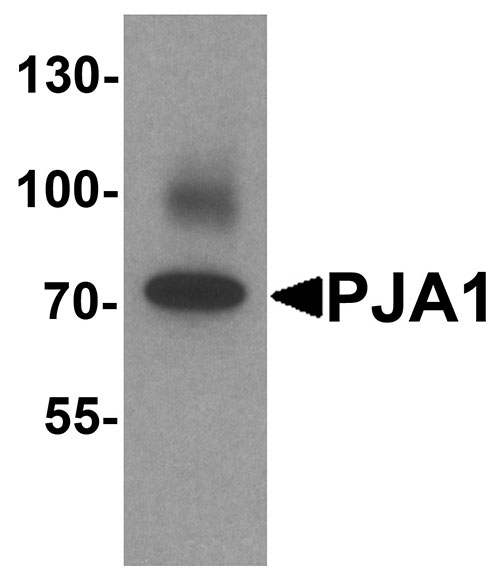
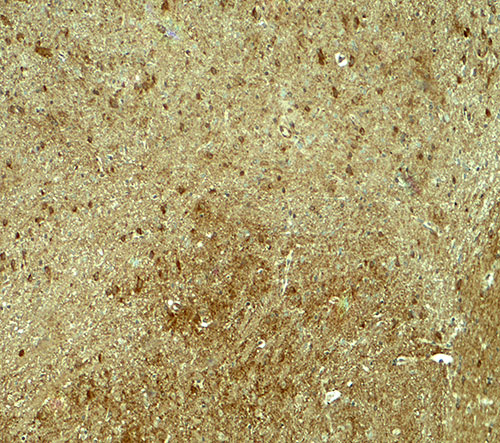
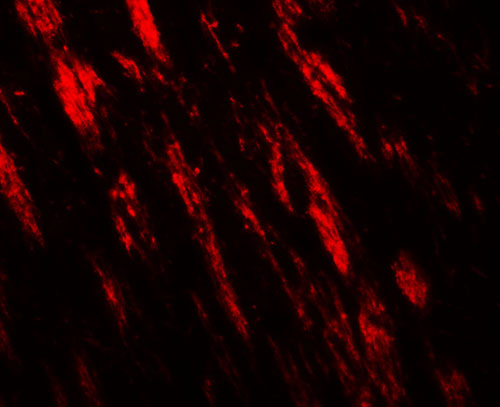
- 产品详情
- 实验流程
- 背景知识
Application 
| WB, IF, E, IHC-P |
|---|---|
| Primary Accession | Q8NG27 |
| Other Accession | NP_660095, 41281725 |
| Reactivity | Human, Mouse, Rat |
| Host | Rabbit |
| Clonality | Polyclonal |
| Isotype | IgG |
| Calculated MW | 71002 Da |
| Concentration (mg/ml) | 1 mg/mL |
| Conjugate | Unconjugated |
| Application Notes | PJA1 antibody can be used for detection of PJA1 by Western blot at 1 - 2 µg/ml. Antibody can also be used for immunohistochemistry starting at 5 µg/mL. For immunofluorescence start at 20 µg/mL. |
| Gene ID | 64219 |
|---|---|
| Other Names | E3 ubiquitin-protein ligase Praja-1, Praja1, 6.3.2.-, RING finger protein 70, PJA1, RNF70 |
| Target/Specificity | PJA1; PJA1 antibody is human, mouse and rat reactive. At least two isoforms of PJA1 are known to exist; this antibody will detect both isoforms. |
| Reconstitution & Storage | PJA1 antibody can be stored at 4℃ for three months and -20℃, stable for up to one year. |
| Precautions | PJA1 Antibody is for research use only and not for use in diagnostic or therapeutic procedures. |
For Research Use Only. Not For Use In Diagnostic Procedures.
| Name | PJA1 |
|---|---|
| Synonyms | RNF70 |
| Function | Has E2-dependent E3 ubiquitin-protein ligase activity. Ubiquitinates MAGED1 antigen leading to its subsequent degradation by proteasome (By similarity). May be involved in protein sorting. |
| Tissue Location | Expressed in various regions of the brain including the cerebellum, cerebral cortex, medulla, occipital pole, frontal lobe, temporal lobe and putamen. Highest levels in the cerebral cortex |
Provided below are standard protocols that you may find useful for product applications.
BACKGROUND
Ubiquitinization is an important cellular degradation process requiring sequential reactions that are mediated by three enzymes: E1, E2 and E3. PJA1, also known as Praja1 and RING finger protein 70, is a 643 amino acid E2-dependent E3-ubiquitin ligase that is abundantly expressed in the brain (1,2). Through interaction and activation with the E2-ubiquitin ligase UBC4, PJA1 mediates substrate-specific ubiquitination via its RING finger domain and facilitates ubiquitination (3). Overexpression of PJA1 in gastrointestinal cancers suggests that it may be responsible for the degradation of some anti-oncogenic proteins (4,5).
REFERENCES
Yu P, Chen Y, Tagle DA, et al. PJA1, encoding a RING-H2 finger ubiquitin ligase, is a novel human X chromosome gene abundantly expressed in brain. Genomics 2002; 79:869-74.
Zoabi M, Sadeh R, de Bie P, et al. PRAJA1 is a ubiquitin ligase for the polycomb repressive complex 2 proteins. Biochem. Biophys. Res. Commun. 2011; 408:393-8.
Doyle JM, Gao J, Wang J, et al. MAGE-RING protein complexes comprise a family of E3 ubiquitin ligases. Mol. Cell 2010; 39:963-74.
Saha T, Vardhini D, Tang Y, et al. RING finger-dependent ubiquitination by PRAJA is dependent on TGF-beta and potentially defines the functional status of the tumor suppressor ELF. Oncogene 2006; 25:693-705.

终于等到您。ABCEPTA(百远生物)抗体产品。
点击下方“我要评价 ”按钮提交您的反馈信息,您的反馈和评价是我们最宝贵的财富之一,
我们将在1-3个工作日内处理您的反馈信息。
如有疑问,联系:0512-88856768 tech-china@abcepta.com.


