


 癌症的基本特征包括细胞增殖、血管生成、迁移、凋亡逃避机制和细胞永生等。找到癌症发生过程中这些通路的关键标记物和对应的抗体用于检测至关重要。
 为您推荐一个泛素化位点预测神器——泛素化分析工具,可以为您的蛋白的泛素化位点作出预测和评分。
 细胞自噬受体图形绘图工具为你的蛋白的细胞受体结合位点作出预测和评分,识别结合到自噬通路中的蛋白是非常重要的,便于让我们理解自噬在正常生理、病理过程中的作用,如发育、细胞分化、神经退化性疾病、压力条件下、感染和癌症。
CRBN Antibody
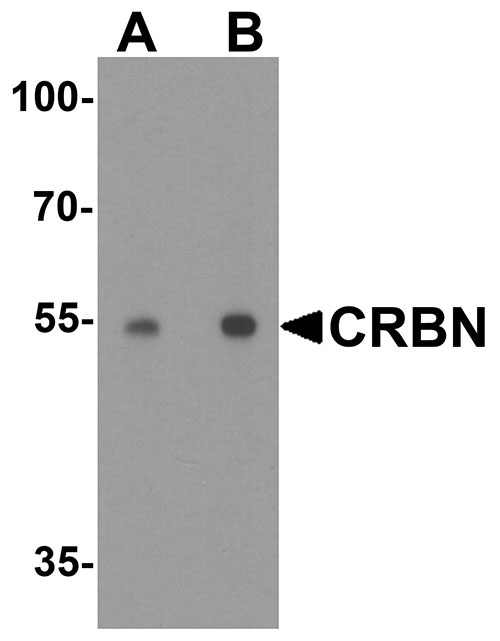
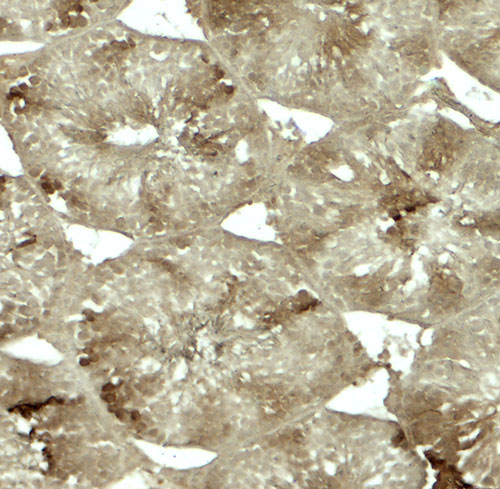
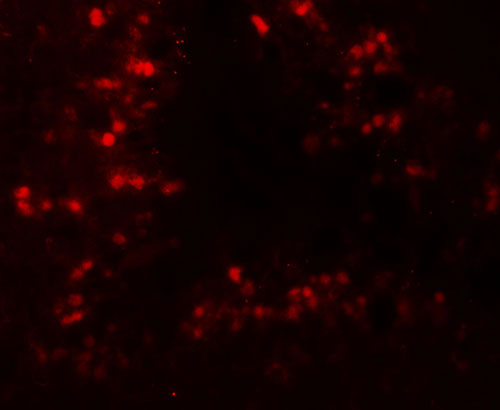
- 产品详情
- 实验流程
- 背景知识
Application 
| WB, IF, E, IHC-P |
|---|---|
| Primary Accession | Q96SW2 |
| Other Accession | NP_057386, 39545580 |
| Reactivity | Human, Mouse, Rat |
| Host | Rabbit |
| Clonality | Polyclonal |
| Isotype | IgG |
| Calculated MW | 50546 Da |
| Concentration (mg/ml) | 1 mg/mL |
| Conjugate | Unconjugated |
| Application Notes | CRBN antibody can be used for detection of CRBN by Western blot at 1 - 2 µg/mL. Antibody can also be used for immunohistochemistry starting at 5 µg/mL. For immunofluorescence start at 20 µg/mL. |
| Gene ID | 51185 |
|---|---|
| Other Names | Protein cereblon, CRBN |
| Target/Specificity | CRBN; CRBN antibody is human, mouse and rat reactive. At least two isoforms of CRBN are known to exist; this antibody will detect both isoforms. |
| Reconstitution & Storage | CRBN antibody can be stored at 4℃ for three months and -20℃, stable for up to one year. |
| Precautions | CRBN Antibody is for research use only and not for use in diagnostic or therapeutic procedures. |
For Research Use Only. Not For Use In Diagnostic Procedures.
| Name | CRBN |
|---|---|
| Function | Substrate recognition component of a DCX (DDB1-CUL4-X-box) E3 protein ligase complex that mediates the ubiquitination and subsequent proteasomal degradation of target proteins, such as MEIS2, ILF2, GLUL, IKZF1 and CSNK1A1 (PubMed:26990986, PubMed:33009960, PubMed:41565821). Normal degradation of key regulatory proteins is required for normal limb outgrowth and expression of the fibroblast growth factor FGF8 (PubMed:20223979, PubMed:24328678, PubMed:25043012, PubMed:25108355). Maintains presynaptic glutamate release and consequently cognitive functions, such as memory and learning, by negatively regulating large- conductance calcium-activated potassium (BK) channels in excitatory neurons (PubMed:18414909, PubMed:29530986). Likely to function by regulating the assembly and neuronal surface expression of BK channels via its interaction with KCNT1 (PubMed:18414909). May also be involved in regulating anxiety-like behaviors via a BK channel-independent mechanism (By similarity). Plays a negative role in TLR4 signaling by interacting with TRAF6 and ECSIT, leading to inhibition of ECSIT ubiquitination, an important step of the signaling (PubMed:31620128). |
| Cellular Location | Cytoplasm. Nucleus. Membrane {ECO:0000250|UniProtKB:Q56AP7}; Peripheral membrane protein {ECO:0000250|UniProtKB:Q56AP7} |
| Tissue Location | Widely expressed. Highly expressed in brain. |
Provided below are standard protocols that you may find useful for product applications.
BACKGROUND
CRBN, a member of the Lon protease protein family, plays a role in brain development (1). It is a component of the DCX (DDB1-CUL4-X-box) E3 protein ligase complex, a complex that mediates the ubiquitination and subsequent proteasomal degradation of target proteins and is required for limb outgrowth and expression of the fibroblast growth factor FGF8 (2). CRBN is thought to regulate the assembly and neuronal surface expression of large-conductance calcium-activated potassium channels in brain regions involved in memory and learning via its interaction with KCNT1. It is widely expressed and highly expressed in brain (3,4).
REFERENCES
Xin W, Xiaohua N, Peilin C, et al. Primary function analysis of human mental retardation related gene CRBN. Mol. Biol. Rep. 2008; 35:251-6.
Gandhi AK, Kang J, Havens CG, et al. Immunomodulatory agents lenalidomide and pomalidomide co-stimulate T cells by inducing degradation of T cell repressors Ikaros and Aiolos via modulation of the E3 ubiquitin ligase complex CRL4(CRBN). Br. J. Haematol. 2014; 164:811-21.
Liu J, Ye J, Zou X, et al. CRL4A (CRBN) E3 ubiquitin ligase restricts BK channel activity and prevents epileptogenesis. Nat. Commun. 2014; 5:3924.
Heintel D, Rocci A, Ludwig H, et al. High expression of cereblon (CRBN) is associated with improved clinical response in patients with multiple myeloma treated with lenalidomide and dexamethasone. Br. J. Haematol. 2013; 161:695-700.

终于等到您。ABCEPTA(百远生物)抗体产品。
点击下方“我要评价 ”按钮提交您的反馈信息,您的反馈和评价是我们最宝贵的财富之一,
我们将在1-3个工作日内处理您的反馈信息。
如有疑问,联系:0512-88856768 tech-china@abcepta.com.


