


 癌症的基本特征包括细胞增殖、血管生成、迁移、凋亡逃避机制和细胞永生等。找到癌症发生过程中这些通路的关键标记物和对应的抗体用于检测至关重要。
 为您推荐一个泛素化位点预测神器——泛素化分析工具,可以为您的蛋白的泛素化位点作出预测和评分。
 细胞自噬受体图形绘图工具为你的蛋白的细胞受体结合位点作出预测和评分,识别结合到自噬通路中的蛋白是非常重要的,便于让我们理解自噬在正常生理、病理过程中的作用,如发育、细胞分化、神经退化性疾病、压力条件下、感染和癌症。
C2CD3 Antibody
- 产品详情
- 实验流程
- 背景知识
Application 
| WB, E |
|---|---|
| Primary Accession | Q4AC94 |
| Other Accession | NP_001273506, 148596944 |
| Reactivity | Human, Mouse, Rat |
| Host | Rabbit |
| Clonality | Polyclonal |
| Isotype | IgG |
| Calculated MW | 260389 Da |
| Concentration (mg/ml) | 1 mg/mL |
| Conjugate | Unconjugated |
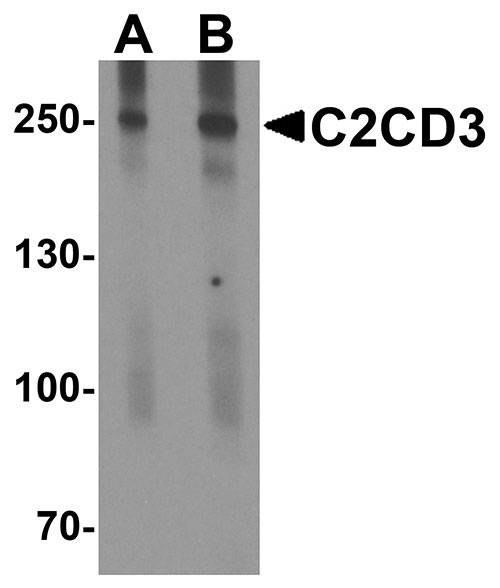
| Application Notes | C2CD3 antibody can be used for detection of C2CD3 by Western blot at 1 - 2 µg/ml. |
| Gene ID | 26005 |
|---|---|
| Other Names | C2 domain-containing protein 3, C2CD3 |
| Target/Specificity | C2CD3; C2CD3 antibody is human, mouse and rat reactive. |
| Reconstitution & Storage | C2CD3 antibody can be stored at 4℃ for three months and -20℃, stable for up to one year. |
| Precautions | C2CD3 Antibody is for research use only and not for use in diagnostic or therapeutic procedures. |
For Research Use Only. Not For Use In Diagnostic Procedures.
| Name | C2CD3 |
|---|---|
| Function | Component of the centrioles that acts as a positive regulator of centriole elongation (PubMed:24997988). Promotes assembly of centriolar distal appendage, a structure at the distal end of the mother centriole that acts as an anchor of the cilium, and is required for recruitment of centriolar distal appendages proteins CEP83, SCLT1, CEP89, FBF1 and CEP164. Not required for centriolar satellite integrity or RAB8 activation. Required for primary cilium formation (PubMed:23769972). Required for sonic hedgehog/SHH signaling and for proteolytic processing of GLI3. |
| Cellular Location | Cytoplasm, cytoskeleton, cilium basal body. Cytoplasm, cytoskeleton, microtubule organizing center, centrosome, centriole. Note=Localizes to centrioles and procentrioles both in interphase and mitosis. Localizes to centriolar satellites, localization is dependent on PCM1 and dynein-mediated retrograde transport. Also localizes to the distal ends of the mother and daughter centrioles |
Provided below are standard protocols that you may find useful for product applications.
BACKGROUND
C2CD3, a putative calcium-dependent lipid-binding protein, is an essential regulator of intracellular transduction of the Hedgehog signal (1). It is localized at the basal body of cilia, mediates calcium-dependent vesicular transport and/or recruitment of proteins and regulates cilium biogenesis by promoting the assembly of centriolar distal appendages critical for docking ciliary vesicles and recruiting other essential ciliogenic proteins (2,3). C2CD3 directly promotes centriole elongation and OFD1 acts as a negative regulator of C2CD3 (4,5).
REFERENCES
Hoover AN, Wynkoop A, Zeng H, et al. C2cd3 is required for cilia formation and Hedgehog signaling in mouse. Development 2008; 135:4049-58.
Ye X, Zeng H, Ning G, et al. C2cd3 is critical for centriolar distal appendage assembly and ciliary vesicle docking in mammals. Proc. Natl. Acad. Sci. USA 2014; 111:2164-9.
Thauvin-Robinet C, Lee JS, Lopez E, et al. The oral-facial-digital syndrome gene C2CD3 encodes a positive regulator of centriole elongation. Nat. Genet. 2014; 46:905-11.
Balestra FR, Strnad P, Fluckiger I, et al. Discovering regulators of centriole biogenesis through siRNA-based functional genomics in human cells. Dev. Cell 2013; 25:555-71.

终于等到您。ABCEPTA(百远生物)抗体产品。
点击下方“我要评价 ”按钮提交您的反馈信息,您的反馈和评价是我们最宝贵的财富之一,
我们将在1-3个工作日内处理您的反馈信息。
如有疑问,联系:0512-88856768 tech-china@abcepta.com.


