


 癌症的基本特征包括细胞增殖、血管生成、迁移、凋亡逃避机制和细胞永生等。找到癌症发生过程中这些通路的关键标记物和对应的抗体用于检测至关重要。
 为您推荐一个泛素化位点预测神器——泛素化分析工具,可以为您的蛋白的泛素化位点作出预测和评分。
 细胞自噬受体图形绘图工具为你的蛋白的细胞受体结合位点作出预测和评分,识别结合到自噬通路中的蛋白是非常重要的,便于让我们理解自噬在正常生理、病理过程中的作用,如发育、细胞分化、神经退化性疾病、压力条件下、感染和癌症。
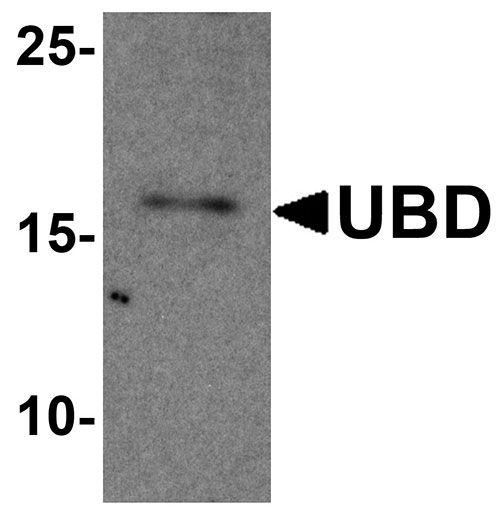
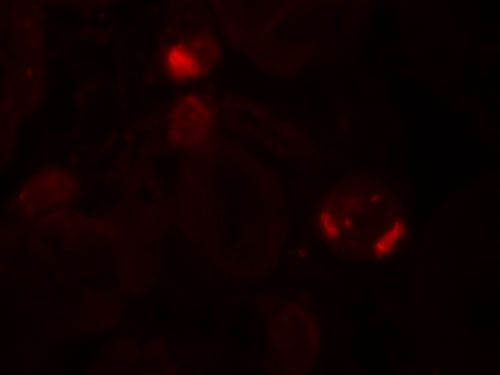
UBD Antibody
- 产品详情
- 实验流程
- 背景知识
Application 
| WB, IF, E |
|---|---|
| Primary Accession | O15205 |
| Other Accession | NP_006389, 222352096 |
| Reactivity | Human |
| Host | Rabbit |
| Clonality | Polyclonal |
| Isotype | IgG |
| Calculated MW | 18473 Da |
| Concentration (mg/ml) | 1 mg/mL |
| Conjugate | Unconjugated |
| Application Notes | UBD antibody can be used for detection of UBD by Western blot at 1 - 2 µg/ml. For immunofluorescence start at 20 µg/mL. |
| Gene ID | 10537 |
|---|---|
| Other Names | Ubiquitin D, Diubiquitin, Ubiquitin-like protein FAT10, UBD, FAT10 |
| Target/Specificity | UBD; UBD antibody is human specific. |
| Reconstitution & Storage | UBD antibody can be stored at 4℃ for three months and -20℃, stable for up to one year. |
| Precautions | UBD Antibody is for research use only and not for use in diagnostic or therapeutic procedures. |
For Research Use Only. Not For Use In Diagnostic Procedures.
| Name | UBD |
|---|---|
| Synonyms | FAT10 |
| Function | Ubiquitin-like protein modifier which can be covalently attached to target proteins and subsequently leads to their degradation by the 26S proteasome, in a NUB1-dependent manner (PubMed:15831455, PubMed:16707496, PubMed:19166848). Conjugation to the target protein is activated by UBA6 via adenylation of its C-terminal glycine (PubMed:17889673, PubMed:35970836). Promotes the expression of the proteasome subunit beta type-9 (PSMB9/LMP2). Regulates TNF-induced and LPS-mediated activation of the central mediator of innate immunity NF- kappa-B by promoting TNF-mediated proteasomal degradation of ubiquitinated-I-kappa-B-alpha (PubMed:19959714). Required for TNF- induced p65 nuclear translocation in renal tubular epithelial cells (RTECs). May be involved in dendritic cell (DC) maturation, the process by which immature dendritic cells differentiate into fully competent antigen-presenting cells that initiate T-cell responses (PubMed:19028597). Mediates mitotic non-disjunction and chromosome instability, in long-term in vitro culture and cancers, by abbreviating mitotic phase and impairing the kinetochore localization of MAD2L1 during the prometaphase stage of the cell cycle (PubMed:16495226). May be involved in the formation of aggresomes when proteasome is saturated or impaired (PubMed:19033385). Mediates apoptosis in a caspase- dependent manner, especially in renal epithelium and tubular cells during renal diseases such as polycystic kidney disease and Human immunodeficiency virus (HIV)-associated nephropathy (HIVAN) (PubMed:16495380). |
| Cellular Location | Nucleus. Cytoplasm {ECO:0000250|UniProtKB:P63072} Note=Accumulates in aggresomes under proteasome inhibition conditions |
| Tissue Location | Constitutively expressed in mature dendritic cells and B-cells. Mostly expressed in the reticuloendothelial system (e.g thymus, spleen), the gastrointestinal system, kidney, lung and prostate gland. |
Provided below are standard protocols that you may find useful for product applications.
BACKGROUND
UBD, also designated ubiquitin D or diubiquitin, plays a role in antigen presentation, cytokine response and apoptosis. It is a 165 amino acid protein encoded in the major histocompatibility complex (MHC) that consists of two domains which share significant homology with ubiquitin (1,2). UBD is inducible by interferon gamma and TNF-alpha and regulates TNF-alpha-induced and LPS-mediated activation of the central mediator of innate immunity NF-kappa-B by promoting TNF-alpha-mediated proteasomal degradation of ubiquitinated-I-kappa-B-alpha (3). It may also regulate cell growth during dendritic cell or B cell activation and development (4,5).
REFERENCES
Ocklenburg F, Moharregh-Khiabani D, Geffers R, et al. UBD, a downstream element of FOXP3, allows the identification of LGALS3, a new marker of human regulatory T cells. Lab. Invest. 2006; 86:724-37.
Cook WJ, Jeffrey LC, Carson M, et al. Structure of a diubiquitin conjugate and a model for interaction with ubiquitin conjugating enzyme (E2). J. Biol. Chem. 1992; 267:16467-71.
Rahighi S, Ikeda F, Kawasaki M, et al. Specific recognition of linear ubiquitin chains by NEMO is important for NF-kappaB activation. Cell 2009;136:1098-109.
Cort L, Habib M, Eberwine RA, et al. Diubiquitin (Ubd) is a susceptibility gene for virus-triggered autoimmune diabetes in rats. Genes Immun. 2014; 15:168-75.

终于等到您。ABCEPTA(百远生物)抗体产品。
点击下方“我要评价 ”按钮提交您的反馈信息,您的反馈和评价是我们最宝贵的财富之一,
我们将在1-3个工作日内处理您的反馈信息。
如有疑问,联系:0512-88856768 tech-china@abcepta.com.


