


 癌症的基本特征包括细胞增殖、血管生成、迁移、凋亡逃避机制和细胞永生等。找到癌症发生过程中这些通路的关键标记物和对应的抗体用于检测至关重要。
 为您推荐一个泛素化位点预测神器——泛素化分析工具,可以为您的蛋白的泛素化位点作出预测和评分。
 细胞自噬受体图形绘图工具为你的蛋白的细胞受体结合位点作出预测和评分,识别结合到自噬通路中的蛋白是非常重要的,便于让我们理解自噬在正常生理、病理过程中的作用,如发育、细胞分化、神经退化性疾病、压力条件下、感染和癌症。
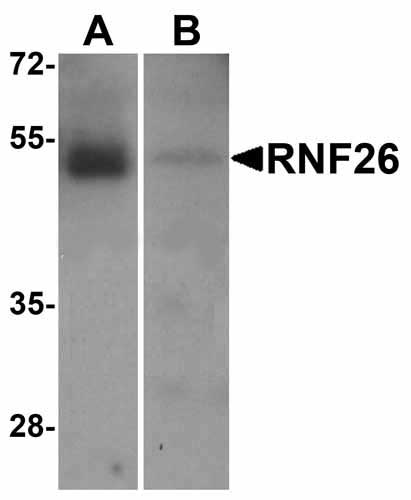
RNF26 Antibody
- 产品详情
- 实验流程
- 背景知识
Application 
| WB, E |
|---|---|
| Primary Accession | Q9BY78 |
| Other Accession | 14042925, NP_114404, 79102 |
| Reactivity | Human, Rat |
| Host | Rabbit |
| Clonality | Polyclonal |
| Isotype | IgG |
| Calculated MW | 47737 Da |
| Application Notes | RNF26 antibody can be used for Western blot at 1 - 2 µg/mL. |
| Gene ID | 79102 |
|---|---|
| Other Names | RNF26 Antibody: FB22, HM89, LAP3, LCR1, NPYR, WHIM, CD184, LESTR, NPY3R, NPYRL, HSY3RR, NPYY3R, D2S201E |
| Precautions | RNF26 Antibody is for research use only and not for use in diagnostic or therapeutic procedures. |
For Research Use Only. Not For Use In Diagnostic Procedures.
| Name | RNF26 (HGNC:14646) |
|---|---|
| Function | E3 ubiquitin-protein ligase that plays a key role in endosome organization by retaining vesicles in the perinuclear cloud (PubMed:27368102). Acts as a platform for perinuclear positioning of the endosomal system by mediating ubiquitination of SQSTM1 through interaction with the ubiquitin conjugating enzyme UBE2J1 (PubMed:27368102, PubMed:33472082). Ubiquitinated SQSTM1 attracts specific vesicle-associated adapters, forming a molecular bridge that restrains cognate vesicles in the perinuclear region and organizes the endosomal pathway for efficient cargo transport (PubMed:27368102, PubMed:33472082). Also acts as a regulator of type I interferon production in response to viral infection by mediating the formation of 'Lys-11'-linked polyubiquitin chains on TMEM173/STING, leading to stabilize TMEM173/STING (PubMed:25254379, PubMed:32614325). Also required to limit type I interferon response by promoting autophagic degradation of IRF3 (PubMed:25254379). |
| Cellular Location | Endoplasmic reticulum membrane; Multi-pass membrane protein |
| Tissue Location | Ubiquitous. Up-regulated in several cancer cell lines. |
Provided below are standard protocols that you may find useful for product applications.
BACKGROUND
RNF26 Antibody: RNF26 was identified as a member of a novel C3HC5 ring finger subfamily (1). RNF26 is ubiquitously expressed in human tissues but has been found to be upregulated in several cancer cell lines including HL-60, HeLa S3, and SW480, as well as 50% of primary gastric cancers. While the substrates of RNF26 ubiquitination have not yet been identified, the upregulation of RNF26 in several types of cancer suggest that it may serve as a target for therapeutic treatment (1).
REFERENCES
Katoh M. Molecular cloning and characterization of RNF26 on chromosome 11q23 region, encoding a novel RING finger protein with leucine zipper. Biochem. Biophys. Res. Commun. 2001; 282:1038-44.;;;

终于等到您。ABCEPTA(百远生物)抗体产品。
点击下方“我要评价 ”按钮提交您的反馈信息,您的反馈和评价是我们最宝贵的财富之一,
我们将在1-3个工作日内处理您的反馈信息。
如有疑问,联系:0512-88856768 tech-china@abcepta.com.


