


 癌症的基本特征包括细胞增殖、血管生成、迁移、凋亡逃避机制和细胞永生等。找到癌症发生过程中这些通路的关键标记物和对应的抗体用于检测至关重要。
 为您推荐一个泛素化位点预测神器——泛素化分析工具,可以为您的蛋白的泛素化位点作出预测和评分。
 细胞自噬受体图形绘图工具为你的蛋白的细胞受体结合位点作出预测和评分,识别结合到自噬通路中的蛋白是非常重要的,便于让我们理解自噬在正常生理、病理过程中的作用,如发育、细胞分化、神经退化性疾病、压力条件下、感染和癌症。
JPH1 Antibody (monoclonal) (M04)
Mouse monoclonal antibody raised against a partial recombinant JPH1.
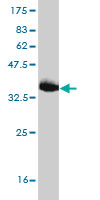
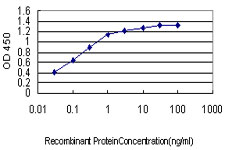
- 产品详情
- 实验流程
- 背景知识
Application 
| WB, E |
|---|---|
| Primary Accession | Q9HDC5 |
| Other Accession | NM_020647 |
| Reactivity | Human |
| Host | mouse |
| Clonality | monoclonal |
| Isotype | IgG2a Kappa |
| Clone Names | 2E7 |
| Calculated MW | 71686 Da |
| Gene ID | 56704 |
|---|---|
| Other Names | Junctophilin-1, JP-1, Junctophilin type 1, JPH1, JP1 |
| Target/Specificity | JPH1 (NP_065698, 501 a.a. ~ 579 a.a) partial recombinant protein with GST tag. MW of the GST tag alone is 26 KDa. |
| Dilution | WB~~1:500~1000 E~~N/A |
| Format | Clear, colorless solution in phosphate buffered saline, pH 7.2 . |
| Storage | Store at -20°C or lower. Aliquot to avoid repeated freezing and thawing. |
| Precautions | JPH1 Antibody (monoclonal) (M04) is for research use only and not for use in diagnostic or therapeutic procedures. |
For Research Use Only. Not For Use In Diagnostic Procedures.
Provided below are standard protocols that you may find useful for product applications.
BACKGROUND
Junctional complexes between the plasma membrane and endoplasmic/sarcoplasmic reticulum are a common feature of all excitable cell types and mediate cross talk between cell surface and intracellular ion channels. The protein encoded by this gene is a component of junctional complexes and is composed of a C-terminal hydrophobic segment spanning the endoplasmic/sarcoplasmic reticulum membrane and a remaining cytoplasmic domain that shows specific affinity for the plasma membrane. This gene is a member of the junctophilin gene family.
REFERENCES
Personalized smoking cessation: interactions between nicotine dose, dependence and quit-success genotype score. Rose JE, et al. Mol Med, 2010 Jul-Aug. PMID 20379614.New molecular components supporting ryanodine receptor-mediated Ca(2+) release: roles of junctophilin and TRIC channel in embryonic cardiomyocytes. Yamazaki D, et al. Pharmacol Ther, 2009 Mar. PMID 19095005.Global, in vivo, and site-specific phosphorylation dynamics in signaling networks. Olsen JV, et al. Cell, 2006 Nov 3. PMID 17081983.DNA sequence and analysis of human chromosome 8. Nusbaum C, et al. Nature, 2006 Jan 19. PMID 16421571.Transcriptome characterization elucidates signaling networks that control human ES cell growth and differentiation. Brandenberger R, et al. Nat Biotechnol, 2004 Jun. PMID 15146197.

终于等到您。ABCEPTA(百远生物)抗体产品。
点击下方“我要评价 ”按钮提交您的反馈信息,您的反馈和评价是我们最宝贵的财富之一,
我们将在1-3个工作日内处理您的反馈信息。
如有疑问,联系:0512-88856768 tech-china@abcepta.com.


